QUESTION IMAGE
Question
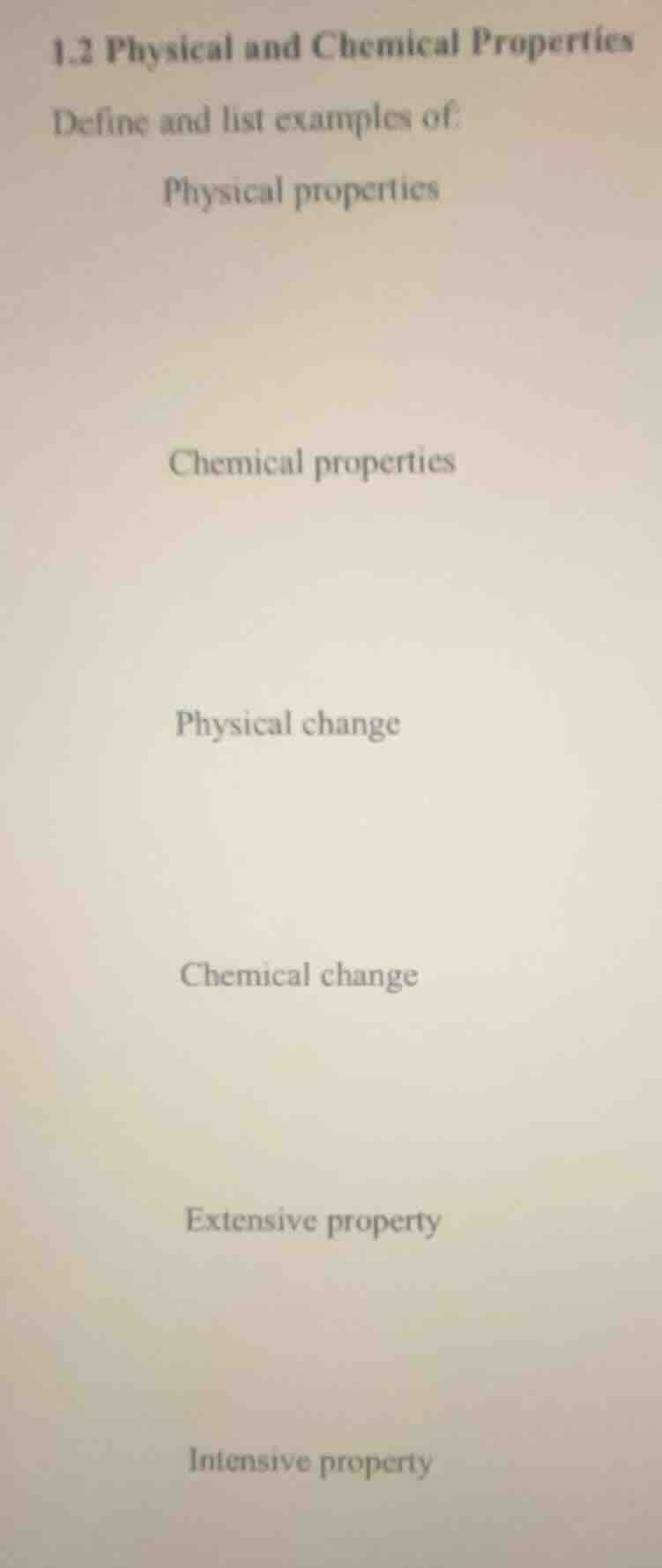
1.2 physical and chemical properties
define and list examples of:
physical properties
chemical properties
physical change
chemical change
extensive property
intensive property
Brief Explanations
- Physical properties: Characteristics of a substance observable/measurable without changing its chemical identity.
- Chemical properties: Characteristics that describe a substance's ability to change into a new substance via chemical reactions.
- Physical change: A change to a substance that alters its form/appearance but not its chemical composition.
- Chemical change: A change where a substance transforms into one or more new substances with distinct chemical compositions.
- Extensive property: A property that depends on the amount of the substance present.
- Intensive property: A property that is independent of the amount of the substance present.

Snap & solve any problem in the app
Get step-by-step solutions on Sovi AI
Photo-based solutions with guided steps
Explore more problems and detailed explanations
- Physical properties
- Definition: Observable without altering chemical identity
- Examples: Color, density, melting point, mass, volume
- Chemical properties
- Definition: Describes chemical reactivity
- Examples: Flammability, corrosiveness, reactivity with acid, oxidation state
- Physical change
- Definition: No change to chemical composition
- Examples: Melting ice, boiling water, crushing a can, dissolving sugar in water
- Chemical change
- Definition: Forms new chemical substances
- Examples: Burning wood, rusting iron, digesting food, baking a cake
- Extensive property
- Definition: Depends on substance amount
- Examples: Mass, volume, total energy, enthalpy
- Intensive property
- Definition: Independent of substance amount
- Examples: Temperature, density, boiling point, color, hardness