QUESTION IMAGE
Question
(2½ points each)
ask jesus to help you as you take your test. do your best.
\o lord, how manifold are thy works! in wisdom hast thou made them all: the earth is full of thy riches.\
psalm 104:24
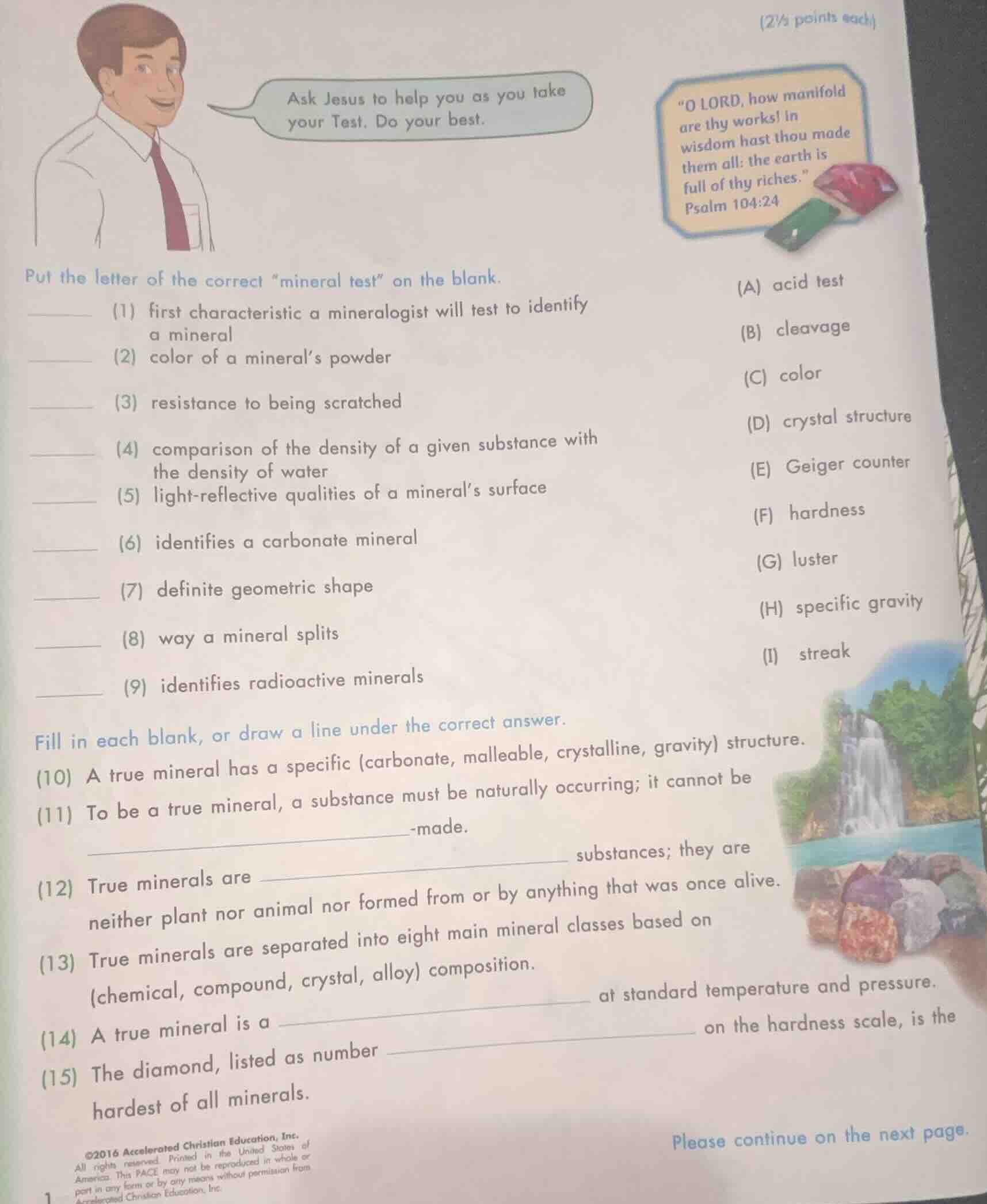
put the letter of the correct \mineral test\ on the blank.
(1) first characteristic a mineralogist will test to identify a mineral
(2) color of a minerals powder
(3) resistance to being scratched
(4) comparison of the density of a given substance with the density of water
(5) light-reflective qualities of a minerals surface
(6) identifies a carbonate mineral
(7) definite geometric shape
(8) way a mineral splits
(9) identifies radioactive minerals
(a) acid test
(b) cleavage
(c) color
(d) crystal structure
(e) geiger counter
(f) hardness
(g) luster
(h) specific gravity
(i) streak
fill in each blank, or draw a line under the correct answer.
(10) a true mineral has a specific (carbonate, malleable, crystalline, gravity) structure.
(11) to be a true mineral, a substance must be naturally occurring; it cannot be _________-made.
(12) true minerals are ______________ substances; they are neither plant nor animal nor formed from or by anything that was once alive.
(13) true minerals are separated into eight main mineral classes based on (chemical, compound, crystal, alloy) composition.
(14) a true mineral is a ______________ at standard temperature and pressure.
(15) the diamond, listed as number ______________ on the hardness scale, is the hardest of all minerals.
©2016 accelerated christian education, inc.
all rights reserved. printed in the united states of america. this pace may not be reproduced in whole or part in any form or by any means without permission from accelerated christian education, inc.
please continue on the next page.
Matching section:
- Color is typically the first observable characteristic tested for mineral identification.
- Streak refers to the color of a mineral's powdered form.
- Hardness measures a mineral's resistance to scratching.
- Specific gravity compares a substance's density to water's density.
- Luster describes how a mineral's surface reflects light.
- Acid test reacts with carbonate minerals to identify them.
- Crystal structure gives minerals a definite geometric shape.
- Cleavage is the way a mineral splits along planes.
- Geiger counters detect radiation from radioactive minerals.
Fill-in section:
- True minerals have a crystalline atomic structure.
- Minerals must be naturally occurring, not human-made.
- Minerals are inorganic, meaning not derived from living things.
- Mineral classes are grouped by their chemical composition.
- Minerals are solid at standard temperature and pressure.
- The Mohs Hardness Scale ranks diamond as the hardest at 10.

Snap & solve any problem in the app
Get step-by-step solutions on Sovi AI
Photo-based solutions with guided steps
Explore more problems and detailed explanations
Matching Answers:
- (C) color
- (I) streak
- (F) hardness
- (H) specific gravity
- (G) luster
- (A) acid test
- (D) crystal structure
- (B) cleavage
- (E) Geiger counter
Fill-in Answers:
- crystalline
- human
- inorganic
- chemical
- solid
- 10