QUESTION IMAGE
Question
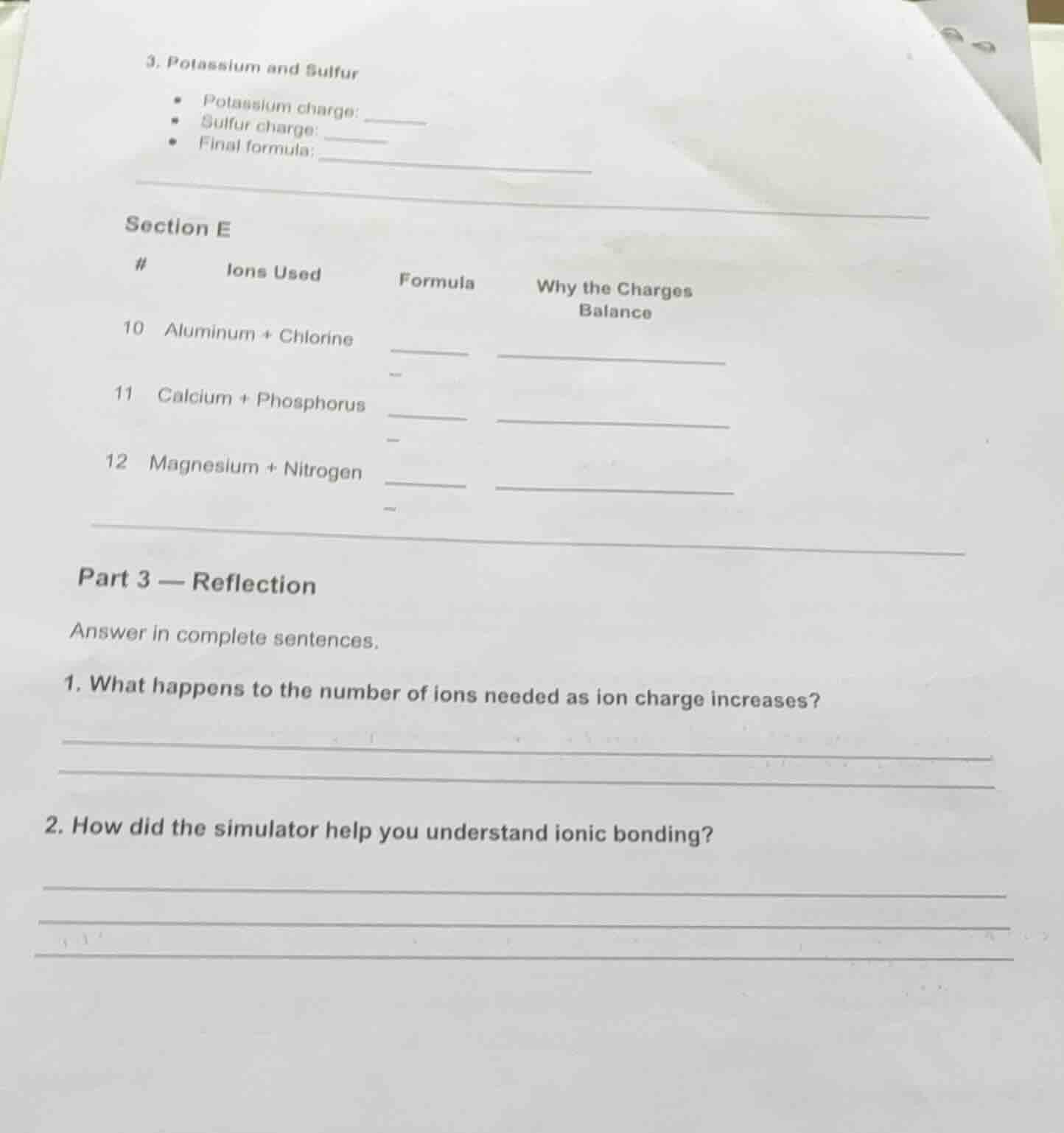
- potassium and sulfur
- potassium charge: ______
- sulfur charge: ______
- final formula: ______
section e
#\tions used\tformula\twhy the charges balance
10\taluminum + chlorine\t____\t____
11\tcalcium + phosphorus\t____\t____
12\tmagnesium + nitrogen\t____\t____
part 3 — reflection
answer in complete sentences.
- what happens to the number of ions needed as ion charge increases?
______
______
- how did the simulator help you understand ionic bonding?
______
______
Step1: Find K and S ion charges
Potassium (Group 1) has charge $+1$; Sulfur (Group 16) has charge $-2$.
Step2: Balance charges for K and S
To balance $+1$ and $-2$, need 2 K⁺ ions: $2(+1) + (-2) = 0$. Final formula: $\text{K}_2\text{S}$.
Step3: Find Al and Cl ion charges
Aluminum (Group 13) has charge $+3$; Chlorine (Group 17) has charge $-1$.
Step4: Balance charges for Al and Cl
To balance $+3$ and $-1$, need 3 Cl⁻ ions: $(+3) + 3(-1) = 0$. Final formula: $\text{AlCl}_3$.
Step5: Find Ca and P ion charges
Calcium (Group 2) has charge $+2$; Phosphorus (Group 15) has charge $-3$.
Step6: Balance charges for Ca and P
To balance $+2$ and $-3$, use 3 Ca²⁺ and 2 P³⁻: $3(+2) + 2(-3) = 0$. Final formula: $\text{Ca}_3\text{P}_2$.
Step7: Find Mg and N ion charges
Magnesium (Group 2) has charge $+2$; Nitrogen (Group 15) has charge $-3$.
Step8: Balance charges for Mg and N
To balance $+2$ and $-3$, use 3 Mg²⁺ and 2 N³⁻: $3(+2) + 2(-3) = 0$. Final formula: $\text{Mg}_3\text{N}_2$.

Snap & solve any problem in the app
Get step-by-step solutions on Sovi AI
Photo-based solutions with guided steps
Explore more problems and detailed explanations
3. Potassium and Sulfur
- Potassium charge: $+1$
- Sulfur charge: $-2$
- Final formula: $\text{K}_2\text{S}$
Section E
- Aluminum + Chlorine
- Formula: $\text{AlCl}_3$
- Why the Charges Balance: $+3 + 3(-1) = 0$
- Calcium + Phosphorus
- Formula: $\text{Ca}_3\text{P}_2$
- Why the Charges Balance: $3(+2) + 2(-3) = 0$
- Magnesium + Nitrogen
- Formula: $\text{Mg}_3\text{N}_2$
- Why the Charges Balance: $3(+2) + 2(-3) = 0$
Part 3 — Reflection
- As the magnitude of an ion's charge increases, the number of the opposing charge ions needed to balance the overall charge changes inversely: a higher charge on one ion means fewer of that ion are needed relative to a lower-charged counterion to reach a net neutral charge.
- A simulator helps visualize the transfer of electrons between metal and nonmetal atoms, shows how ions form with specific charges, and demonstrates the ratio of ions required to create a neutral ionic compound, making the abstract concept of ionic bonding concrete and easier to grasp.