QUESTION IMAGE
Question
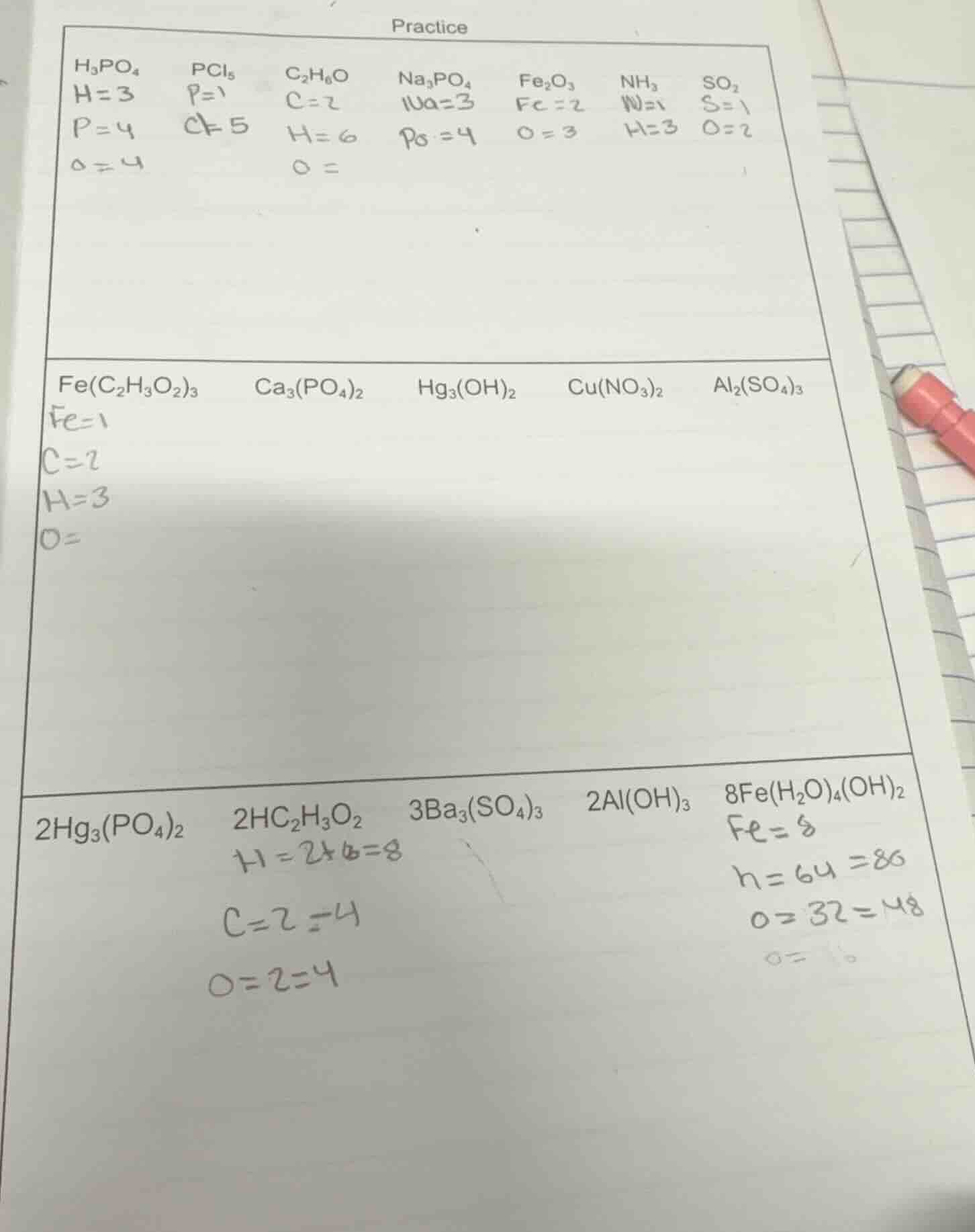
practice
h₃po₄ h=3 p=4 o=4
pcl₅ p=1 cl=5
c₂h₆o c=2 h=6 o=
na₃po₄ na=3 p=4
fe₂o₃ fe=2 o=3
nh₃ n=1 h=3
so₂ s=1 o=2
fe(c₂h₃o₂)₃ fe=1 c=2 h=3 o=
ca₃(po₄)₂
hg₃(oh)₂
cu(no₃)₂
al₂(so₄)₃
2hg₃(po₄)₂
2hc₂h₃o₂ h=2+6=8 c=2=4 o=2=4
3ba₃(so₄)₃
2al(oh)₃
8fe(h₂o)₄(oh)₂ fe=8 h=64=86 o=32=48 o=
To solve for the number of oxygen atoms in each compound, we use the subscripts and coefficients (if present) to calculate the total number of O atoms. Let's go through a few examples:
Example 1: \( \boldsymbol{C_2H_6O} \)
- The subscript for O is 1 (since there's no number after O, it's 1).
- So, number of O atoms: \( 1 \).
Example 2: \( \boldsymbol{Fe(C_2H_3O_2)_3} \)
- Inside the parentheses: \( C_2H_3O_2 \) has \( O = 2 \).
- The coefficient outside the parentheses is 3, so multiply: \( 2 \times 3 = 6 \).
- So, number of O atoms: \( 6 \).
Example 3: \( \boldsymbol{2HC_2H_3O_2} \)
- Inside the compound: \( HC_2H_3O_2 \) has \( O = 2 \).
- The coefficient in front is 2, so multiply: \( 2 \times 2 = 4 \).
- So, number of O atoms: \( 4 \).
Example 4: \( \boldsymbol{8Fe(H_2O)_4(OH)_2} \)
- For \( (H_2O)_4 \): \( O = 1 \times 4 = 4 \) per formula unit.
- For \( (OH)_2 \): \( O = 1 \times 2 = 2 \) per formula unit.
- Total O per formula unit: \( 4 + 2 = 6 \).
- Multiply by the coefficient 8: \( 6 \times 8 = 48 \).
- So, number of O atoms: \( 48 \).
General Rule:
For a compound \( A_x(B_yO_z)_w \) (or with a coefficient \( c \) in front, \( cA_x(B_yO_z)_w \)):
- If O is in a group (e.g., \( O_z \) or \( (B_yO_z) \)), multiply the subscript of O by any subscripts outside the group and the coefficient in front.
Let’s apply this to all compounds:
| Compound | Calculation for O Atoms | O Atoms |
|---|---|---|
| \( PCl_5 \) | No O atoms (no O in formula) | 0 |
| \( C_2H_6O \) | \( O = 1 \) (subscript) | 1 |
| \( Na_3PO_4 \) | \( O = 4 \) (subscript) | 4 |
| \( Fe_2O_3 \) | \( O = 3 \) (subscript) | 3 |
| \( NH_3 \) | No O atoms (no O in formula) | 0 |
| \( SO_2 \) | \( O = 2 \) (subscript) | 2 |
| \( Fe(C_2H_3O_2)_3 \) | \( O = 2 \times 3 = 6 \) | 6 |
| \( Ca_3(PO_4)_2 \) | \( O = 4 \times 2 = 8 \) | 8 |
| \( Hg_3(OH)_2 \) | \( O = 1 \times 2 = 2 \) | 2 |
| \( Cu(NO_3)_2 \) | \( O = 3 \times 2 = 6 \) | 6 |
| \( Al_2(SO_4)_3 \) | \( O = 4 \times 3 = 12 \) | 12 |
| \( 2Hg_3(PO_4)_2 \) | \( O = 4 \times 2 = 8 \) per unit; \( 8 \times 2 = 16 \) | 16 |
| \( 2HC_2H_3O_2 \) | \( O = 2 \times 2 = 4 \) | 4 |
| \( 3Ba_3(SO_4)_3 \) | \( O = 4 \times 3 = 12 \) per unit; \( 12 \times 3 = 36 \) | 36 |
| \( 2Al(OH)_3 \) | \( O = 1 \times 3 = 3 \) per unit; \( 3 \times 2 = 6 \) | 6 |
| \( 8Fe(H_2O)_4(OH)_2 \) | \( O = (4 + 2) \times 8 = 48 \) | 48 |
Use this method to find O atoms for any compound by analyzing subscripts and coefficients!

Snap & solve any problem in the app
Get step-by-step solutions on Sovi AI
Photo-based solutions with guided steps
Explore more problems and detailed explanations
To solve for the number of oxygen atoms in each compound, we use the subscripts and coefficients (if present) to calculate the total number of O atoms. Let's go through a few examples:
Example 1: \( \boldsymbol{C_2H_6O} \)
- The subscript for O is 1 (since there's no number after O, it's 1).
- So, number of O atoms: \( 1 \).
Example 2: \( \boldsymbol{Fe(C_2H_3O_2)_3} \)
- Inside the parentheses: \( C_2H_3O_2 \) has \( O = 2 \).
- The coefficient outside the parentheses is 3, so multiply: \( 2 \times 3 = 6 \).
- So, number of O atoms: \( 6 \).
Example 3: \( \boldsymbol{2HC_2H_3O_2} \)
- Inside the compound: \( HC_2H_3O_2 \) has \( O = 2 \).
- The coefficient in front is 2, so multiply: \( 2 \times 2 = 4 \).
- So, number of O atoms: \( 4 \).
Example 4: \( \boldsymbol{8Fe(H_2O)_4(OH)_2} \)
- For \( (H_2O)_4 \): \( O = 1 \times 4 = 4 \) per formula unit.
- For \( (OH)_2 \): \( O = 1 \times 2 = 2 \) per formula unit.
- Total O per formula unit: \( 4 + 2 = 6 \).
- Multiply by the coefficient 8: \( 6 \times 8 = 48 \).
- So, number of O atoms: \( 48 \).
General Rule:
For a compound \( A_x(B_yO_z)_w \) (or with a coefficient \( c \) in front, \( cA_x(B_yO_z)_w \)):
- If O is in a group (e.g., \( O_z \) or \( (B_yO_z) \)), multiply the subscript of O by any subscripts outside the group and the coefficient in front.
Let’s apply this to all compounds:
| Compound | Calculation for O Atoms | O Atoms |
|---|---|---|
| \( PCl_5 \) | No O atoms (no O in formula) | 0 |
| \( C_2H_6O \) | \( O = 1 \) (subscript) | 1 |
| \( Na_3PO_4 \) | \( O = 4 \) (subscript) | 4 |
| \( Fe_2O_3 \) | \( O = 3 \) (subscript) | 3 |
| \( NH_3 \) | No O atoms (no O in formula) | 0 |
| \( SO_2 \) | \( O = 2 \) (subscript) | 2 |
| \( Fe(C_2H_3O_2)_3 \) | \( O = 2 \times 3 = 6 \) | 6 |
| \( Ca_3(PO_4)_2 \) | \( O = 4 \times 2 = 8 \) | 8 |
| \( Hg_3(OH)_2 \) | \( O = 1 \times 2 = 2 \) | 2 |
| \( Cu(NO_3)_2 \) | \( O = 3 \times 2 = 6 \) | 6 |
| \( Al_2(SO_4)_3 \) | \( O = 4 \times 3 = 12 \) | 12 |
| \( 2Hg_3(PO_4)_2 \) | \( O = 4 \times 2 = 8 \) per unit; \( 8 \times 2 = 16 \) | 16 |
| \( 2HC_2H_3O_2 \) | \( O = 2 \times 2 = 4 \) | 4 |
| \( 3Ba_3(SO_4)_3 \) | \( O = 4 \times 3 = 12 \) per unit; \( 12 \times 3 = 36 \) | 36 |
| \( 2Al(OH)_3 \) | \( O = 1 \times 3 = 3 \) per unit; \( 3 \times 2 = 6 \) | 6 |
| \( 8Fe(H_2O)_4(OH)_2 \) | \( O = (4 + 2) \times 8 = 48 \) | 48 |
Use this method to find O atoms for any compound by analyzing subscripts and coefficients!