QUESTION IMAGE
Question
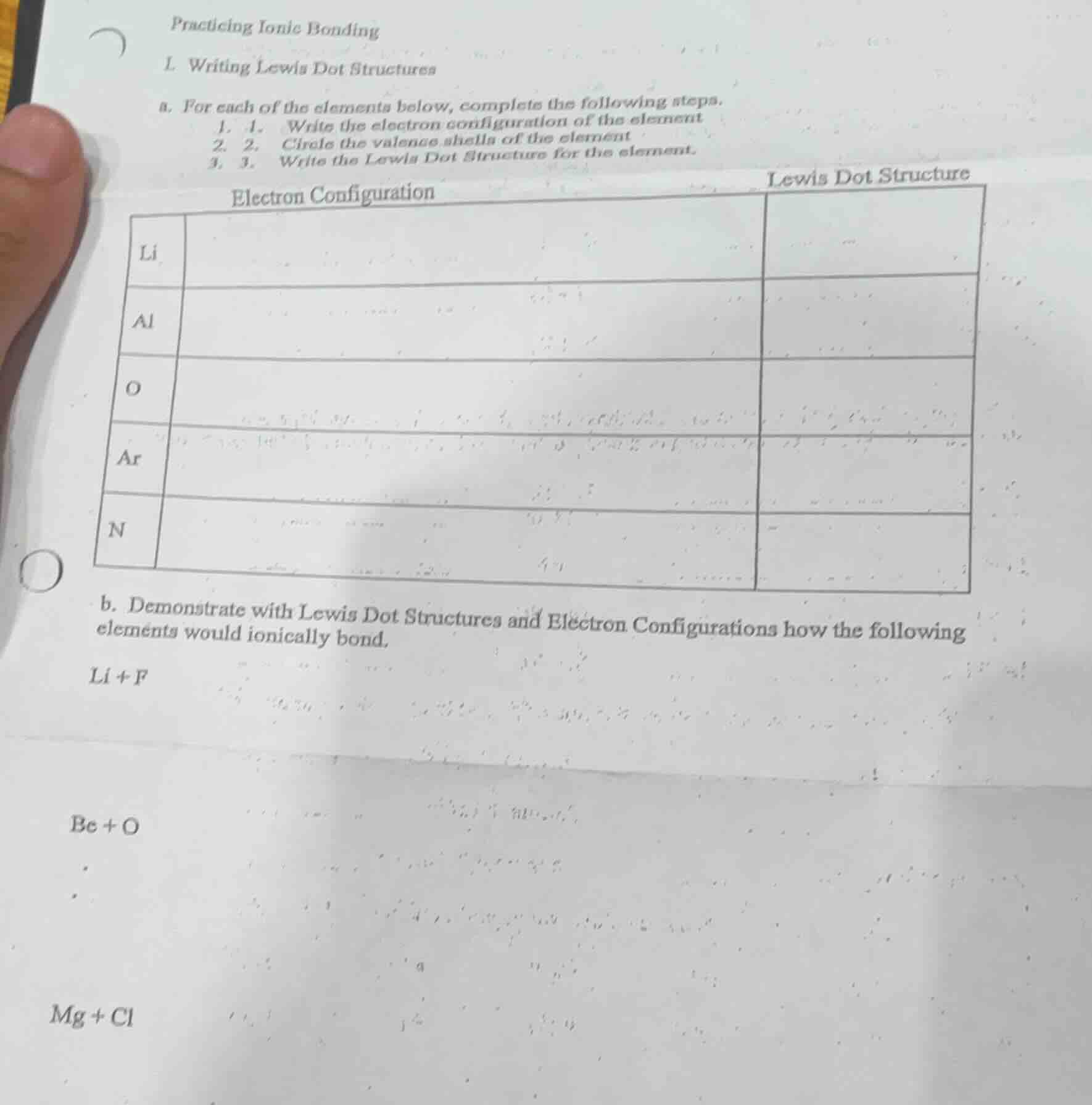
practicing ionic bonding
i. writing lewis dot structures
a. for each of the elements below, completes the following steps.
- write the electron configuration of the element
- circle the valence shells of the element
- write the lewis dot structure for the element.
| electron configuration | lewis dot structure | |
|---|---|---|
| al | ||
| o | ||
| ar | ||
| n |
b. demonstrate with lewis dot structures and electron configurations how the following elements would ionically bond.
li + f
be + o
mg + cl
Part I.a: Writing Lewis Dot Structures for Elements
Element: Li (Lithium)
Step 1: Electron Configuration
Lithium has an atomic number of 3. The electron configuration is built by filling orbitals: $1s^2 2s^1$.
Step 2: Valence Shell
The outermost (valence) shell is the $2s$ subshell (circled: $1s^2 \boldsymbol{\circ 2s^1}$).
Step 3: Lewis Dot Structure
Valence electrons = 1 (from $2s^1$). The Lewis dot structure is $\text{Li} \cdot$ (one dot representing the valence electron).
Element: Al (Aluminum)
Step 1: Electron Configuration
Aluminum (atomic number 13) has the configuration: $1s^2 2s^2 2p^6 3s^2 3p^1$.
Step 2: Valence Shell
The valence shell is the $3s^2 3p^1$ subshell (circled: $1s^2 2s^2 2p^6 \boldsymbol{\circ 3s^2 3p^1}$).
Step 3: Lewis Dot Structure
Valence electrons = 3 (from $3s^2 3p^1$). The Lewis dot structure is $\text{Al} \cdot \cdot \cdot$ (three dots).
Element: O (Oxygen)
Step 1: Electron Configuration
Oxygen (atomic number 8) has the configuration: $1s^2 2s^2 2p^4$.
Step 2: Valence Shell
The valence shell is the $2s^2 2p^4$ subshell (circled: $1s^2 \boldsymbol{\circ 2s^2 2p^4}$).
Step 3: Lewis Dot Structure
Valence electrons = 6 (from $2s^2 2p^4$). The Lewis dot structure is $\ddot{\text{O}} \cdot \cdot$ (two lone pairs + two unpaired electrons, total 6 dots).
Element: Ar (Argon)
Step 1: Electron Configuration
Argon (atomic number 18) has the configuration: $1s^2 2s^2 2p^6 3s^2 3p^6$.
Step 2: Valence Shell
The valence shell is the $3s^2 3p^6$ subshell (circled: $1s^2 2s^2 2p^6 \boldsymbol{\circ 3s^2 3p^6}$).
Step 3: Lewis Dot Structure
Valence electrons = 8 (full octet). The Lewis dot structure is $\ddot{\text{Ar}} \ddot{}$ (four lone pairs, total 8 dots).
Element: N (Nitrogen)
Step 1: Electron Configuration
Nitrogen (atomic number 7) has the configuration: $1s^2 2s^2 2p^3$.
Step 2: Valence Shell
The valence shell is the $2s^2 2p^3$ subshell (circled: $1s^2 \boldsymbol{\circ 2s^2 2p^3}$).
Step 3: Lewis Dot Structure
Valence electrons = 5 (from $2s^2 2p^3$). The Lewis dot structure is $\ddot{\text{N}} \cdot \cdot \cdot$ (one lone pair + three unpaired electrons, total 5 dots).
Part I.b: Ionic Bonding with Lewis Dot Structures and Electron Configurations
1. $\text{Li} + \text{F}$
- Li (Lithium):
Electron configuration: $1s^2 2s^1$ → Loses 1 electron to form $\text{Li}^+$ (configuration: $1s^2$, same as He).
Lewis dot: $\text{Li} \cdot
ightarrow \text{Li}^+$ (no valence electrons).
- F (Fluorine):
Electron configuration: $1s^2 2s^2 2p^5$ → Gains 1 electron to form $\text{F}^-$ (configuration: $1s^2 2s^2 2p^6$, same as Ne).
Lewis dot: $\ddot{\text{F}} \cdot \cdot \cdot \cdot \cdot
ightarrow \ddot{\text{F}}^- \ddot{}$ (full octet).
- Ionic Bond: $\text{Li}^+$ and $\text{F}^-$ attract via electrostatic forces. The compound is $\text{LiF}$.
2. $\text{Be} + \text{O}$
- Be (Beryllium):
Electron configuration: $1s^2 2s^2$ → Loses 2 electrons to form $\text{Be}^{2+}$ (configuration: $1s^2$, same as He).
Lewis dot: $\text{Be} \cdot \cdot
ightarrow \text{Be}^{2+}$ (no valence electrons).
- O (Oxygen):
Electron configuration: $1s^2 2s^2 2p^4$ → Gains 2 electrons to form $\text{O}^{2-}$ (configuration: $1s^2 2s^2 2p^6$, same as Ne).
Lewis dot: $\ddot{\text{O}} \cdot \cdot
ightarrow \ddot{\text{O}}^{2-} \ddot{}$ (full octet).
- Ionic Bond: $\text{Be}^{2+}$ and $\text{O}^{2-}$ attract. The compound is $\text{BeO}$.
3. $\text{Mg} + \text{Cl}$
- Mg (Magnesium):
Electron config…

Snap & solve any problem in the app
Get step-by-step solutions on Sovi AI
Photo-based solutions with guided steps
Explore more problems and detailed explanations
Part I.a: Writing Lewis Dot Structures for Elements
Element: Li (Lithium)
Step 1: Electron Configuration
Lithium has an atomic number of 3. The electron configuration is built by filling orbitals: $1s^2 2s^1$.
Step 2: Valence Shell
The outermost (valence) shell is the $2s$ subshell (circled: $1s^2 \boldsymbol{\circ 2s^1}$).
Step 3: Lewis Dot Structure
Valence electrons = 1 (from $2s^1$). The Lewis dot structure is $\text{Li} \cdot$ (one dot representing the valence electron).
Element: Al (Aluminum)
Step 1: Electron Configuration
Aluminum (atomic number 13) has the configuration: $1s^2 2s^2 2p^6 3s^2 3p^1$.
Step 2: Valence Shell
The valence shell is the $3s^2 3p^1$ subshell (circled: $1s^2 2s^2 2p^6 \boldsymbol{\circ 3s^2 3p^1}$).
Step 3: Lewis Dot Structure
Valence electrons = 3 (from $3s^2 3p^1$). The Lewis dot structure is $\text{Al} \cdot \cdot \cdot$ (three dots).
Element: O (Oxygen)
Step 1: Electron Configuration
Oxygen (atomic number 8) has the configuration: $1s^2 2s^2 2p^4$.
Step 2: Valence Shell
The valence shell is the $2s^2 2p^4$ subshell (circled: $1s^2 \boldsymbol{\circ 2s^2 2p^4}$).
Step 3: Lewis Dot Structure
Valence electrons = 6 (from $2s^2 2p^4$). The Lewis dot structure is $\ddot{\text{O}} \cdot \cdot$ (two lone pairs + two unpaired electrons, total 6 dots).
Element: Ar (Argon)
Step 1: Electron Configuration
Argon (atomic number 18) has the configuration: $1s^2 2s^2 2p^6 3s^2 3p^6$.
Step 2: Valence Shell
The valence shell is the $3s^2 3p^6$ subshell (circled: $1s^2 2s^2 2p^6 \boldsymbol{\circ 3s^2 3p^6}$).
Step 3: Lewis Dot Structure
Valence electrons = 8 (full octet). The Lewis dot structure is $\ddot{\text{Ar}} \ddot{}$ (four lone pairs, total 8 dots).
Element: N (Nitrogen)
Step 1: Electron Configuration
Nitrogen (atomic number 7) has the configuration: $1s^2 2s^2 2p^3$.
Step 2: Valence Shell
The valence shell is the $2s^2 2p^3$ subshell (circled: $1s^2 \boldsymbol{\circ 2s^2 2p^3}$).
Step 3: Lewis Dot Structure
Valence electrons = 5 (from $2s^2 2p^3$). The Lewis dot structure is $\ddot{\text{N}} \cdot \cdot \cdot$ (one lone pair + three unpaired electrons, total 5 dots).
Part I.b: Ionic Bonding with Lewis Dot Structures and Electron Configurations
1. $\text{Li} + \text{F}$
- Li (Lithium):
Electron configuration: $1s^2 2s^1$ → Loses 1 electron to form $\text{Li}^+$ (configuration: $1s^2$, same as He).
Lewis dot: $\text{Li} \cdot
ightarrow \text{Li}^+$ (no valence electrons).
- F (Fluorine):
Electron configuration: $1s^2 2s^2 2p^5$ → Gains 1 electron to form $\text{F}^-$ (configuration: $1s^2 2s^2 2p^6$, same as Ne).
Lewis dot: $\ddot{\text{F}} \cdot \cdot \cdot \cdot \cdot
ightarrow \ddot{\text{F}}^- \ddot{}$ (full octet).
- Ionic Bond: $\text{Li}^+$ and $\text{F}^-$ attract via electrostatic forces. The compound is $\text{LiF}$.
2. $\text{Be} + \text{O}$
- Be (Beryllium):
Electron configuration: $1s^2 2s^2$ → Loses 2 electrons to form $\text{Be}^{2+}$ (configuration: $1s^2$, same as He).
Lewis dot: $\text{Be} \cdot \cdot
ightarrow \text{Be}^{2+}$ (no valence electrons).
- O (Oxygen):
Electron configuration: $1s^2 2s^2 2p^4$ → Gains 2 electrons to form $\text{O}^{2-}$ (configuration: $1s^2 2s^2 2p^6$, same as Ne).
Lewis dot: $\ddot{\text{O}} \cdot \cdot
ightarrow \ddot{\text{O}}^{2-} \ddot{}$ (full octet).
- Ionic Bond: $\text{Be}^{2+}$ and $\text{O}^{2-}$ attract. The compound is $\text{BeO}$.
3. $\text{Mg} + \text{Cl}$
- Mg (Magnesium):
Electron configuration: $1s^2 2s^2 2p^6 3s^2$ → Loses 2 electrons to form $\text{Mg}^{2+}$ (configuration: $1s^2 2s^2 2p^6$, same as Ne).
Lewis dot: $\text{Mg} \cdot \cdot
ightarrow \text{Mg}^{2+}$ (no valence electrons).
- Cl (Chlorine):
Electron configuration: $1s^2 2s^2 2p^6 3s^2 3p^5$ → Gains 1 electron to form $\text{Cl}^-$ (configuration: $1s^2 2s^2 2p^6 3s^2 3p^6$, same as Ar).
Lewis dot: $\ddot{\text{Cl}} \cdot \cdot \cdot \cdot \cdot
ightarrow \ddot{\text{Cl}}^- \ddot{}$ (full octet).
- Ionic Bond: $\text{Mg}^{2+}$ needs two $\text{Cl}^-$ ions (since Mg loses 2, Cl gains 1). The compound is $\text{MgCl}_2$.
Summary Table (Part I.a)
| Element | Electron Configuration | Lewis Dot Structure |
|---|---|---|
| Al | $1s^2 2s^2 2p^6 3s^2 3p^1$ | $\text{Al} \cdot \cdot \cdot$ |
| O | $1s^2 2s^2 2p^4$ | $\ddot{\text{O}} \cdot \cdot$ |
| Ar | $1s^2 2s^2 2p^6 3s^2 3p^6$ | $\ddot{\text{Ar}} \ddot{}$ |
| N | $1s^2 2s^2 2p^3$ | $\ddot{\text{N}} \cdot \cdot \cdot$ |
Final Answer (Key Takeaways)
- Lewis Dot Structures represent valence electrons as dots.
- Ionic Bonding involves electron transfer to achieve stable octets (or duets for H/He-like ions).
For specific sub-questions (e.g., electron configurations, Lewis dots, or ionic bonding), refer to the detailed steps above.