QUESTION IMAGE
Question
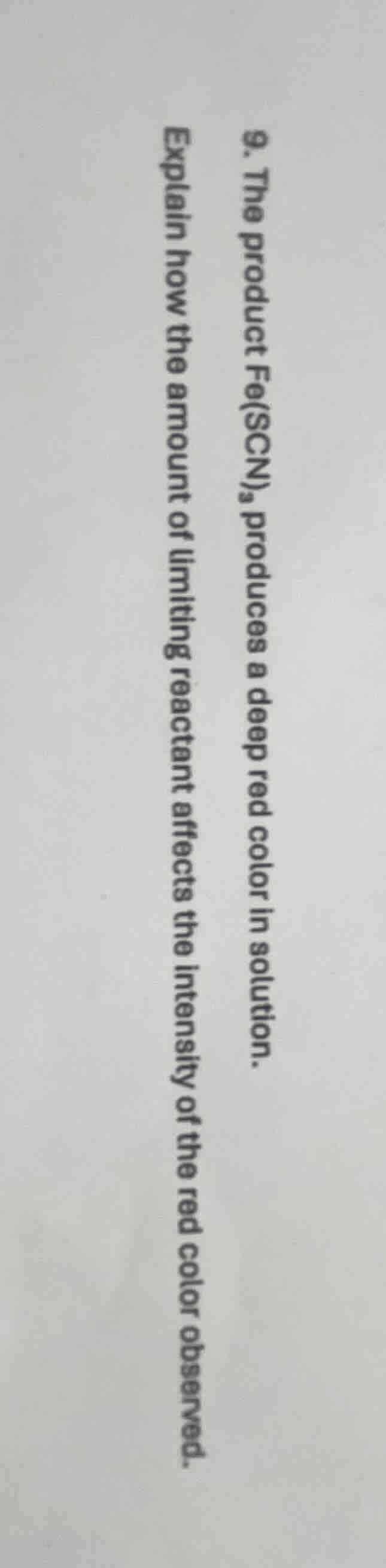
- the product fe(scn)₃ produces a deep red color in solution. explain how the amount of limiting reactant affects the intensity of the red color observed.
The reaction to form $\ce{Fe(SCN)_{3}}$ (e.g., $\ce{Fe^{3+} + 3SCN^{-} <=> Fe(SCN)_{3}}$) depends on the amount of limiting reactant (either $\ce{Fe^{3+}}$ or $\ce{SCN^{-}}$). A greater amount of the limiting reactant allows more $\ce{Fe(SCN)_{3}}$ to form. Since the intensity of the red color is related to the concentration of $\ce{Fe(SCN)_{3}}$ (more product means higher concentration), more limiting reactant leads to a more intense red color, while less limiting reactant leads to a less intense (paler) red color as less $\ce{Fe(SCN)_{3}}$ is produced.

Snap & solve any problem in the app
Get step-by-step solutions on Sovi AI
Photo-based solutions with guided steps
Explore more problems and detailed explanations
The amount of the limiting reactant (either $\ce{Fe^{3+}}$ or $\ce{SCN^{-}}$ in the reaction to form $\ce{Fe(SCN)_{3}}$) determines the maximum amount of $\ce{Fe(SCN)_{3}}$ that can be produced. A larger amount of the limiting reactant results in a greater concentration of $\ce{Fe(SCN)_{3}}$, leading to a more intense (darker) red color. A smaller amount of the limiting reactant produces less $\ce{Fe(SCN)_{3}}$, resulting in a less intense (paler) red color.