QUESTION IMAGE
Question
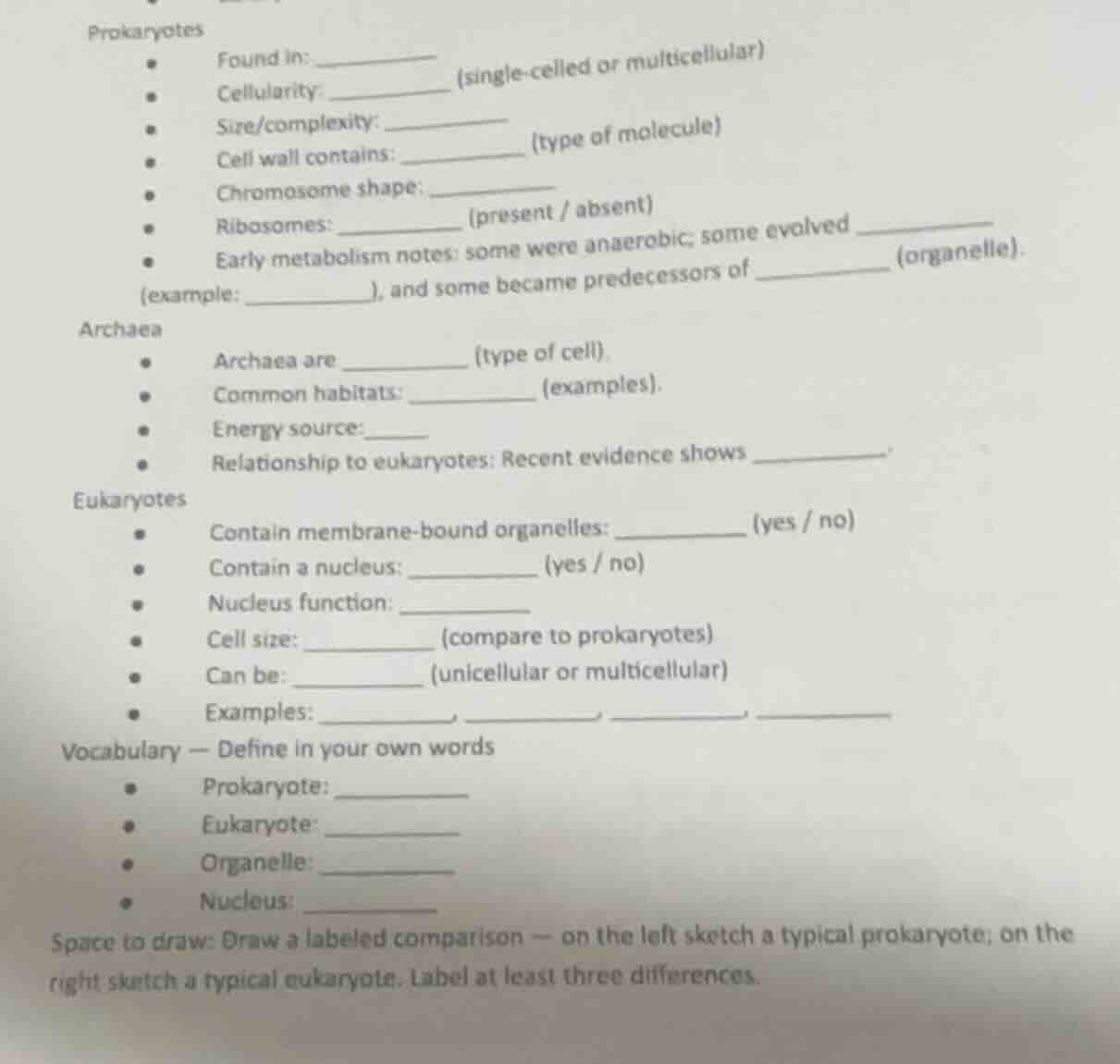
prokaryotes
- found in: ______
- cellularity: ______ (single - celled or multicellular)
- size/complexity: ______
- cell wall contains: ______ (type of molecule)
- chromosome shape: ______
- ribosomes: ______ (present / absent)
- early metabolism notes: some were anaerobic; some evolved ____ (example: __), and some became predecessors of ____ (organelle).
archaea
- archaea are ______ (type of cell).
- common habitats: ______ (examples).
- energy source: ______
- relationship to eukaryotes: recent evidence shows ______.
eukaryotes
- contain membrane - bound organelles: ______ (yes / no)
- contain a nucleus: ______ (yes / no)
- nucleus function: ______
- cell size: ______ (compare to prokaryotes)
- can be: ______ (unicellular or multicellular)
- examples: ____, __, __, ____
vocabulary — define in your own words
- prokaryote: ______
- eukaryote: ______
- organelle: ______
- nucleus: ______
space to draw: draw a labeled comparison — on the left sketch a typical prokaryote; on the right sketch a typical eukaryote. label at least three differences.
Brief Explanations
This is a biology worksheet covering prokaryotes, archaea, and eukaryotes, including their traits, definitions, and a drawing task. All answers are based on core cell biology concepts.

Snap & solve any problem in the app
Get step-by-step solutions on Sovi AI
Photo-based solutions with guided steps
Explore more problems and detailed explanations
Prokaryotes
- Found in: Bacteria and Archaea
- Cellularity: single-celled
- Size/complexity: Small (1-5 μm), simple structure
- Cell wall contains: peptidoglycan (in bacteria)
- Chromosome shape: circular (single, no nucleus)
- Ribosomes: present
- Early metabolism notes: some were anaerobic; some evolved aerobic respiration (example: cyanobacteria), and some became predecessors of mitochondria (organelle)
Archaea
- Archaea are prokaryotic cells
- Common habitats: extreme environments (hot springs, deep-sea hydrothermal vents, salt flats)
- Energy source: organic compounds, inorganic chemicals (chemosynthesis), or sunlight (some)
- Relationship to eukaryotes: Recent evidence shows they are more closely related to eukaryotes than bacteria
Eukaryotes
- Contain membrane-bound organelles: yes
- Contain a nucleus: yes
- Nucleus function: Stores genetic material (DNA), controls cell activities
- Cell size: Larger (10-100 μm, bigger than prokaryotes)
- Can be: unicellular or multicellular
- Examples: animals, plants, fungi, protists (e.g., amoeba)
Vocabulary — Define in your own words
- Prokaryote: A simple, single-celled organism with no nucleus or membrane-bound organelles
- Eukaryote: An organism (single or multi-celled) with a nucleus and membrane-bound organelles
- Organelle: A specialized structure inside a cell that performs a specific function
- Nucleus: A membrane-bound organelle that holds and protects a cell's genetic material
Space to draw
(Left: Prokaryote sketch)
- Label 1: No nucleus (circular DNA floating in cytoplasm)
- Label 2: Small, simple ribosomes
- Label 3: Cell wall (peptidoglycan for bacteria)
(Right: Eukaryote sketch)
- Label 1: Membrane-bound nucleus holding linear DNA
- Label 2: Membrane-bound organelles (e.g., mitochondria, endoplasmic reticulum)
- Label 3: Larger overall cell size compared to prokaryote