QUESTION IMAGE
Question
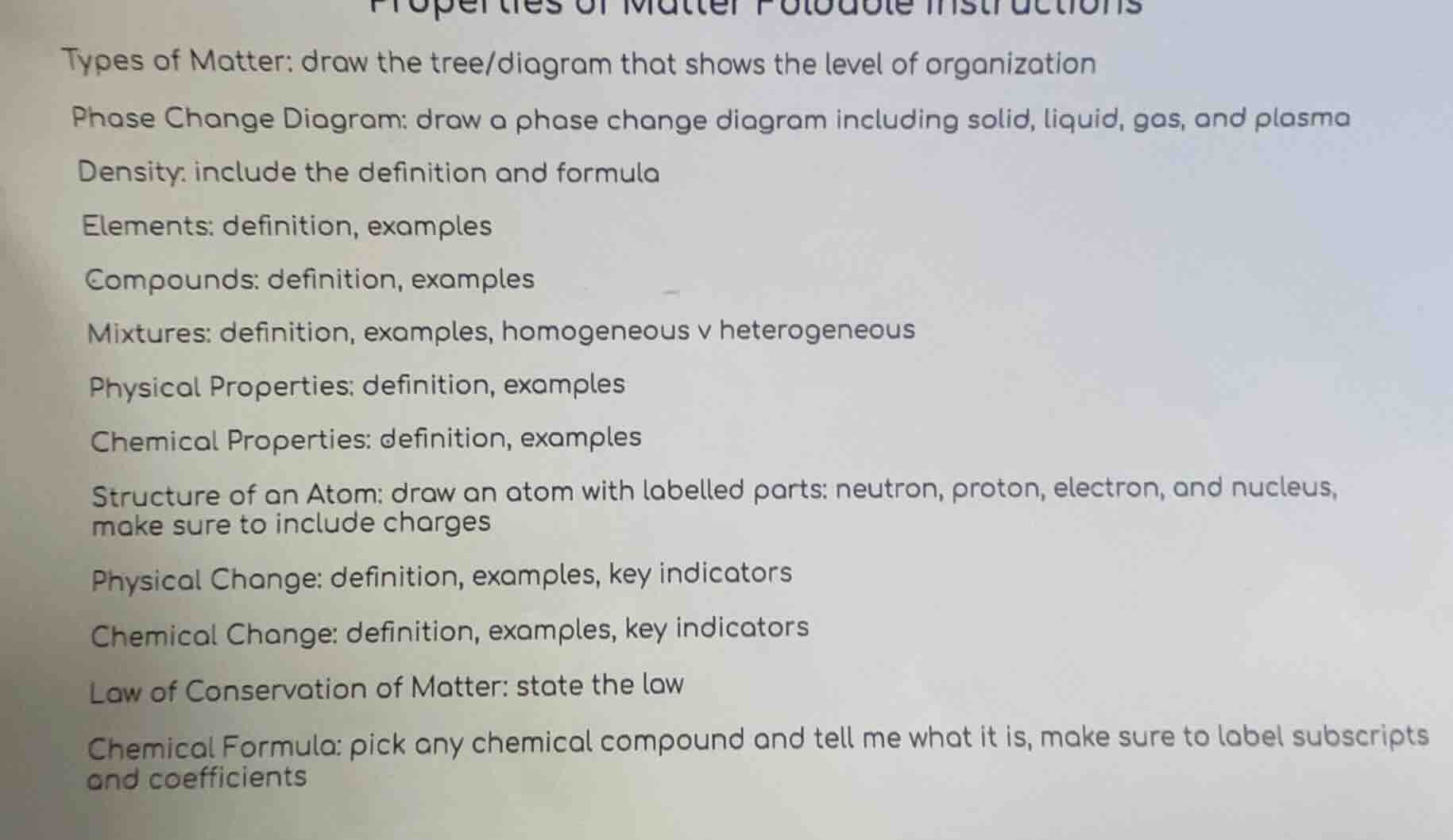
properties of matter foldable instructions
types of matter: draw the tree/diagram that shows the level of organization
phase change diagram: draw a phase change diagram including solid, liquid, gas, and plasma
density: include the definition and formula
elements: definition, examples
compounds: definition, examples
mixtures: definition, examples, homogeneous v heterogeneous
physical properties: definition, examples
chemical properties: definition, examples
structure of an atom: draw an atom with labelled parts: neutron, proton, electron, and nucleus, make sure to include charges
physical change: definition, examples, key indicators
chemical change: definition, examples, key indicators
law of conservation of matter: state the law
chemical formula: pick any chemical compound and tell me what it is, make sure to label subscripts and coefficients
- Types of Matter Organization Tree:
Matter is split into pure substances and mixtures. Pure substances are either elements (single type of atom) or compounds (multiple elements bonded). Mixtures are homogeneous (uniform) or heterogeneous (non-uniform).
- Phase Change Diagram:
A temperature vs. heat energy diagram with flat segments for phase changes (solid→liquid: melting; liquid→gas: vaporization; gas→plasma: ionization) and sloped segments for temperature increase in a single phase. Labels for solid, liquid, gas, plasma, and phase transition points.
- Density:
Definition: Mass per unit volume of a substance. Formula: $
ho = \frac{m}{V}$ where $
ho$ = density, $m$ = mass, $V$ = volume.
- Elements:
Definition: Pure substances made of only one type of atom, cannot be broken down chemically. Examples: Hydrogen (H), Gold (Au), Oxygen (O₂).
- Compounds:
Definition: Pure substances made of two or more different elements chemically bonded in fixed ratios. Examples: Water (H₂O), Carbon Dioxide (CO₂), Sodium Chloride (NaCl).
- Mixtures:
Definition: Combinations of two or more substances physically mixed, not chemically bonded.
- Homogeneous: Uniform composition (e.g., saltwater, air)
- Heterogeneous: Non-uniform composition (e.g., sand and water, cereal with milk)
- Physical Properties:
Definition: Characteristics of a substance observed without changing its chemical identity. Examples: color, density, melting point, solubility.
- Chemical Properties:
Definition: Characteristics that describe a substance's ability to change into a new substance via chemical reaction. Examples: flammability, reactivity with acid, rusting tendency.
- Structure of an Atom:
A central positively charged nucleus (contains neutral neutrons and positively charged protons) surrounded by negatively charged electrons in electron shells. Labels: Nucleus (overall + charge), Proton (+1 charge), Neutron (0 charge), Electron (-1 charge).
- Physical Change:
Definition: A change that alters a substance's physical form but not its chemical identity. Examples: ice melting, paper tearing, water boiling. Key indicators: no new substance formed, reversible with physical changes.
- Chemical Change:
Definition: A change that converts a substance into one or more new substances with different chemical properties. Examples: burning wood, rusting iron, baking a cake. Key indicators: new substance formed, irreversible via physical means, color change/gas production/precipitate formation.
- Law of Conservation of Matter:
Matter cannot be created or destroyed in a closed system; it only changes form or is rearranged during physical or chemical changes.
- Chemical Formula:
Using water as an example: $2H_2O$
- Subscripts: The 2 in $H_2$ indicates 2 hydrogen atoms per water molecule; no subscript after O means 1 oxygen atom per molecule.
- Coefficient: The 2 before $H_2O$ indicates 2 total water molecules.

Snap & solve any problem in the app
Get step-by-step solutions on Sovi AI
Photo-based solutions with guided steps
Explore more problems and detailed explanations
- Types of Matter Tree:
Matter
├─ Pure Substances
│  ├─ Elements
│  └─ Compounds
└─ Mixtures
   ├─ Homogeneous
└─ Heterogeneous- Phase Change Diagram: (Conceptual)
- Y-axis: Temperature, X-axis: Heat Energy
- Sloped line 1: Solid heating up
- Flat line 1: Melting (Solid → Liquid)
- Sloped line 2: Liquid heating up
- Flat line 2: Vaporization (Liquid → Gas)
- Sloped line 3: Gas heating up
- Flat line 3: Ionization (Gas → Plasma)
- Density: Definition = Mass per unit volume; Formula: $
ho = \frac{m}{V}$
- Elements: Definition = Pure single-atom substance; Examples: H, Au, O₂
- Compounds: Definition = Bonded elements in fixed ratios; Examples: H₂O, CO₂, NaCl
- Mixtures: Definition = Physically mixed substances; Homogeneous (saltwater, air), Heterogeneous (sand+water, cereal+milk)
- Physical Properties: Definition = No chemical change needed to observe; Examples: color, density, melting point
- Chemical Properties: Definition = Describes chemical reactivity; Examples: flammability, acid reactivity, rusting
- Atom Structure: Central nucleus (+ charge, protons + neutrons) with orbiting electrons (- charge)
- Physical Change: Definition = No new substance formed; Examples: ice melting, paper tearing; Key indicators: reversible, no chemical identity change
- Chemical Change: Definition = New substance formed; Examples: burning wood, rusting iron; Key indicators: irreversible, gas/color/precipitate change
- Law of Conservation of Matter: Matter is neither created nor destroyed in a closed system, only rearranged.
- Chemical Formula Example: $2H_2O$; Subscripts: 2 (H atoms per molecule), 1 (O atom per molecule); Coefficient: 2 (total water molecules)