QUESTION IMAGE
Question
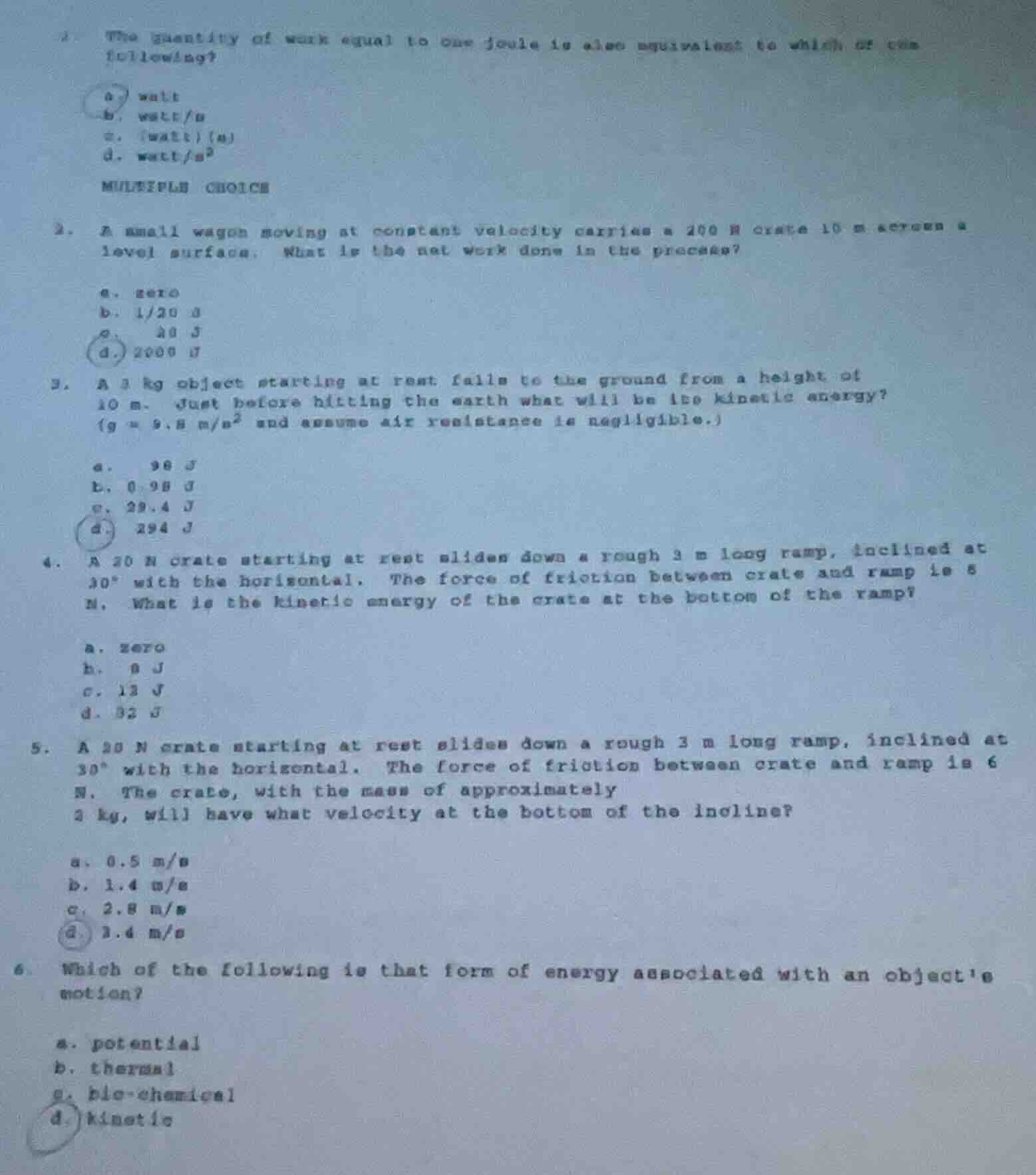
- the quantity of work equal to one joule is also equivalent to which of the following?
a. watt
b. watt/s
c. (watt)(s)
d. watt/s²
multiple choice
- a small wagon moving at constant velocity carries a 200 n crate 10 m across a level surface. what is the net work done in the process?
a. zero
b. 1/20 j
c. 20 j
d. 2000 j
- a 3 kg object starting at rest falls to the ground from a height of 10 m. just before hitting the earth what will be its kinetic energy? (g = 9.8 m/s² and assume air resistance is negligible.)
a. 98 j
b. 0.98 j
c. 29.4 j
d. 294 j
- a 20 n crate starting at rest slides down a rough 3 m long ramp, inclined at 30° with the horizontal. the force of friction between crate and ramp is 5 n. what is the kinetic energy of the crate at the bottom of the ramp?
a. zero
b. 0 j
c. 13 j
d. 32 j
- a 20 n crate starting at rest slides down a rough 3 m long ramp, inclined at 30° with the horizontal. the force of friction between crate and ramp is 6 n. the crate, with the mass of approximately 2 kg, will have what velocity at the bottom of the incline?
a. 0.5 m/s
b. 1.4 m/s
c. 2.8 m/s
d. 3.4 m/s
- which of the following is that form of energy associated with an objects motion?
a. potential
b. thermal
c. bio - chemical
d. kinetic
Question 1
We know that work \( W \) is measured in joules, power \( P \) is measured in watts, and power is defined as \( P=\frac{W}{t} \), so \( W = P\times t \). The unit of power is watt (W) and time is second (s), so the unit of work (joule) is equivalent to (watt)(s).
Step1: Recall the work - energy theorem
The work - energy theorem states that the net work done on an object is equal to the change in its kinetic energy, \( W_{net}=\Delta K = K_f - K_i \).
Step2: Analyze the kinetic energy of the wagon - crate system
The wagon is moving at a constant velocity. The mass of the crate is constant, and since \( K=\frac{1}{2}mv^{2} \), the initial kinetic energy \( K_i=\frac{1}{2}mv_i^{2} \) and the final kinetic energy \( K_f=\frac{1}{2}mv_f^{2} \). Since \( v_i = v_f \) (constant velocity), \( \Delta K=K_f - K_i = 0 \). By the work - energy theorem, \( W_{net}=\Delta K = 0 \).
Step1: Use the principle of conservation of mechanical energy
In the absence of air resistance, the mechanical energy of the object is conserved. The initial mechanical energy is gravitational potential energy \( U = mgh \) (since it starts from rest, \( K_i = 0 \)), and the final mechanical energy is kinetic energy \( K_f \) (when it hits the ground, \( U_f = 0 \)). So \( K_f=U_i=mgh \).
Step2: Calculate the mass of the object
We know that weight \( W = mg \), so \( m=\frac{W}{g} \). Given \( W = mg\) (wait, the object has a mass \( m = 3\space kg \), \( g = 9.8\space m/s^{2} \), \( h = 10\space m \)).
Step3: Substitute the values
\( K_f=mgh=3\space kg\times9.8\space m/s^{2}\times10\space m = 294\space J \)

Snap & solve any problem in the app
Get step-by-step solutions on Sovi AI
Photo-based solutions with guided steps
Explore more problems and detailed explanations
c. (watts)(s)