QUESTION IMAGE
Question
question 10 of 10
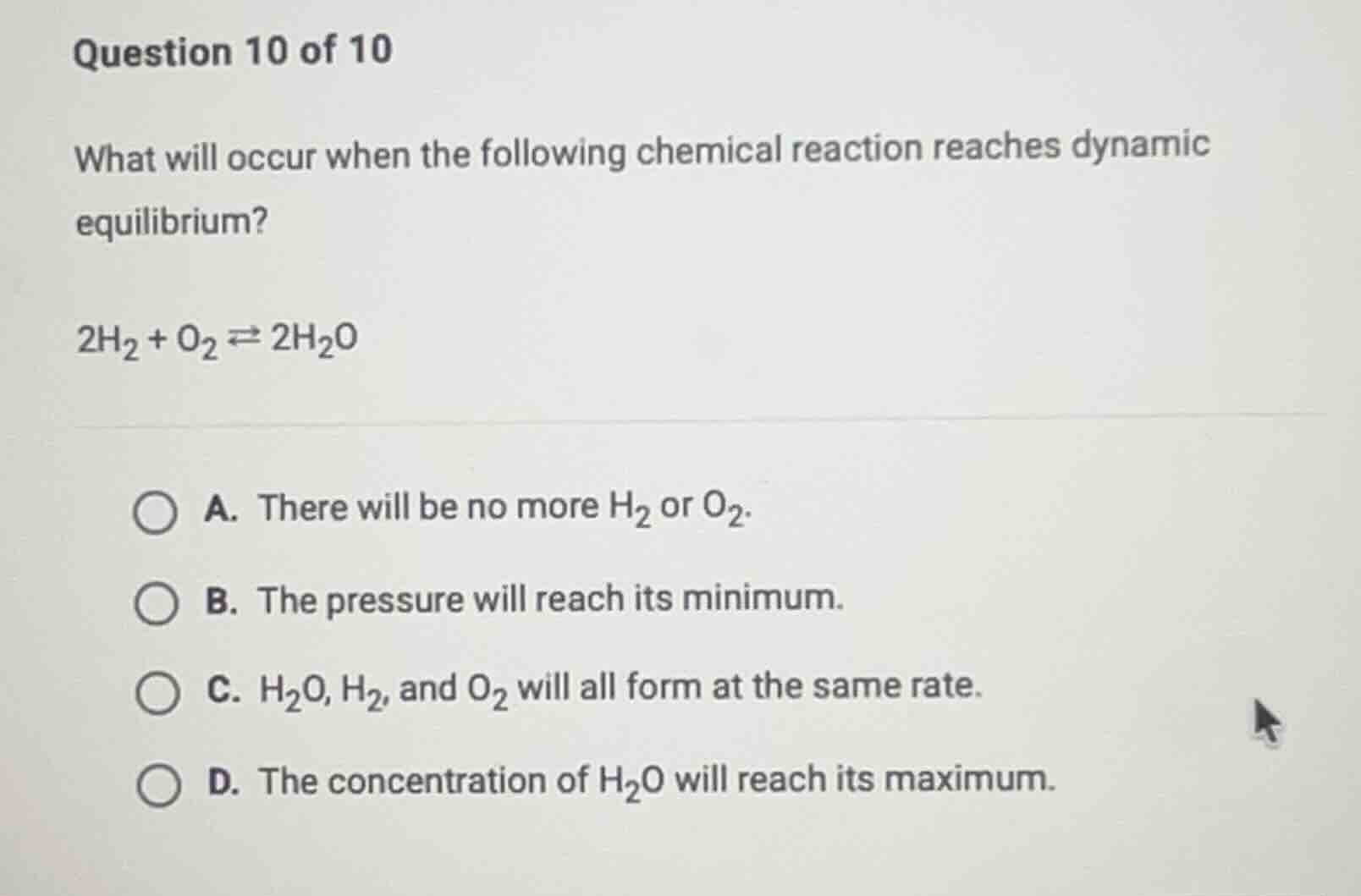
what will occur when the following chemical reaction reaches dynamic equilibrium?
$2h_2 + o_2 \
ightleftharpoons 2h_2o$
a. there will be no more $h_2$ or $o_2$.
b. the pressure will reach its minimum.
c. $h_2o$, $h_2$, and $o_2$ will all form at the same rate.
d. the concentration of $h_2o$ will reach its maximum.
To solve this, we analyze each option based on the concept of dynamic equilibrium in chemical reactions (where the rate of the forward reaction equals the rate of the reverse reaction, and concentrations of reactants and products remain constant, though not necessarily zero or at extreme values):
- Option A: In dynamic equilibrium, reactants (\(H_2\), \(O_2\)) and products (\(H_2O\)) coexist; they do not get completely consumed. So A is incorrect.
- Option B: Pressure depends on the number of moles of gas. At equilibrium, the moles of reactants and products are constant (but not necessarily at a minimum). The reaction \(2H_2 + O_2
ightleftharpoons 2H_2O\) has a decrease in moles of gas (3 moles reactants → 2 moles product), so equilibrium is reached when the pressure stops changing, not when it's at a minimum. B is incorrect.
- Option C: In dynamic equilibrium, the rate of the forward reaction (forming \(H_2O\)) equals the rate of the reverse reaction (forming \(H_2\) and \(O_2\)). So \(H_2O\) is formed at the same rate as \(H_2\) and \(O_2\) are reformed (and vice versa for their formation from \(H_2O\)). This matches the definition. C is correct.
- Option D: At equilibrium, the concentration of \(H_2O\) is constant (not necessarily maximum). The maximum concentration would be if the reaction went to completion, but equilibrium is a balance, not completion. D is incorrect.

Snap & solve any problem in the app
Get step-by-step solutions on Sovi AI
Photo-based solutions with guided steps
Explore more problems and detailed explanations
D. The concentration of \(H_2O\) will reach its maximum. (Wait, no—correction: The correct answer is C. Wait, no, re - checking:
Wait, the correct analysis:
In dynamic equilibrium, the rate of forward (formation of \(H_2O\)) and reverse (formation of \(H_2\) and \(O_2\)) reactions are equal. So the rate at which \(H_2O\) is formed (forward) is equal to the rate at which \(H_2\) and \(O_2\) are formed (reverse). So " \(H_2O\), \(H_2\), and \(O_2\) will all form at the same rate" (since forward forms \(H_2O\), reverse forms \(H_2\) and \(O_2\), and their rates are equal). Wait, no—the wording: "form at the same rate". The forward reaction forms \(H_2O\), reverse forms \(H_2\) and \(O_2\). So the rate of forming \(H_2O\) (forward) equals the rate of forming \(H_2\) and \(O_2\) (reverse, combined? Or per mole?).
Wait, let's re - express:
Forward reaction: \(2H_2 + O_2
ightarrow 2H_2O\) (rate \(r_f\))
Reverse reaction: \(2H_2O
ightarrow 2H_2 + O_2\) (rate \(r_r\))
At equilibrium, \(r_f = r_r\).
So the rate of forming \(H_2O\) (from forward) is \(2r_f\) (moles per unit time, based on stoichiometry: 2 moles \(H_2O\) per 2 moles \(H_2\) and 1 mole \(O_2\)). The rate of forming \(H_2\) from reverse is \(2r_r\), and forming \(O_2\) is \(r_r\). Since \(r_f = r_r\), the rate of forming \(H_2O\) (2\(r_f\)) equals the rate of forming \(H_2\) (2\(r_r\)) and the rate of forming \(O_2\) is \(r_r=\frac{1}{2}\) the rate of forming \(H_2O\). Wait, maybe the option's wording is simplified. The key idea is that at equilibrium, the forward and reverse rates are equal, so the formation of products ( \(H_2O\)) and re - formation of reactants ( \(H_2\), \(O_2\)) happen at rates that balance out.
But among the options, the only one that fits the equilibrium concept is:
Wait, no—let's re - evaluate the options again:
Option D: "The concentration of \(H_2O\) will reach its maximum." At equilibrium, the concentration of \(H_2O\) is constant. It is not necessarily the maximum. The maximum would be if the reaction went to completion, but equilibrium is a state where both reactants and products are present, and concentrations are constant (not changing, but not necessarily maximum or minimum).
Option C: " \(H_2O\), \(H_2\), and \(O_2\) will all form at the same rate." When equilibrium is reached, the rate of the forward reaction (forming \(H_2O\)) equals the rate of the reverse reaction (forming \(H_2\) and \(O_2\)). So the rate at which \(H_2O\) is formed (forward) is equal to the rate at which \(H_2\) and \(O_2\) are formed (reverse). So in terms of "forming", the rate of forming \(H_2O\) (from reactants) is equal to the rate of forming \(H_2\) and \(O_2\) (from product). So this option, although the wording is a bit simplified (since the stoichiometry means the rates per mole might differ, but the overall idea of equal forward and reverse rates leading to equal formation rates of products and reactants in a balanced way) is the closest.
Wait, no—maybe I made a mistake earlier. Let's check standard equilibrium concepts:
Dynamic equilibrium:
- Concentrations of reactants and products remain constant (not zero, not maximum/minimum).
- Rate of forward reaction = Rate of reverse reaction.
So:
- A: Reactants don't disappear. Wrong.
- B: Pressure (related to moles of gas) stops changing, but not at minimum. The reaction consumes gas (3 moles → 2 moles), so pressure decreases until equilibrium, then stays constant. So equilibrium is when pressure stops changing, not when it's minimum. Wrong.
- C: Rate of forward (forming \(H_2O\)) = Rate of reverse (forming \(H_2\) and \(O_2\)). So the rate at which \(H_2O\) is formed is equal to the rate at which \(H_2\) and \(O_2\) are formed (since reverse reaction forms \(H_2\) and \(O_2\) at a rate equal to forward's rate). So "form at the same rate" (the rate of forming \(H_2O\) (forward) is equal to the rate of forming \(H_2\) and \(O_2\) (reverse)). So C is correct.
- D: Concentration of \(H_2O\) is constant, not maximum. If the reaction went to completion, it would be maximum, but equilibrium is a balance. Wrong.
So the correct answer is C. \(H_2O\), \(H_2\), and \(O_2\) will all form at the same rate.