QUESTION IMAGE
Question
question 15 of 25
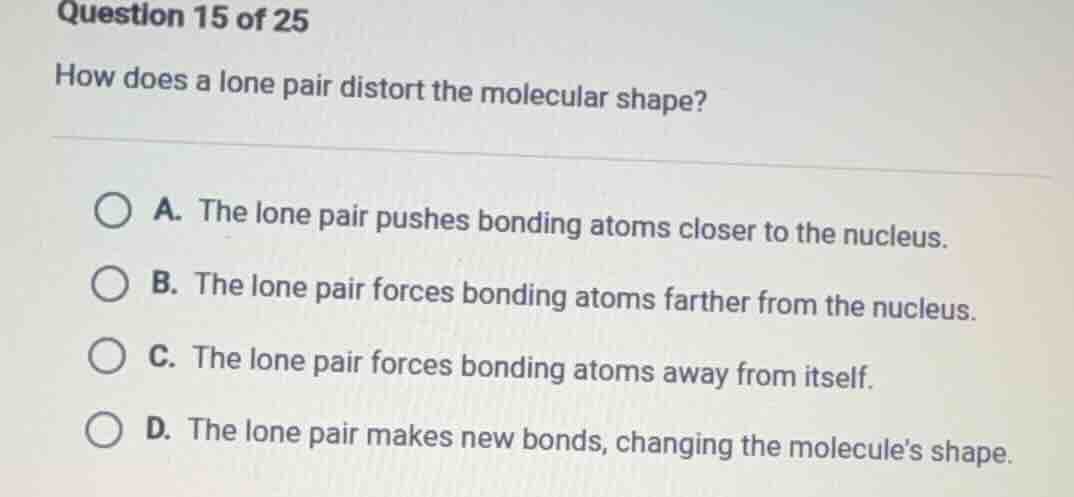
how does a lone pair distort the molecular shape?
a. the lone pair pushes bonding atoms closer to the nucleus.
b. the lone pair forces bonding atoms farther from the nucleus.
c. the lone pair forces bonding atoms away from itself.
d. the lone pair makes new bonds, changing the molecule’s shape.
Brief Explanations
To solve this, we analyze each option:
- Option A: Lone pairs don't push bonding atoms toward the nucleus. Bonding atoms' distance from the nucleus is related to their own electron - nucleus interactions, not lone pair - nucleus interaction. So A is incorrect.
- Option B: Lone pairs don't force bonding atoms farther from the nucleus. The nucleus - bonding atom distance is determined by other factors, not this mechanism. So B is incorrect.
- Option C: Lone pairs have greater electron - electron repulsion compared to bonding pairs. This repulsion forces the bonding atoms (which are involved in bonding pairs) away from the lone pair, thus distorting the molecular shape. For example, in a molecule like $\ce{NH3}$, the lone pair on nitrogen pushes the three $\ce{N - H}$ bonding pairs, changing the molecular shape from a tetrahedral electron - pair geometry to a trigonal pyramidal molecular shape. So C is correct.
- Option D: Lone pairs are non - bonding electrons and do not form new bonds. So D is incorrect.

Snap & solve any problem in the app
Get step-by-step solutions on Sovi AI
Photo-based solutions with guided steps
Explore more problems and detailed explanations
C. The lone pair forces bonding atoms away from itself.