QUESTION IMAGE
Question
question 15.8
mark as: none
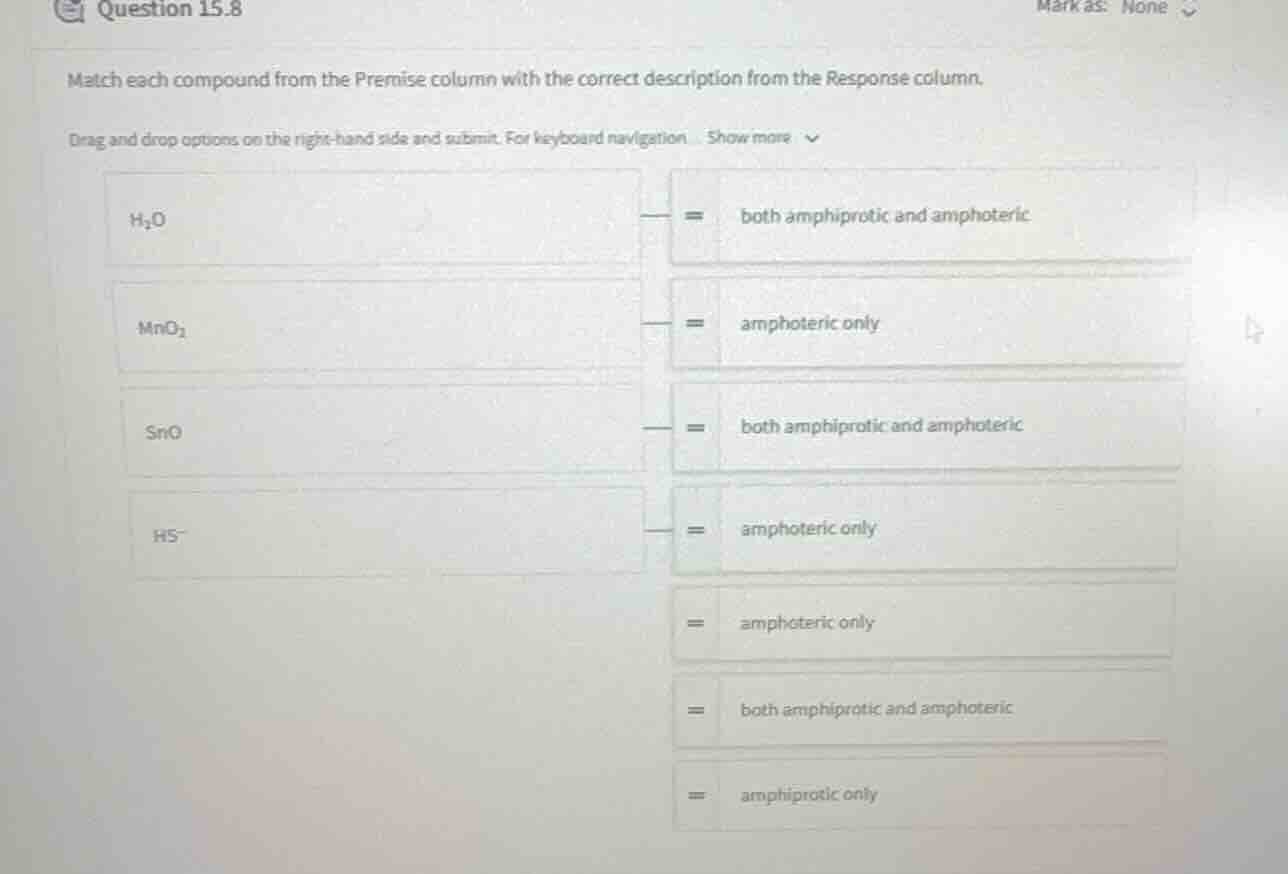
match each compound from the premise column with the correct description from the response column.
drag and drop options on the right-hand side and submit. for keyboard navigation show more
h₂o
mno₂
sno
hs⁻
both amphiprotic and amphoteric
amphoteric only
both amphiprotic and amphoteric
amphoteric only
amphoteric only
both amphiprotic and amphoteric
amphiprotic only
- H₂O: Can donate a proton (acts as acid: $\text{H}_2\text{O}
ightarrow \text{H}^+ + \text{OH}^-$) and accept a proton (acts as base: $\text{H}_2\text{O} + \text{H}^+
ightarrow \text{H}_3\text{O}^+$), so it is amphiprotic. Amphiprotic substances are a subset of amphoteric substances, meaning it is both.
- MnO₂: Transition metal oxide that reacts with both strong acids (e.g., $\text{MnO}_2 + 4\text{HCl}
ightarrow \text{MnCl}_2 + \text{Cl}_2 + 2\text{H}_2\text{O}$) and strong bases (e.g., $\text{MnO}_2 + 2\text{NaOH}
ightarrow \text{Na}_2\text{MnO}_3 + \text{H}_2\text{O}$) but cannot donate/accept protons, so it is amphoteric only.
- SnO: Metal oxide that reacts with strong acids (e.g., $\text{SnO} + 2\text{HCl}
ightarrow \text{SnCl}_2 + \text{H}_2\text{O}$) and strong bases (e.g., $\text{SnO} + 2\text{NaOH}
ightarrow \text{Na}_2\text{SnO}_2 + \text{H}_2\text{O}$) but cannot donate/accept protons, so it is amphoteric only.
- HS⁻: Can donate a proton (acts as acid: $\text{HS}^-
ightarrow \text{H}^+ + \text{S}^{2-}$) and accept a proton (acts as base: $\text{HS}^- + \text{H}^+
ightarrow \text{H}_2\text{S}$), so it is amphiprotic, and therefore both amphiprotic and amphoteric.

Snap & solve any problem in the app
Get step-by-step solutions on Sovi AI
Photo-based solutions with guided steps
Explore more problems and detailed explanations
- $\text{H}_2\text{O}$ = both amphiprotic and amphoteric
- $\text{MnO}_2$ = amphoteric only
- $\text{SnO}$ = amphoteric only
- $\text{HS}^-$ = both amphiprotic and amphoteric