QUESTION IMAGE
Question
question 25 of 25
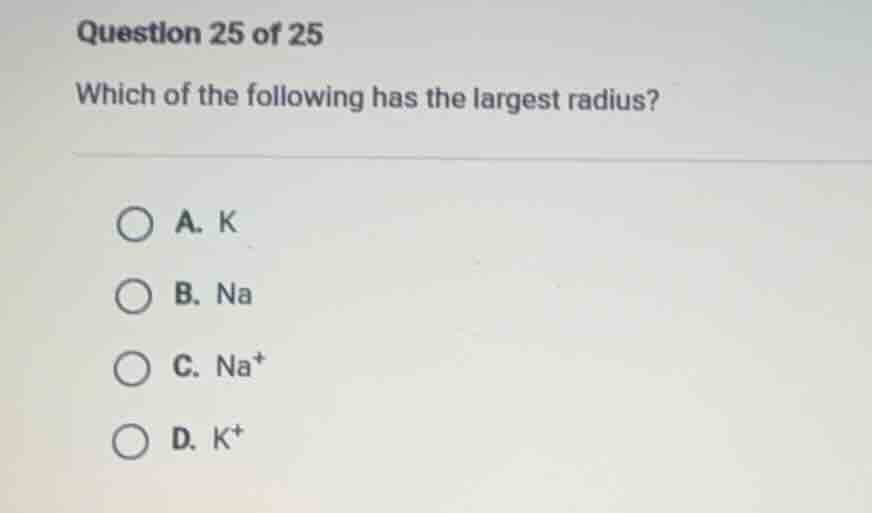
which of the following has the largest radius?
a. k
b. na
c. na⁺
d. k⁺
Step1: Analyze atomic radius trend down a group
Potassium (K) and sodium (Na) are in the same group (Group 1) of the periodic table. As we move down a group, the number of electron shells increases. K is below Na, so K has more electron shells than Na. Thus, the atomic radius of K is larger than that of Na.
Step2: Analyze ionic vs atomic radius for same element
For a given element, the cation (positive ion) has fewer electrons than the neutral atom. So, \( \text{Na}^+ \) has fewer electrons than Na, and \( \text{K}^+ \) has fewer electrons than K. Removing an electron reduces electron - electron repulsion, so the ionic radius of \( \text{Na}^+ \) is smaller than Na, and ionic radius of \( \text{K}^+ \) is smaller than K.
Step3: Compare K and \( \text{K}^+ \), Na and \( \text{Na}^+ \) and K and Na
- Comparing K and \( \text{K}^+ \): K has a larger radius than \( \text{K}^+ \) because K has more electrons.
- Comparing Na and \( \text{Na}^+ \): Na has a larger radius than \( \text{Na}^+ \) because Na has more electrons.
- Comparing K and Na: As K is below Na in Group 1, K has more electron shells. So atomic radius of K > atomic radius of Na.
- Comparing \( \text{K}^+ \) and \( \text{Na}^+ \): \( \text{K}^+ \) has more electron shells than \( \text{Na}^+ \), but when we compare K (neutral) with \( \text{K}^+ \) (cation) and Na (neutral) with \( \text{Na}^+ \) (cation), and then K with Na, we find that K (neutral atom) has the largest radius among the given species.

Snap & solve any problem in the app
Get step-by-step solutions on Sovi AI
Photo-based solutions with guided steps
Explore more problems and detailed explanations
A. K