QUESTION IMAGE
Question
question 7 (1 point)
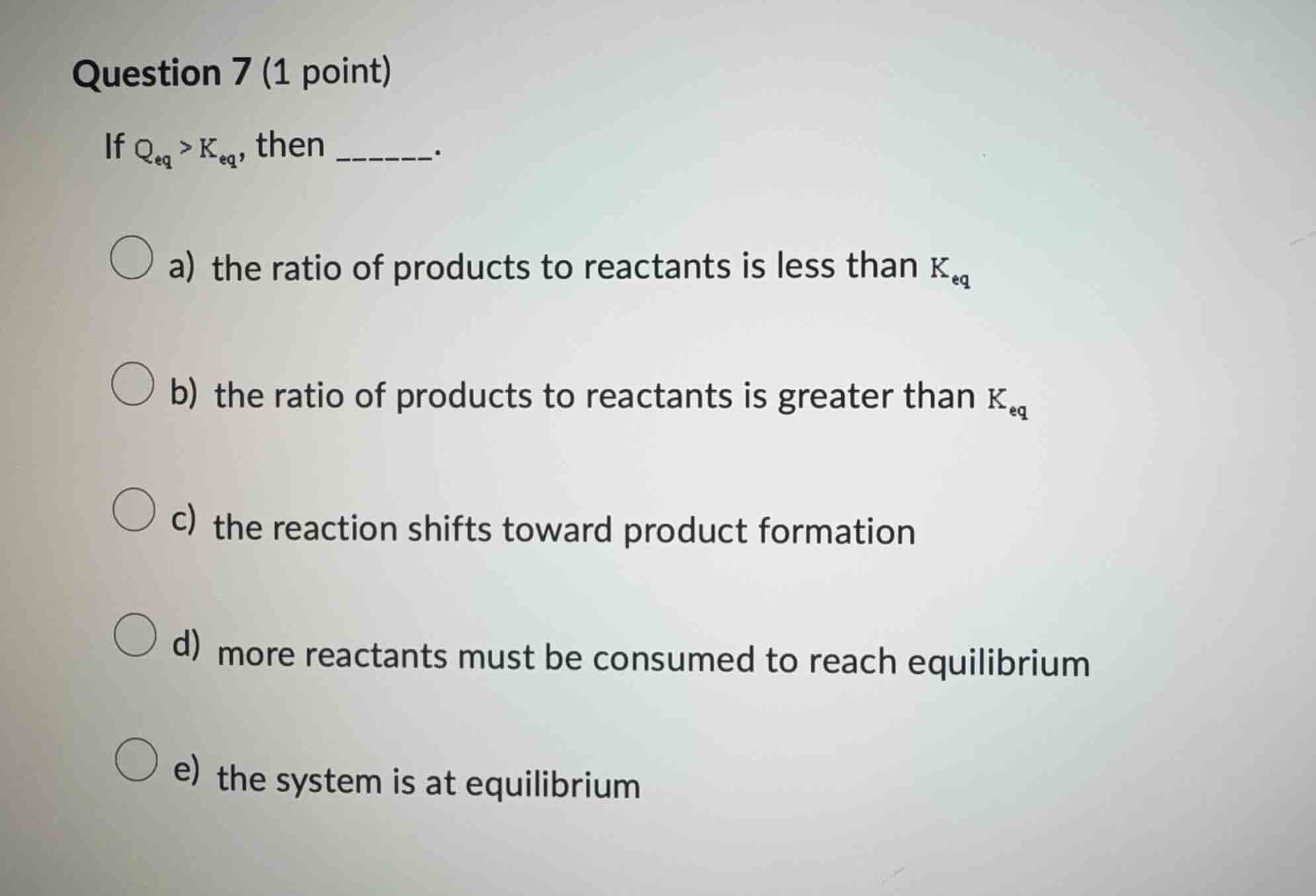
if $q_{eq} > k_{eq}$, then ______.
a) the ratio of products to reactants is less than $k_{eq}$
b) the ratio of products to reactants is greater than $k_{eq}$
c) the reaction shifts toward product formation
d) more reactants must be consumed to reach equilibrium
e) the system is at equilibrium
To solve this, we recall the concepts of reaction quotient (\(Q_{eq}\)) and equilibrium constant (\(K_{eq}\)). The reaction quotient \(Q_{eq}\) has the same formula as \(K_{eq}\) (ratio of products to reactants, each raised to their stoichiometric coefficients), but \(Q_{eq}\) is at any point, while \(K_{eq}\) is at equilibrium.
- Option a: If \(Q_{eq}>K_{eq}\), the ratio of products to reactants (which is \(Q_{eq}\)) is greater than \(K_{eq}\), so a is wrong.
- Option b: By definition, \(Q_{eq}\) is the ratio of products to reactants (at a given time). So if \(Q_{eq}>K_{eq}\), this ratio is greater than \(K_{eq}\). This matches.
- Option c: When \(Q_{eq}>K_{eq}\), the reaction shifts to the left (toward reactants) to reduce the amount of products and increase reactants, so c is wrong.
- Option d: To reach equilibrium, we need to form more reactants (so reactants are produced, not consumed), so d is wrong.
- Option e: The system is at equilibrium only when \(Q_{eq} = K_{eq}\), so e is wrong.

Snap & solve any problem in the app
Get step-by-step solutions on Sovi AI
Photo-based solutions with guided steps
Explore more problems and detailed explanations
b) the ratio of products to reactants is greater than \(K_{eq}\)