QUESTION IMAGE
Question
question 7 1 pts
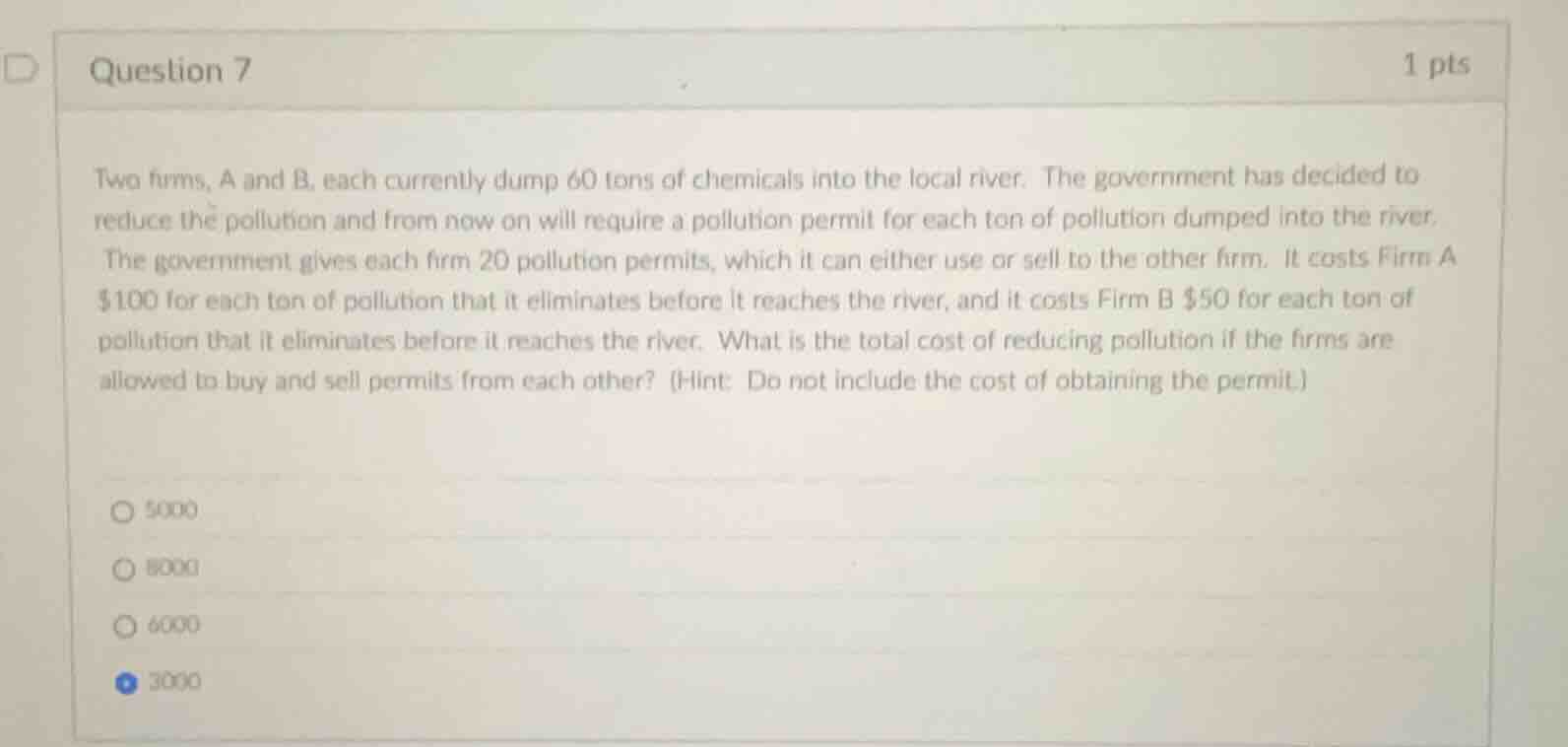
two firms, a and b, each currently dump 60 tons of chemicals into the local river. the government has decided to reduce the pollution and from now on will require a pollution permit for each ton of pollution dumped into the river. the government gives each firm 20 pollution permits, which it can either use or sell to the other firm. it costs firm a $100 for each ton of pollution that it eliminates before it reaches the river, and it costs firm b $50 for each ton of pollution that it eliminates before it reaches the river. what is the total cost of reducing pollution if the firms are allowed to buy and sell permits from each other? (hint: do not include the cost of obtaining the permit.)
5000
8000
6000
3000
Step1: Calculate total required reduction
Total initial pollution: $60 + 60 = 120$ tons. Total permits given: $20 + 20 = 40$ tons. Total reduction needed: $120 - 40 = 80$ tons.
Step2: Identify cost-efficient reducer
Firm B's elimination cost ($\$50$/ton) is lower than Firm A's ($\$100$/ton), so B should eliminate as much as possible.
Step3: Calculate B's maximum elimination
Firm B initially dumps 60 tons, can use 20 permits, so it can eliminate $60 - 0 = 60$ tons (sell all permits to A).
Step4: Calculate remaining reduction for A
Total reduction needed: 80 tons. B eliminates 60 tons, so A needs to eliminate $80 - 60 = 20$ tons.
Step5: Calculate total cost
Cost for B: $60 \times 50 = 3000$ dollars. Cost for A: $20 \times 100 = 2000$ dollars. Total cost: $3000 + 2000 = 5000$ dollars.

Snap & solve any problem in the app
Get step-by-step solutions on Sovi AI
Photo-based solutions with guided steps
Explore more problems and detailed explanations
5000