QUESTION IMAGE
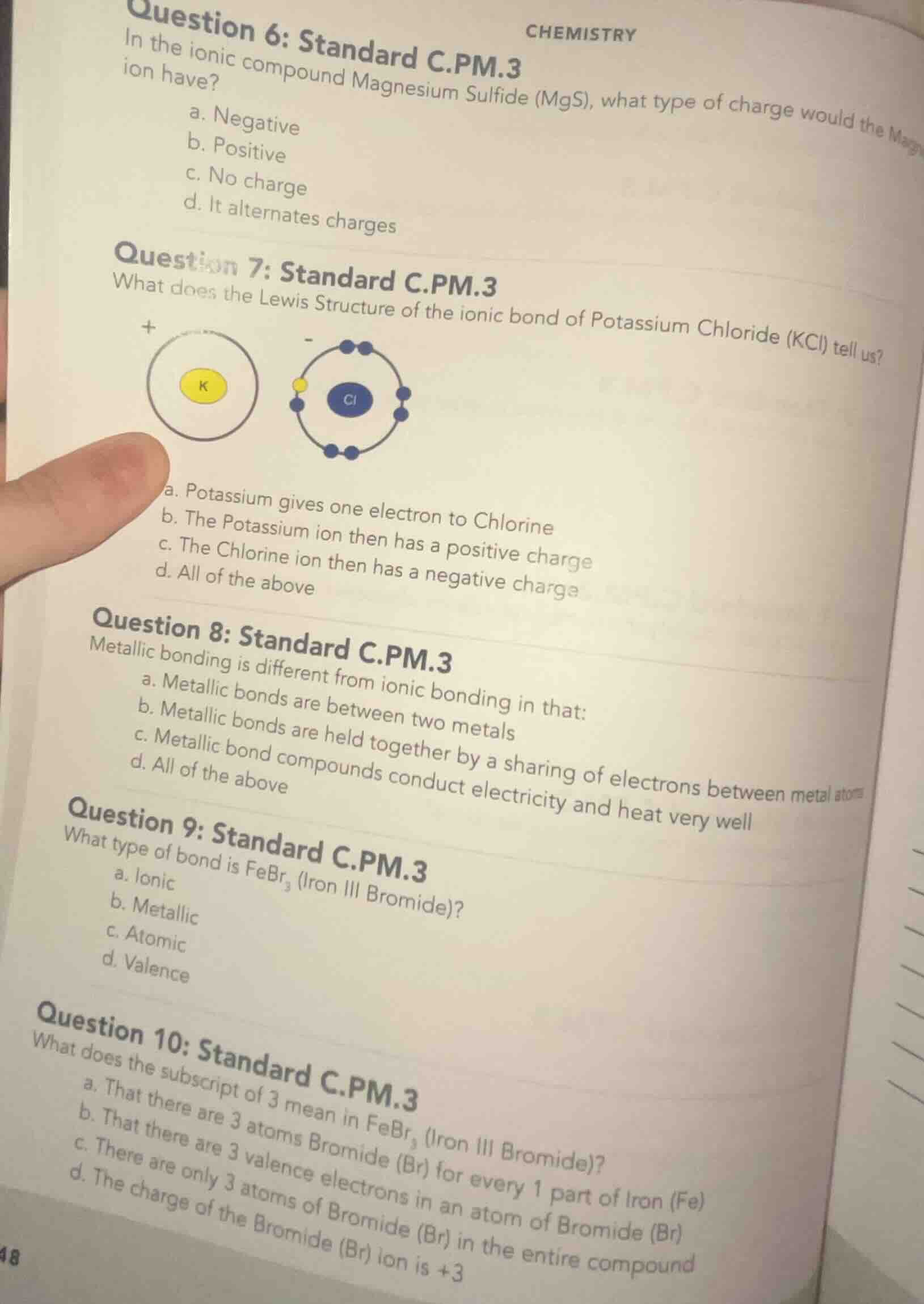
Question
question 6: standard c.pm.3
in the ionic compound magnesium sulfide (mgs), what type of charge would the magnesium ion have?
a. negative
b. positive
c. no charge
d. it alternates charges
question 7: standard c.pm.3
what does the lewis structure of the ionic bond of potassium chloride (kcl) tell us?
a. potassium gives one electron to chlorine
b. the potassium ion then has a positive charge
c. the chlorine ion then has a negative charge
d. all of the above
question 8: standard c.pm.3
metallic bonding is different from ionic bonding in that:
a. metallic bonds are between two metals
b. metallic bonds are held together by a sharing of electrons between metal atoms
c. metallic bond compounds conduct electricity and heat very well
d. all of the above
question 9: standard c.pm.3
what type of bond is febr₃ (iron iii bromide)?
a. ionic
b. metallic
c. atomic
d. valence
question 10: standard c.pm.3
what does the subscript of 3 mean in febr₃ (iron iii bromide)?
a. that there are 3 atoms bromide (br) for every 1 part of iron (fe)
b. that there are 3 valence electrons in an atom of bromide (br)
c. there are only 3 atoms of bromide (br) in the entire compound
d. the charge of the bromide (br) ion is +3
Question 6:
Magnesium is a group 2 metal, so it loses 2 valence electrons to form a positively charged ion to achieve a full outer shell.
Question 7:
The Lewis structure shows K (group 1) loses one electron to Cl (group 17), making K⁺ (positive charge) and Cl⁻ (negative charge). All listed statements are correct.
Question 8:
Metallic bonding occurs between metal atoms, involves a sea of delocalized shared electrons, and metallic compounds have high electrical and thermal conductivity. All listed statements are correct.
Question 9:
Iron (III) bromide forms between a metal (Fe) and a nonmetal (Br), with electrons transferred from Fe to Br to form ions, which defines an ionic bond.
Question 10:
In chemical formulas, subscripts indicate the ratio of atoms. The 3 in FeBr₃ means 3 Br atoms for each Fe atom in the compound.

Snap & solve any problem in the app
Get step-by-step solutions on Sovi AI
Photo-based solutions with guided steps
Explore more problems and detailed explanations
Question 6: b. Positive
Question 7: d. All of the above
Question 8: d. All of the above
Question 9: a. Ionic
Question 10: a. That there are 3 atoms Bromide (Br) for every 1 part of Iron (Fe)