QUESTION IMAGE
Question
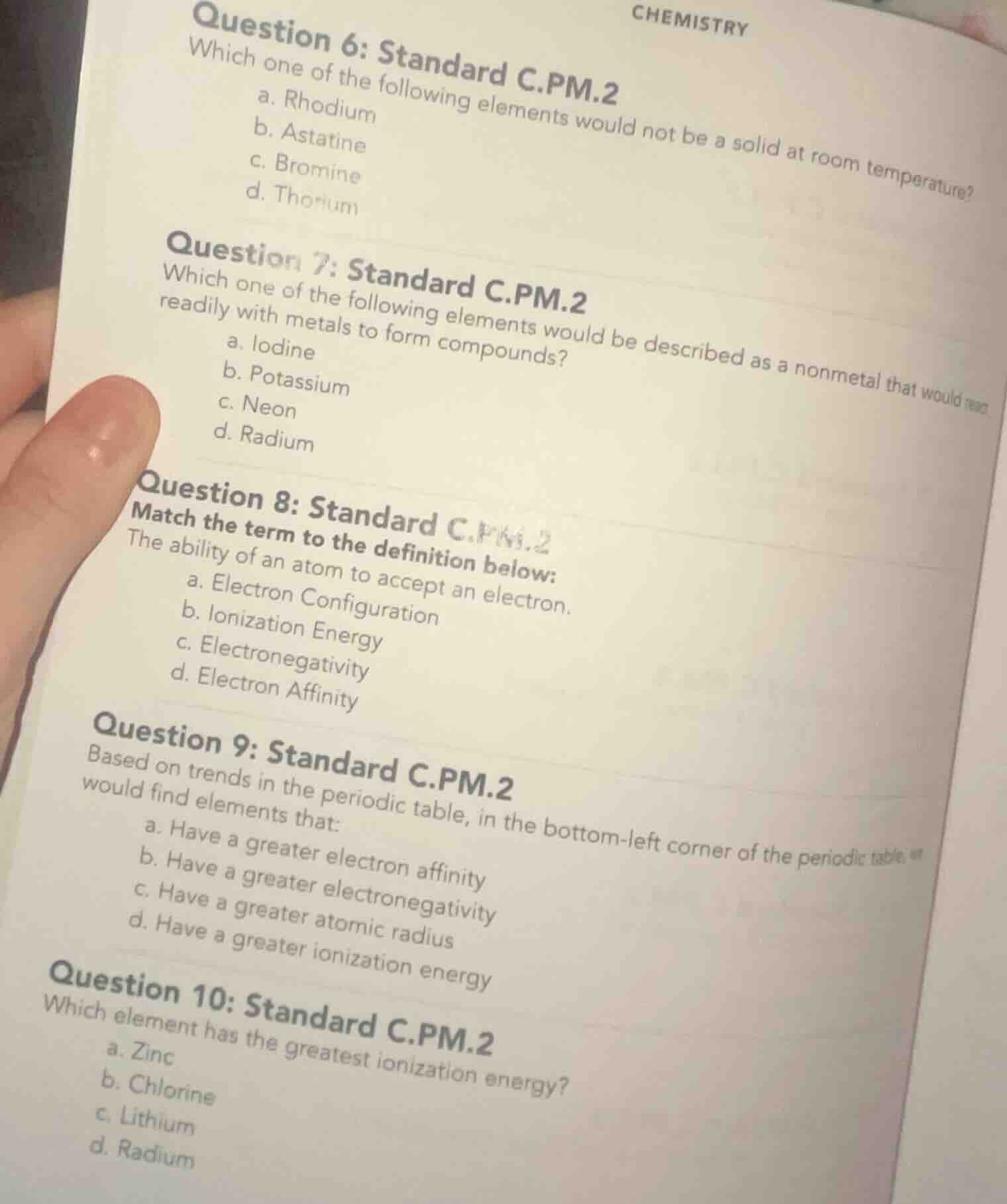
question 6: standard c.pm.2
which one of the following elements would not be a solid at room temperature?
a. rhodium
b. astatine
c. bromine
d. thorium
question 7: standard c.pm.2
which one of the following elements would be described as a nonmetal that would react readily with metals to form compounds?
a. iodine
b. potassium
c. neon
d. radium
question 8: standard c.pm.2
match the term to the definition below:
the ability of an atom to accept an electron.
a. electron configuration
b. ionization energy
c. electronegativity
d. electron affinity
question 9: standard c.pm.2
based on trends in the periodic table, in the bottom - left corner of the periodic table, we would find elements that:
a. have a greater electron affinity
b. have a greater electronegativity
c. have a greater atomic radius
d. have a greater ionization energy
question 10: standard c.pm.2
which element has the greatest ionization energy?
a. zinc
b. chlorine
c. lithium
d. radium
Question 6: Rhodium (metal, solid), Astatine (solid nonmetal), Thorium (metal, solid); Bromine is a liquid at room temperature.
Question 7: Potassium and Radium are metals; Neon is a noble gas (nonreactive); Iodine is a nonmetal that reacts with metals to form iodides.
Question 8: Electron Configuration is orbital arrangement of electrons; Ionization Energy is energy to remove an electron; Electronegativity is electron-attracting ability; Electron Affinity is the ability to accept an electron.
Question 9: Atomic radius increases down a group and left across a period (bottom-left has largest radii); electron affinity, electronegativity, and ionization energy increase up/right.
Question 10: Ionization energy increases up a group and right across a period; Chlorine is farthest up/right among the options.

Snap & solve any problem in the app
Get step-by-step solutions on Sovi AI
Photo-based solutions with guided steps
Explore more problems and detailed explanations
Question 6: c. Bromine
Question 7: a. Iodine
Question 8: d. Electron Affinity
Question 9: c. Have a greater atomic radius
Question 10: b. Chlorine