QUESTION IMAGE
Question
question:
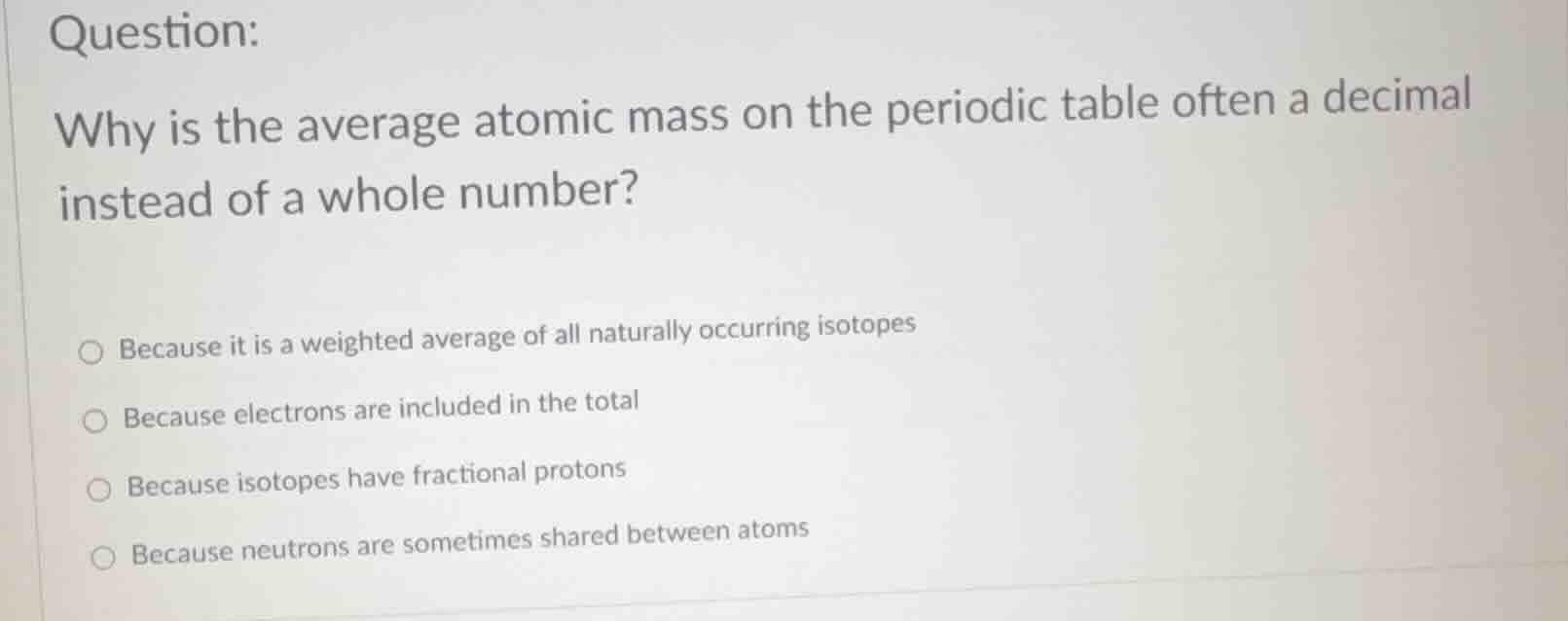
why is the average atomic mass on the periodic table often a decimal instead of a whole number?
because it is a weighted average of all naturally occurring isotopes
because electrons are included in the total
because isotopes have fractional protons
because neutrons are sometimes shared between atoms
Brief Explanations
- Option 1: Average atomic mass is a weighted average of the masses of all naturally occurring isotopes of an element, considering their relative abundances. This weighted average can result in a decimal.
- Option 2: Electrons have negligible mass compared to protons and neutrons, so including them doesn't significantly affect the atomic mass to make it a decimal.
- Option 3: Isotopes have the same number of protons (only neutrons differ), so they don't have fractional protons.
- Option 4: Neutrons are not shared between atoms in a way that would affect atomic mass calculation for the periodic table.

Snap & solve any problem in the app
Get step-by-step solutions on Sovi AI
Photo-based solutions with guided steps
Explore more problems and detailed explanations
A. Because it is a weighted average of all naturally occurring isotopes