QUESTION IMAGE
Question
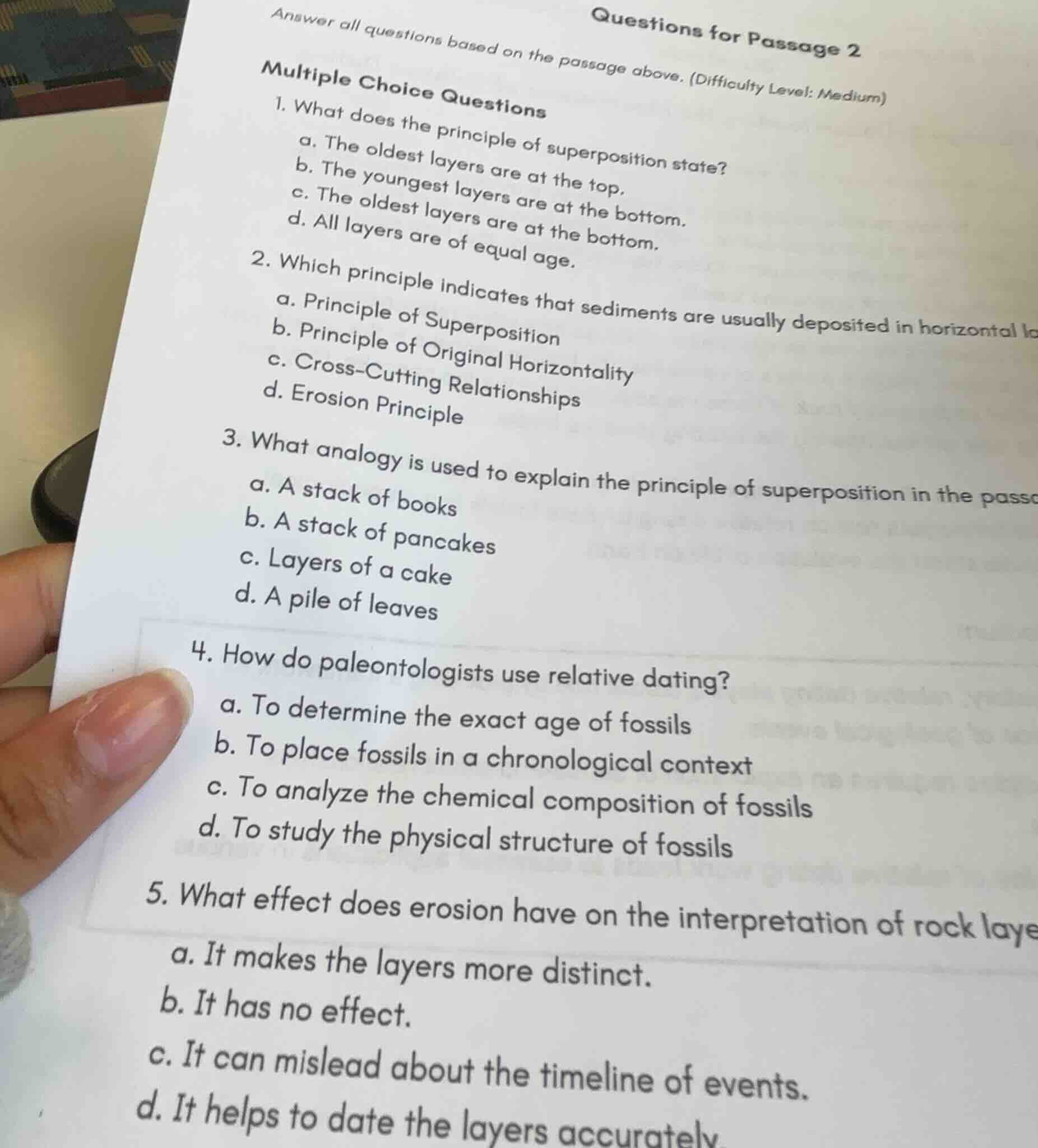
questions for passage 2
answer all questions based on the passage above. (difficulty level: medium)
multiple choice questions
- what does the principle of superposition state?
a. the oldest layers are at the top.
b. the youngest layers are at the bottom.
c. the oldest layers are at the bottom.
d. all layers are of equal age.
- which principle indicates that sediments are usually deposited in horizontal la
a. principle of superposition
b. principle of original horizontality
c. cross-cutting relationships
d. erosion principle
- what analogy is used to explain the principle of superposition in the passa
a. a stack of books
b. a stack of pancakes
c. layers of a cake
d. a pile of leaves
- how do paleontologists use relative dating?
a. to determine the exact age of fossils
b. to place fossils in a chronological context
c. to analyze the chemical composition of fossils
d. to study the physical structure of fossils
- what effect does erosion have on the interpretation of rock laye
a. it makes the layers more distinct.
b. it has no effect.
c. it can mislead about the timeline of events.
d. it helps to date the layers accurately.
- The principle of superposition states that in undisturbed rock layers, the oldest layers form first at the bottom, with younger layers on top.
- The Principle of Original Horizontality defines that sediments are deposited in horizontal layers initially.
- A stack of books is a common analogy for superposition, as each new book (layer) is added on top, with the bottom books being the oldest.
- Relative dating does not give exact ages; it orders fossils and rock layers chronologically.
- Erosion removes rock layers, creating gaps (unconformities) that can distort the apparent timeline of geological events.

Snap & solve any problem in the app
Get step-by-step solutions on Sovi AI
Photo-based solutions with guided steps
Explore more problems and detailed explanations
- c. The oldest layers are at the bottom.
- b. Principle of Original Horizontality
- a. A stack of books
- b. To place fossils in a chronological context
- c. It can mislead about the timeline of events.