QUESTION IMAGE
Question
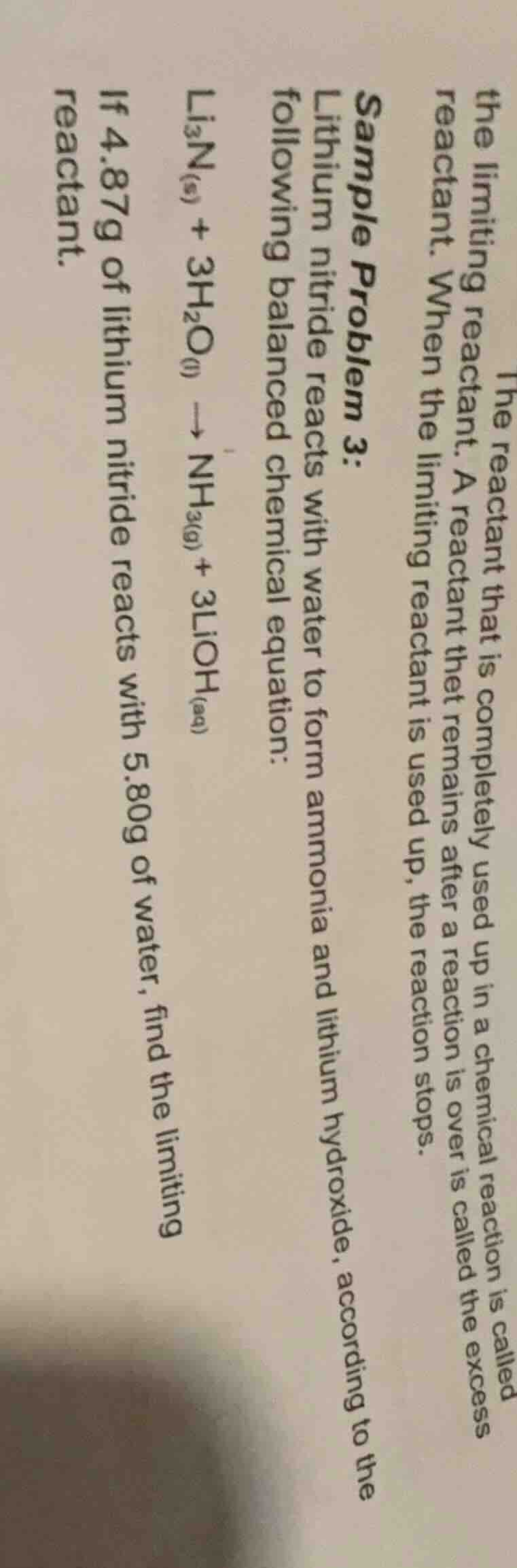
the reactant that is completely used up in a chemical reaction is called the limiting reactant. a reactant that remains after a reaction is over is called the excess reactant. when the limiting reactant is used up, the reaction stops.
sample problem 3:
lithium nitride reacts with water to form ammonia and lithium hydroxide, according to the following balanced chemical equation:
$ce{li_{3}n_{(s)} + 3h_{2}o_{(l)} -> nh_{3(g)} + 3lioh_{(aq)}}$
if 4.87 g of lithium nitride reacts with 5.80 g of water, find the limiting reactant.
Step1: Calculate moles of \( Li_3N \)
Molar mass of \( Li_3N \): \( 3\times6.94 + 14.01 = 34.83 \, g/mol \)
Moles of \( Li_3N = \frac{4.87 \, g}{34.83 \, g/mol} \approx 0.140 \, mol \)
Step2: Calculate moles of \( H_2O \)
Molar mass of \( H_2O \): \( 2\times1.01 + 16.00 = 18.02 \, g/mol \)
Moles of \( H_2O = \frac{5.80 \, g}{18.02 \, g/mol} \approx 0.322 \, mol \)
Step3: Determine mole ratio from reaction
Reaction: \( Li_3N + 3H_2O
ightarrow NH_3 + 3LiOH \)
Mole ratio \( Li_3N : H_2O = 1 : 3 \)
Step4: Find required moles of \( H_2O \) for \( Li_3N \)
Required \( H_2O \) for \( 0.140 \, mol \, Li_3N \): \( 0.140 \, mol \times 3 = 0.420 \, mol \)
Step5: Compare required and available \( H_2O \)
Available \( H_2O = 0.322 \, mol \), which is less than required \( 0.420 \, mol \). So \( H_2O \) is limiting? Wait, no—wait, check ratio the other way.
Wait, alternatively, find moles of \( Li_3N \) required for \( H_2O \):
Required \( Li_3N \) for \( 0.322 \, mol \, H_2O \): \( \frac{0.322 \, mol}{3} \approx 0.107 \, mol \)
Available \( Li_3N = 0.140 \, mol \), which is more than required \( 0.107 \, mol \). Thus, \( H_2O \) is limiting? Wait, no—wait, let's re-express:
From reaction, 1 mol \( Li_3N \) needs 3 mol \( H_2O \).
Moles of \( Li_3N = 0.140 \, mol \), needs \( 0.140 \times 3 = 0.420 \, mol \, H_2O \). But we have only \( 0.322 \, mol \, H_2O \). So \( H_2O \) is insufficient for \( Li_3N \). Alternatively, moles of \( H_2O = 0.322 \, mol \), needs \( 0.322 / 3 \approx 0.107 \, mol \, Li_3N \). We have \( 0.140 \, mol \, Li_3N \), which is more than needed. So \( H_2O \) is the limiting reactant? Wait, no—wait, the question is to find limiting reactant between \( Li_3N \) (4.87g) and \( H_2O \) (5.80g). Wait, maybe I made a mistake. Wait, let's recalculate moles:
Molar mass of \( Li_3N \): Li is 6.94, N is 14.01. So \( 3(6.94) + 14.01 = 20.82 + 14.01 = 34.83 \, g/mol \). Correct. So 4.87g / 34.83g/mol ≈ 0.140 mol.
Molar mass of \( H_2O \): 18.02g/mol. 5.80g / 18.02g/mol ≈ 0.322 mol. Correct.
Reaction: 1 mol \( Li_3N \) reacts with 3 mol \( H_2O \).
So, for \( Li_3N \) to react completely, need 3 * 0.140 = 0.420 mol \( H_2O \). We have only 0.322 mol \( H_2O \), which is less. So \( H_2O \) is limiting? Wait, no—wait, if we take \( H_2O \) as limiting, how much \( Li_3N \) is needed? 0.322 / 3 ≈ 0.107 mol. We have 0.140 mol \( Li_3N \), which is more than 0.107 mol. So \( H_2O \) is limiting. Wait, but let's check the other way: if \( Li_3N \) is limiting, it would need 0.420 mol \( H_2O \), but we have only 0.322, so \( Li_3N \) can't be limiting. Thus, \( H_2O \) is limiting? Wait, no—wait, the problem is to find the limiting reactant. Wait, maybe I messed up. Wait, let's do the calculation again.
Wait, moles of \( Li_3N \): 4.87g / 34.83g/mol ≈ 0.140 mol.
Moles of \( H_2O \): 5.80g / 18.02g/mol ≈ 0.322 mol.
From the balanced equation, 1 mol \( Li_3N \) reacts with 3 mol \( H_2O \).
So the mole ratio of \( Li_3N \) to \( H_2O \) in the reaction is 1:3.
Now, divide moles of each reactant by their stoichiometric coefficient:
For \( Li_3N \): \( 0.140 \, mol / 1 = 0.140 \)
For \( H_2O \): \( 0.322 \, mol / 3 \approx 0.107 \)
The smaller value is for \( H_2O \), so \( H_2O \) is the limiting reactant? Wait, no—wait, the stoichiometric coefficient for \( Li_3N \) is 1, for \( H_2O \) is 3. So when we divide moles by coefficient, the smaller quotient is the limiting reactant. So \( H_2O \) has quotient ~0.107, \( Li_3N \) has 0.140. So \( H_2O \) is limiting. Wait, but let's confirm with mass.
Alternat…

Snap & solve any problem in the app
Get step-by-step solutions on Sovi AI
Photo-based solutions with guided steps
Explore more problems and detailed explanations
The limiting reactant is \( \boldsymbol{H_2O} \) (water).