QUESTION IMAGE
Question
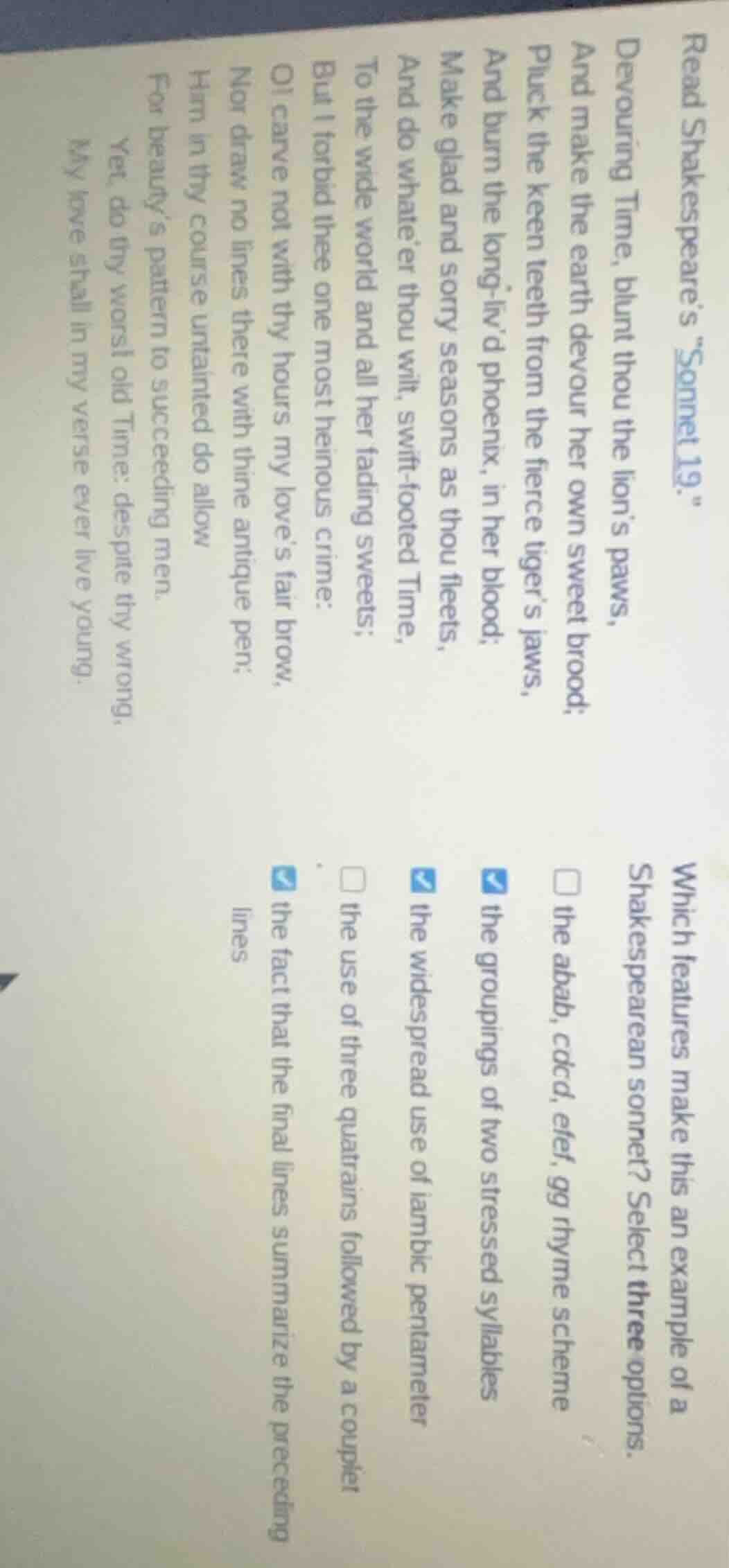
read shakespeare’s \sonnet 19.\
devouring time, blunt thou the lion’s paws,
and make the earth devour her own sweet brood;
pluck the keen teeth from the fierce tiger’s jaws,
and burn the long-liv’d phoenix, in her blood;
make glad and sorry seasons as thou fleets,
and do whate’er thou wilt, swift-footed time,
to the wide world and all her fading sweets;
but i forbid thee one most heinous crime:
o! carve not with thy hours my love’s fair brow,
nor draw no lines there with thine antique pen;
him in thy course untainted do allow
for beauty’s pattern to succeeding men.
yet, do thy worst! old time: despite thy wrong,
my love shall in my verse ever live young.
which features make this an example of a shakespearean sonnet? select three options.
□ the abab, cdcd, efef, gg rhyme scheme
☑ the groupings of two stressed syllables
☑ the widespread use of iambic pentameter
□ the use of three quatrains followed by a couplet
☑ the fact that the final lines summarize the preceding lines
- Shakespearean sonnets follow the abab, cdcd, efef, gg rhyme scheme: the first quatrain rhymes paws/brood, jaws/blood; the second fleets/sweets, crime/brow; the third pen/allow, men/young, fitting this structure.
- They are written in iambic pentameter, a line of five pairs of unstressed-stressed syllables, which is consistent with the rhythm of Sonnet 19.
- Shakespearean sonnets have a structure of three quatrains (four-line stanzas) followed by a rhyming couplet (two lines), where the couplet here ("Yet, do thy worst old Time: despite thy wrong, My love shall in my verse ever live young.") summarizes the poem's theme of defeating time through verse.

Snap & solve any problem in the app
Get step-by-step solutions on Sovi AI
Photo-based solutions with guided steps
Explore more problems and detailed explanations
- the abab, cdcd, efef, gg rhyme scheme
- the widespread use of iambic pentameter
- the fact that the final lines summarize the preceding lines