QUESTION IMAGE
Question
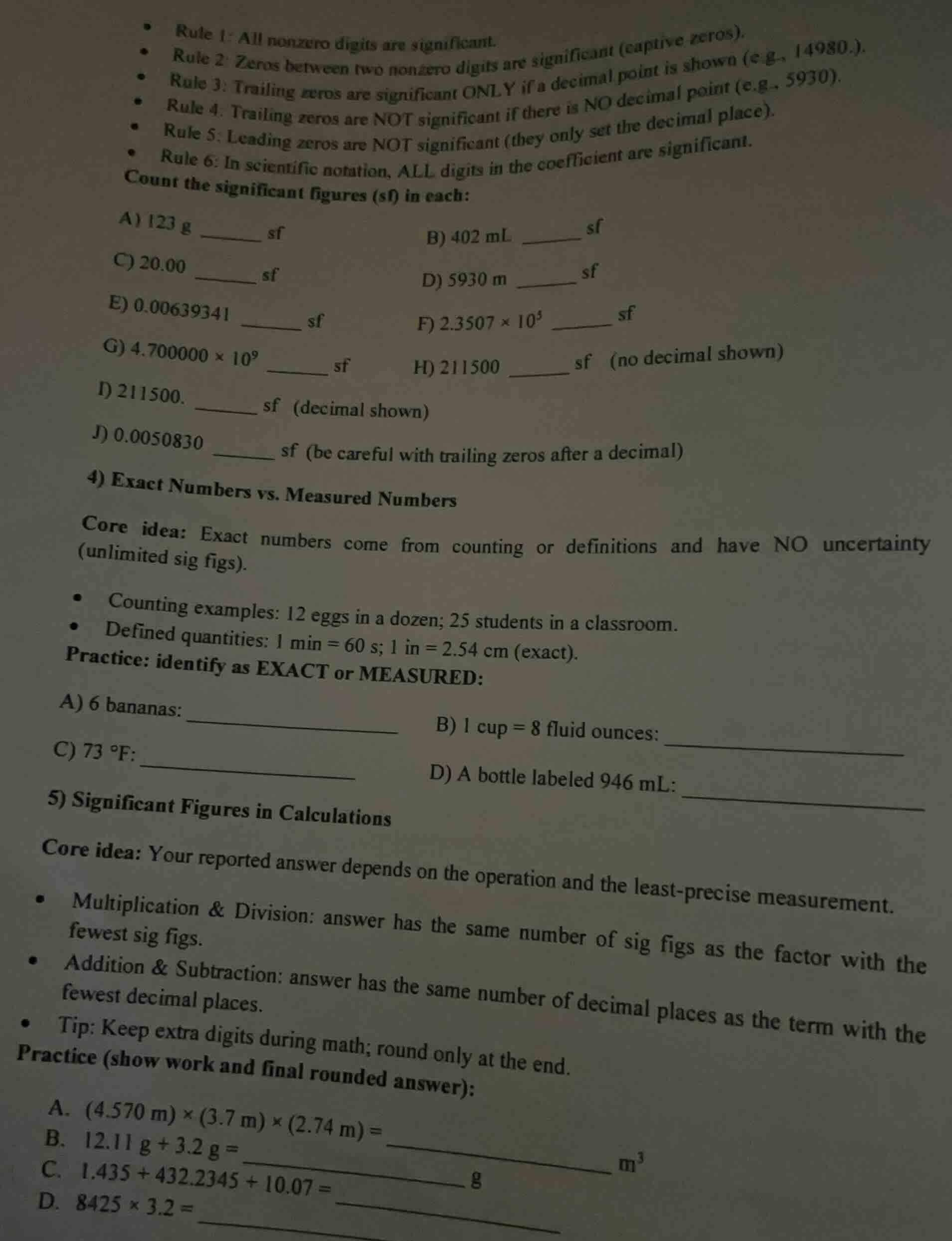
- rule 1: all nonzero digits are significant.
- rule 2: zeros between two nonzero digits are significant (captive zeros).
- rule 3: trailing zeros are significant only if a decimal point is shown (e.g., 14980.).
- rule 4: trailing zeros are not significant if there is no decimal point (e.g., 5930).
- rule 5: leading zeros are not significant (they only set the decimal place).
- rule 6: in scientific notation, all digits in the coefficient are significant.
count the significant figures (sf) in each:
a) 123 g ____ sf b) 402 ml ____ sf
c) 20.00 ____ sf d) 5930 m ____ sf
e) 0.00639341 ____ sf f) 2.3507 × 10⁵ ____ sf
g) 4.700000 × 10⁹ ____ sf h) 211500 ____ sf (no decimal shown)
i) 211500. ______ sf (decimal shown)
j) 0.0050830 ______ sf (be careful with trailing zeros after a decimal)
- exact numbers vs. measured numbers
core idea: exact numbers come from counting or definitions and have no uncertainty (unlimited sig figs).
- counting examples: 12 eggs in a dozen; 25 students in a classroom.
- defined quantities: 1 min = 60 s; 1 in = 2.54 cm (exact).
practice: identify as exact or measured:
a) 6 bananas: _____________ b) 1 cup = 8 fluid ounces: _____________
c) 73 °f: _____________ d) a bottle labeled 946 ml: _____________
- significant figures in calculations
core idea: your reported answer depends on the operation and the least - precise measurement.
- multiplication & division: answer has the same number of sig figs as the factor with the fewest sig figs.
- addition & subtraction: answer has the same number of decimal places as the term with the fewest decimal places.
- tip: keep extra digits during math; round only at the end.
practice (show work and final rounded answer):
a. (4.570 m) × (3.7 m) × (2.74 m) = ______ m³
b. 12.11 g + 3.2 g = ______ g
c. 1.435 + 432.2345 + 10.07 = ______
d. 8425 × 3.2 = ______
Part 1: Count Significant Figures
Step1: Apply sig fig rules to each value
Step2: Count valid significant figures
A) 123 g
All non-zero digits are significant (Rule 1).
Count: 3 non-zero digits
B) 402 mL
Zeros between non-zeros are significant (Rule 2).
Count: 2 non-zeros + 1 captive zero = 3
C) 20.00
Trailing zeros with decimal are significant (Rule 3).
Count: 1 non-zero + 3 trailing zeros = 4
D) 5930 m
No decimal, trailing zero not significant (Rule 4).
Count: 3 non-zero digits
E) 0.00639341
Leading zeros not significant (Rule 5).
Count: 6 non-zero digits
F) $2.3507 \times 10^5$
All coefficient digits are significant (Rule 6).
Count: 5 digits in coefficient
G) $4.700000 \times 10^9$
All coefficient digits are significant (Rule 6).
Count: 7 digits in coefficient
H) 211500 (no decimal)
No decimal, trailing zeros not significant (Rule 4).
Count: 4 non-zero/captive digits
I) 211500. (decimal shown)
Trailing zeros with decimal are significant (Rule 3).
Count: 6 digits
J) 0.0050830
Leading zeros not significant; trailing zero after decimal is significant (Rules 3,5).
Count: 1 non-zero + 1 captive zero + 2 non-zeros +1 trailing zero = 5
- Exact numbers come from counting or defined unit conversions, with no uncertainty.
- Measured numbers are obtained from measurements, with inherent uncertainty.
A) $(4.570\ \text{m}) \times (3.7\ \text{m}) \times (2.74\ \text{m})$
Step1: Calculate raw product
$4.570 \times 3.7 \times 2.74 = 46.02206$
Step2: Round to least sig figs
3.7 has 2 sig figs (fewest), so round to 2 sig figs.
B) $12.11\ \text{g} + 3.2\ \text{g}$
Step1: Calculate raw sum
$12.11 + 3.2 = 15.31$
Step2: Round to least decimal places
3.2 has 1 decimal place (fewest), so round to 1 decimal place.
C) $1.435 + 432.2345 + 10.07$
Step1: Calculate raw sum
$1.435 + 432.2345 + 10.07 = 443.7395$
Step2: Round to least decimal places
10.07 has 2 decimal places (fewest), so round to 2 decimal places.
D) $8425 \times 3.2$
Step1: Calculate raw product
$8425 \times 3.2 = 26960$
Step2: Round to least sig figs
3.2 has 2 sig figs (fewest), so round to 2 sig figs.

Snap & solve any problem in the app
Get step-by-step solutions on Sovi AI
Photo-based solutions with guided steps
Explore more problems and detailed explanations
A) 3 sf
B) 3 sf
C) 4 sf
D) 3 sf
E) 6 sf
F) 5 sf
G) 7 sf
H) 4 sf
I) 6 sf
J) 5 sf
---