QUESTION IMAGE
Question
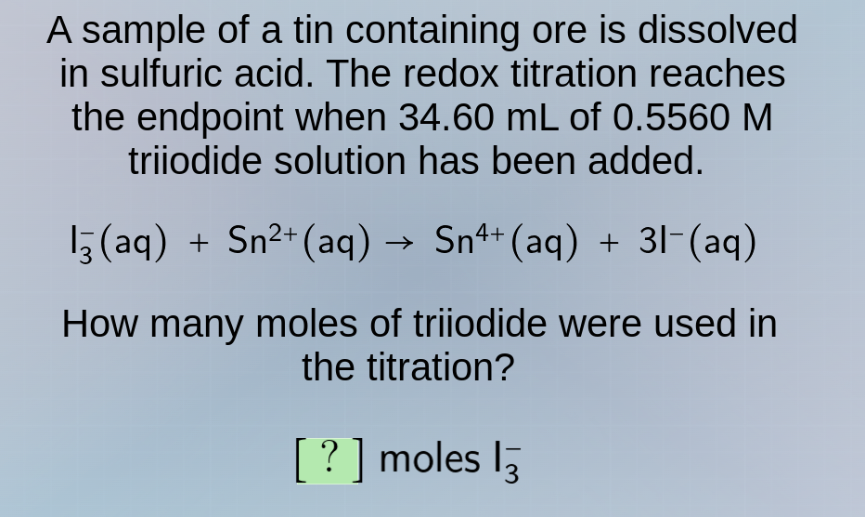
a sample of a tin containing ore is dissolved in sulfuric acid. the redox titration reaches the endpoint when 34.60 ml of 0.5560 m triiodide solution has been added.
i₃⁻(aq) + sn²⁺(aq) → sn⁴⁺(aq) + 3i⁻(aq)
how many moles of triiodide were used in the titration?
? moles i₃⁻
Step1: Recall the formula for moles from molarity and volume
The formula to calculate moles (\(n\)) from molarity (\(M\)) and volume (\(V\)) is \(n = M\times V\), where the volume should be in liters.
First, convert the volume from milliliters to liters: \(34.60\space mL=\frac{34.60}{1000}\space L = 0.03460\space L\).
Step2: Calculate the moles of triiodide
Given \(M = 0.5560\space M\) (which is \(\frac{mol}{L}\)) and \(V = 0.03460\space L\).
Using the formula \(n = M\times V\), we substitute the values:
\(n=0.5560\space\frac{mol}{L}\times0.03460\space L\)
\(n = 0.5560\times0.03460\)
\(n=0.0192376\space mol\) (we can round to appropriate significant figures, but let's check the calculation: \(0.5560\times0.03460 = 0.0192376\), which can be reported as \(0.01924\) or depending on significant figures, but let's do the exact multiplication here)

Snap & solve any problem in the app
Get step-by-step solutions on Sovi AI
Photo-based solutions with guided steps
Explore more problems and detailed explanations
\(0.01924\) (or more precisely \(0.0192376\)) moles of \(\ce{I_3^-}\) were used.