QUESTION IMAGE
Question
select the correct answer.
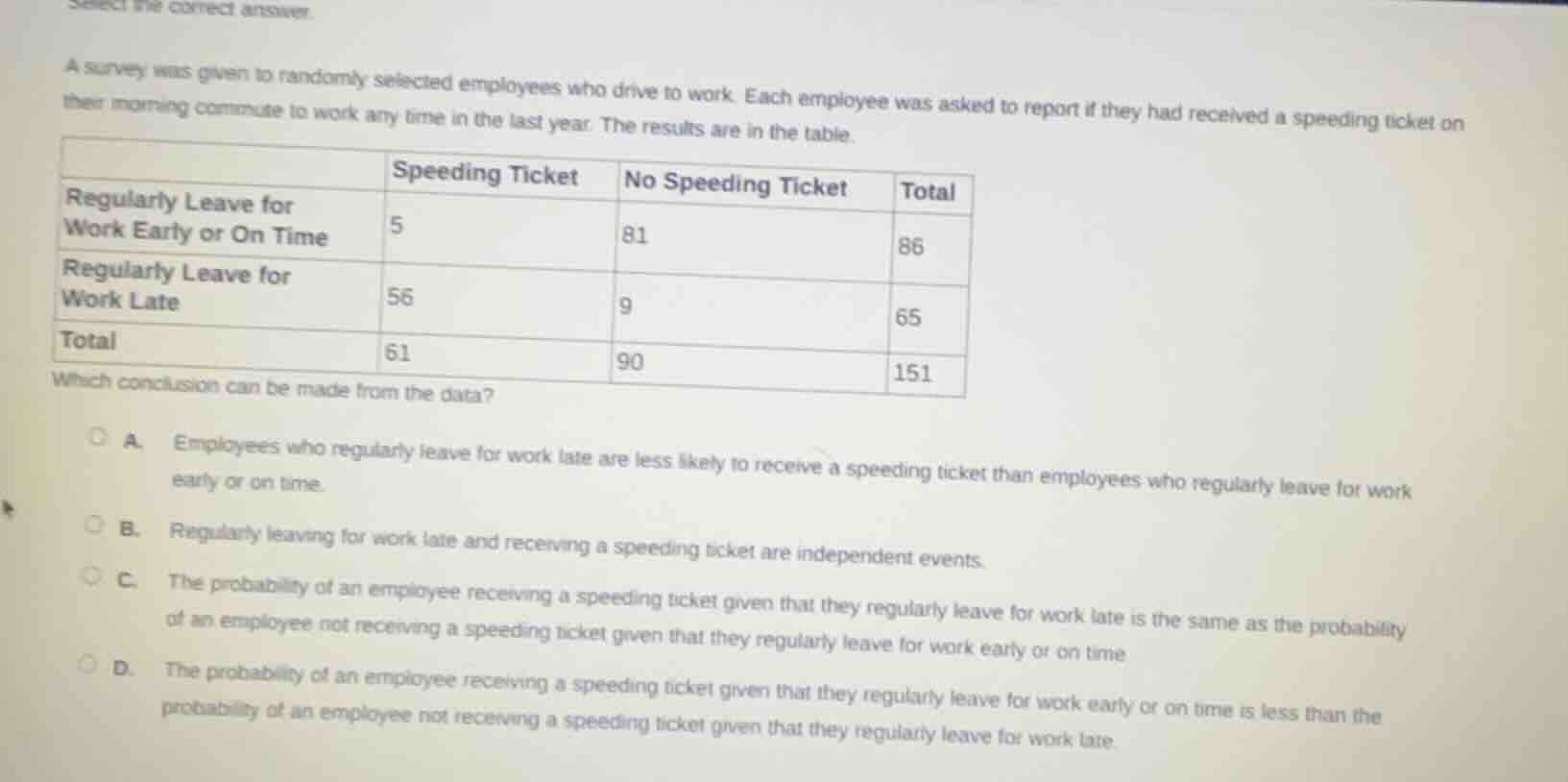
a survey was given to randomly selected employees who drive to work. each employee was asked to report if they had received a speeding ticket on their morning commute to work any time in the last year. the results are in the table.
| speeding ticket | no speeding ticket | total | |
|---|---|---|---|
| regularly leave for work late | 56 | 9 | 65 |
| total | 61 | 90 | 151 |
which conclusion can be made from the data?
a. employees who regularly leave for work late are less likely to receive a speeding ticket than employees who regularly leave for work early or on time.
b. regularly leaving for work late and receiving a speeding ticket are independent events.
c. the probability of an employee receiving a speeding ticket given that they regularly leave for work late is the same as the probability of an employee not receiving a speeding ticket given that they regularly leave for work early or on time
d. the probability of an employee receiving a speeding ticket given that they regularly leave for work early or on time is less than the probability of an employee not receiving a speeding ticket given that they regularly leave for work late.
To solve this, we calculate conditional probabilities for each option:
- Option A: Probability of speeding ticket for late leavers: \( \frac{56}{65} \approx 0.8615 \). For early/on - time leavers: \( \frac{5}{86} \approx 0.0581 \). So late leavers are more likely, A is wrong.
- Option B: Let \( A \) be "leave late" and \( B \) be "speeding ticket". \( P(A)=\frac{65}{151}\), \( P(B)=\frac{61}{151}\), \( P(A\cap B)=\frac{56}{151}\). \( P(A)\times P(B)=\frac{65\times61}{151\times151}\approx\frac{3965}{22801}\approx0.174\), \( P(A\cap B)\approx0.371\). Not equal, so not independent, B is wrong.
- Option C: Probability of speeding ticket (late): \( \frac{56}{65}\approx0.8615 \). Probability of no - speeding (early/on - time): \( \frac{81}{86}\approx0.9419 \). Not the same, C is wrong.
- Option D: Probability of speeding (early/on - time): \( \frac{5}{86}\approx0.0581 \). Probability of no - speeding (late): \( \frac{9}{65}\approx0.1385 \). \( 0.0581<0.1385 \), so this is true.

Snap & solve any problem in the app
Get step-by-step solutions on Sovi AI
Photo-based solutions with guided steps
Explore more problems and detailed explanations
D. The probability of an employee receiving a speeding ticket given that they regularly leave for work early or on time is less than the probability of an employee not receiving a speeding ticket given that they regularly leave for work late.