QUESTION IMAGE
Question
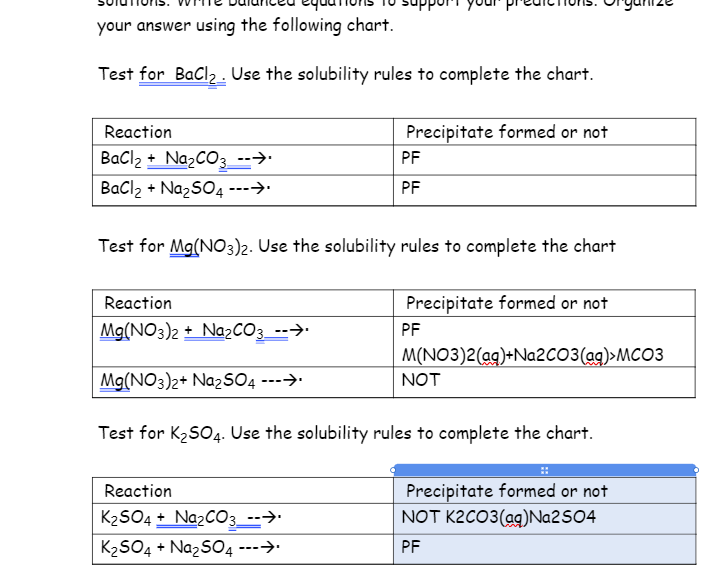
solutions. write balanced equations to support your predictions. organize your answer using the following chart.
test for bacl₂. use the solubility rules to complete the chart.
| reaction | precipitate formed or not |
|---|---|
| bacl₂ + na₂so₄ ----→· | pf |
test for mg(no₃)₂. use the solubility rules to complete the chart
| reaction | precipitate formed or not |
|---|---|
| mg(no₃)₂+ na₂so₄ ----→· | not |
test for k₂so₄. use the solubility rules to complete the chart.
| reaction | precipitate formed or not |
|---|---|
| k₂so₄ + na₂so₄ ----→· | pf |
To solve this, we analyze each reaction using solubility rules:
For \( \boldsymbol{BaCl_2} \) tests:
- \( \boldsymbol{BaCl_2 + Na_2CO_3
ightarrow} \)
- Products: \( BaCO_3 \) (solid, insoluble) and \( NaCl \) (aqueous).
- Precipitate: \( BaCO_3 \) forms (PF).
- Balanced equation: \( BaCl_2(aq) + Na_2CO_3(aq) = BaCO_3(s) + 2NaCl(aq) \).
- \( \boldsymbol{BaCl_2 + Na_2SO_4
ightarrow} \)
- Products: \( BaSO_4 \) (solid, insoluble) and \( NaCl \) (aqueous).
- Precipitate: \( BaSO_4 \) forms (PF).
- Balanced equation: \( BaCl_2(aq) + Na_2SO_4(aq) = BaSO_4(s) + 2NaCl(aq) \).
For \( \boldsymbol{Mg(NO_3)_2} \) tests:
- \( \boldsymbol{Mg(NO_3)_2 + Na_2CO_3
ightarrow} \)
- Products: \( MgCO_3 \) (solid, insoluble) and \( NaNO_3 \) (aqueous).
- Precipitate: \( MgCO_3 \) forms (PF).
- Balanced equation: \( Mg(NO_3)_2(aq) + Na_2CO_3(aq) = MgCO_3(s) + 2NaNO_3(aq) \).
- \( \boldsymbol{Mg(NO_3)_2 + Na_2SO_4
ightarrow} \)
- Products: \( MgSO_4 \) (aqueous, soluble) and \( NaNO_3 \) (aqueous).
- Precipitate: None (NOT).
- Balanced equation: \( Mg(NO_3)_2(aq) + Na_2SO_4(aq) = MgSO_4(aq) + 2NaNO_3(aq) \).
For \( \boldsymbol{K_2SO_4} \) tests:
- \( \boldsymbol{K_2SO_4 + Na_2CO_3
ightarrow} \)
- Products: \( K_2CO_3 \) (aqueous, soluble) and \( Na_2SO_4 \) (aqueous, soluble).
- Precipitate: None (NOT).
- Balanced equation: \( K_2SO_4(aq) + Na_2CO_3(aq) = K_2CO_3(aq) + Na_2SO_4(aq) \).
- \( \boldsymbol{K_2SO_4 + Na_2SO_4
ightarrow} \)
- These are both sulfates of Group 1 metals (K⁺, Na⁺), which are soluble. No reaction occurs (mixing two soluble salts with same anion/cation).
- Precipitate: None (NOT, correction: The original “PF” is incorrect—no reaction means no precipitate).
Final Chart (with corrections for \( \boldsymbol{K_2SO_4 + Na_2SO_4} \)):
| Test for Compound | Reaction | Precipitate Formed? | Balanced Equation |
|---|---|---|---|
| \( BaCl_2 \) | \( BaCl_2 + Na_2SO_4 \) | PF | \( BaCl_2 + Na_2SO_4 = BaSO_4 \downarrow + 2NaCl \) |
| \( Mg(NO_3)_2 \) | \( Mg(NO_3)_2 + Na_2CO_3 \) | PF | \( Mg(NO_3)_2 + Na_2CO_3 = MgCO_3 \downarrow + 2NaNO_3 \) |
| \( Mg(NO_3)_2 \) | \( Mg(NO_3)_2 + Na_2SO_4 \) | NOT | \( Mg(NO_3)_2 + Na_2SO_4 = MgSO_4 + 2NaNO_3 \) |
| \( K_2SO_4 \) | \( K_2SO_4 + Na_2CO_3 \) | NOT | \( K_2SO_4 + Na_2CO_3 = K_2CO_3 + Na_2SO_4 \) |
| \( K_2SO_4 \) | \( K_2SO_4 + Na_2SO_4 \) | NOT | No reaction (same anion/cation, no precipitate) |
(Note: The original “PF” for \( K_2SO_4 + Na_2SO_4 \) is incorrect—no reaction occurs between two soluble salts with identical ions.)

Snap & solve any problem in the app
Get step-by-step solutions on Sovi AI
Photo-based solutions with guided steps
Explore more problems and detailed explanations
To solve this, we analyze each reaction using solubility rules:
For \( \boldsymbol{BaCl_2} \) tests:
- \( \boldsymbol{BaCl_2 + Na_2CO_3
ightarrow} \)
- Products: \( BaCO_3 \) (solid, insoluble) and \( NaCl \) (aqueous).
- Precipitate: \( BaCO_3 \) forms (PF).
- Balanced equation: \( BaCl_2(aq) + Na_2CO_3(aq) = BaCO_3(s) + 2NaCl(aq) \).
- \( \boldsymbol{BaCl_2 + Na_2SO_4
ightarrow} \)
- Products: \( BaSO_4 \) (solid, insoluble) and \( NaCl \) (aqueous).
- Precipitate: \( BaSO_4 \) forms (PF).
- Balanced equation: \( BaCl_2(aq) + Na_2SO_4(aq) = BaSO_4(s) + 2NaCl(aq) \).
For \( \boldsymbol{Mg(NO_3)_2} \) tests:
- \( \boldsymbol{Mg(NO_3)_2 + Na_2CO_3
ightarrow} \)
- Products: \( MgCO_3 \) (solid, insoluble) and \( NaNO_3 \) (aqueous).
- Precipitate: \( MgCO_3 \) forms (PF).
- Balanced equation: \( Mg(NO_3)_2(aq) + Na_2CO_3(aq) = MgCO_3(s) + 2NaNO_3(aq) \).
- \( \boldsymbol{Mg(NO_3)_2 + Na_2SO_4
ightarrow} \)
- Products: \( MgSO_4 \) (aqueous, soluble) and \( NaNO_3 \) (aqueous).
- Precipitate: None (NOT).
- Balanced equation: \( Mg(NO_3)_2(aq) + Na_2SO_4(aq) = MgSO_4(aq) + 2NaNO_3(aq) \).
For \( \boldsymbol{K_2SO_4} \) tests:
- \( \boldsymbol{K_2SO_4 + Na_2CO_3
ightarrow} \)
- Products: \( K_2CO_3 \) (aqueous, soluble) and \( Na_2SO_4 \) (aqueous, soluble).
- Precipitate: None (NOT).
- Balanced equation: \( K_2SO_4(aq) + Na_2CO_3(aq) = K_2CO_3(aq) + Na_2SO_4(aq) \).
- \( \boldsymbol{K_2SO_4 + Na_2SO_4
ightarrow} \)
- These are both sulfates of Group 1 metals (K⁺, Na⁺), which are soluble. No reaction occurs (mixing two soluble salts with same anion/cation).
- Precipitate: None (NOT, correction: The original “PF” is incorrect—no reaction means no precipitate).
Final Chart (with corrections for \( \boldsymbol{K_2SO_4 + Na_2SO_4} \)):
| Test for Compound | Reaction | Precipitate Formed? | Balanced Equation |
|---|---|---|---|
| \( BaCl_2 \) | \( BaCl_2 + Na_2SO_4 \) | PF | \( BaCl_2 + Na_2SO_4 = BaSO_4 \downarrow + 2NaCl \) |
| \( Mg(NO_3)_2 \) | \( Mg(NO_3)_2 + Na_2CO_3 \) | PF | \( Mg(NO_3)_2 + Na_2CO_3 = MgCO_3 \downarrow + 2NaNO_3 \) |
| \( Mg(NO_3)_2 \) | \( Mg(NO_3)_2 + Na_2SO_4 \) | NOT | \( Mg(NO_3)_2 + Na_2SO_4 = MgSO_4 + 2NaNO_3 \) |
| \( K_2SO_4 \) | \( K_2SO_4 + Na_2CO_3 \) | NOT | \( K_2SO_4 + Na_2CO_3 = K_2CO_3 + Na_2SO_4 \) |
| \( K_2SO_4 \) | \( K_2SO_4 + Na_2SO_4 \) | NOT | No reaction (same anion/cation, no precipitate) |
(Note: The original “PF” for \( K_2SO_4 + Na_2SO_4 \) is incorrect—no reaction occurs between two soluble salts with identical ions.)