QUESTION IMAGE
Question
standard deviation
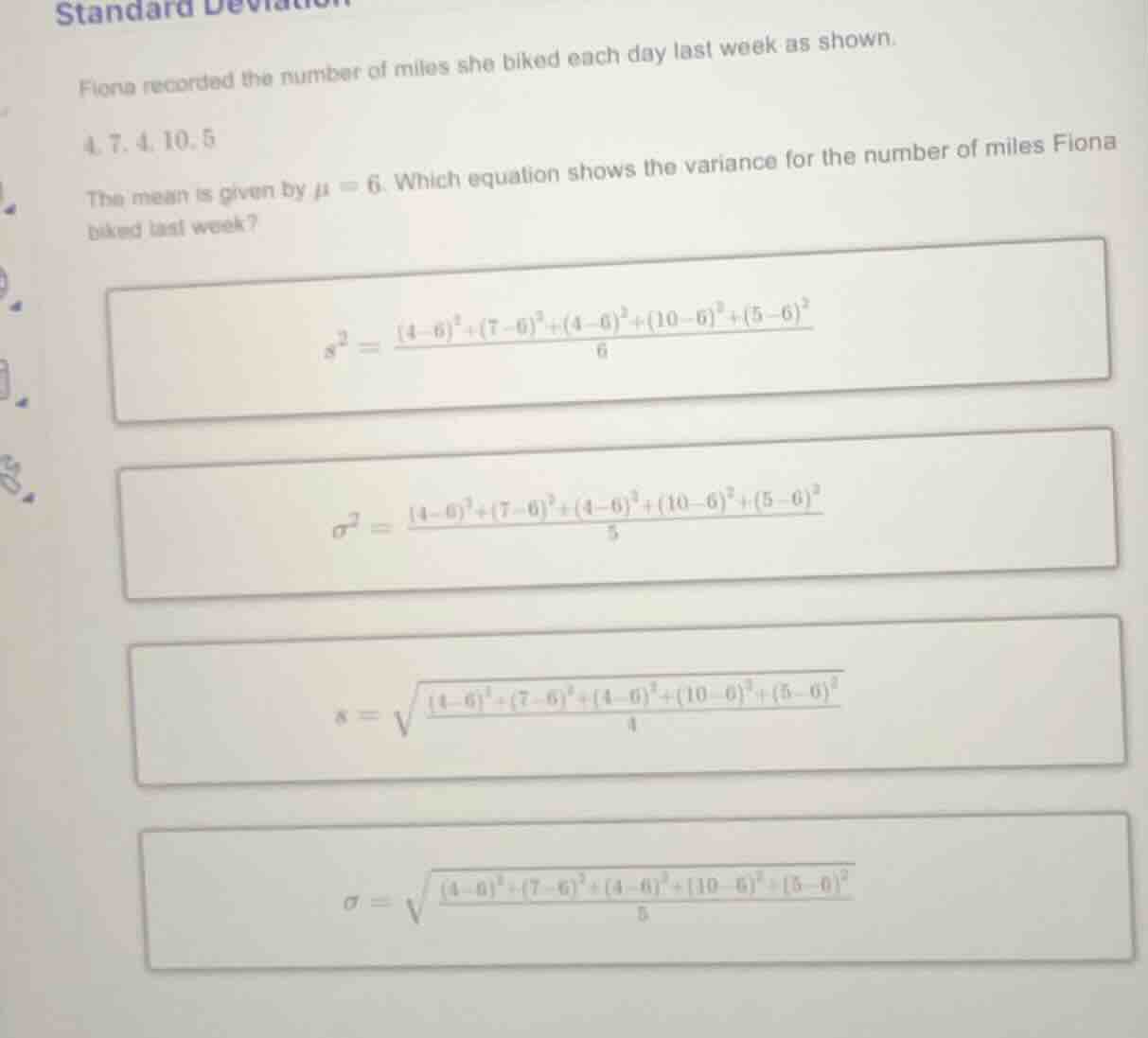
fiona recorded the number of miles she biked each day last week as shown.
4, 7, 4, 10, 5
the mean is given by \\( \mu = 6 \\). which equation shows the variance for the number of miles fiona biked last week?
\\( s^2 = \frac{(4 - 6)^2 + (7 - 6)^2 + (4 - 6)^2 + (10 - 6)^2 + (5 - 6)^2}{6} \\)
\\( \sigma^2 = \frac{(4 - 6)^2 + (7 - 6)^2 + (4 - 6)^2 + (10 - 6)^2 + (5 - 6)^2}{5} \\)
\\( s = \sqrt{\frac{(4 - 6)^2 + (7 - 6)^2 + (4 - 6)^2 + (10 - 6)^2 + (5 - 6)^2}{4}} \\)
\\( \sigma = \sqrt{\frac{(4 - 6)^2 + (7 - 6)^2 + (4 - 6)^2 + (10 - 6)^2 + (5 - 6)^2}{5}} \\)
Step1: Recall Variance Formula
Variance for a population (denoted by \(\sigma^2\)) is calculated as the average of the squared differences from the Mean. The formula is \(\sigma^2=\frac{\sum_{i = 1}^{n}(x_i-\mu)^2}{n}\), where \(n\) is the number of data points, \(x_i\) are the data points, and \(\mu\) is the mean.
Step2: Identify Data Points and \(n\)
The data points are \(4,7,4,10,5\), so \(n = 5\). The mean \(\mu=6\).
Step3: Analyze Each Option
- Option 1: Uses \(s^2\) (sample variance) and divides by 6, but \(n = 5\) and we use population variance here (since we have all data of the week), so wrong.
- Option 2: Uses \(\sigma^2\) (population variance), sums \((4 - 6)^2+(7 - 6)^2+(4 - 6)^2+(10 - 6)^2+(5 - 6)^2\) (squared differences from mean) and divides by \(n = 5\), which matches the formula.
- Option 3: Calculates standard deviation (\(s\)) and has wrong denominator, so wrong.
- Option 4: Calculates standard deviation (\(\sigma\)) instead of variance, so wrong.

Snap & solve any problem in the app
Get step-by-step solutions on Sovi AI
Photo-based solutions with guided steps
Explore more problems and detailed explanations
\(\boldsymbol{\sigma^2=\frac{(4 - 6)^2+(7 - 6)^2+(4 - 6)^2+(10 - 6)^2+(5 - 6)^2}{5}}\) (the second option)