QUESTION IMAGE
Question
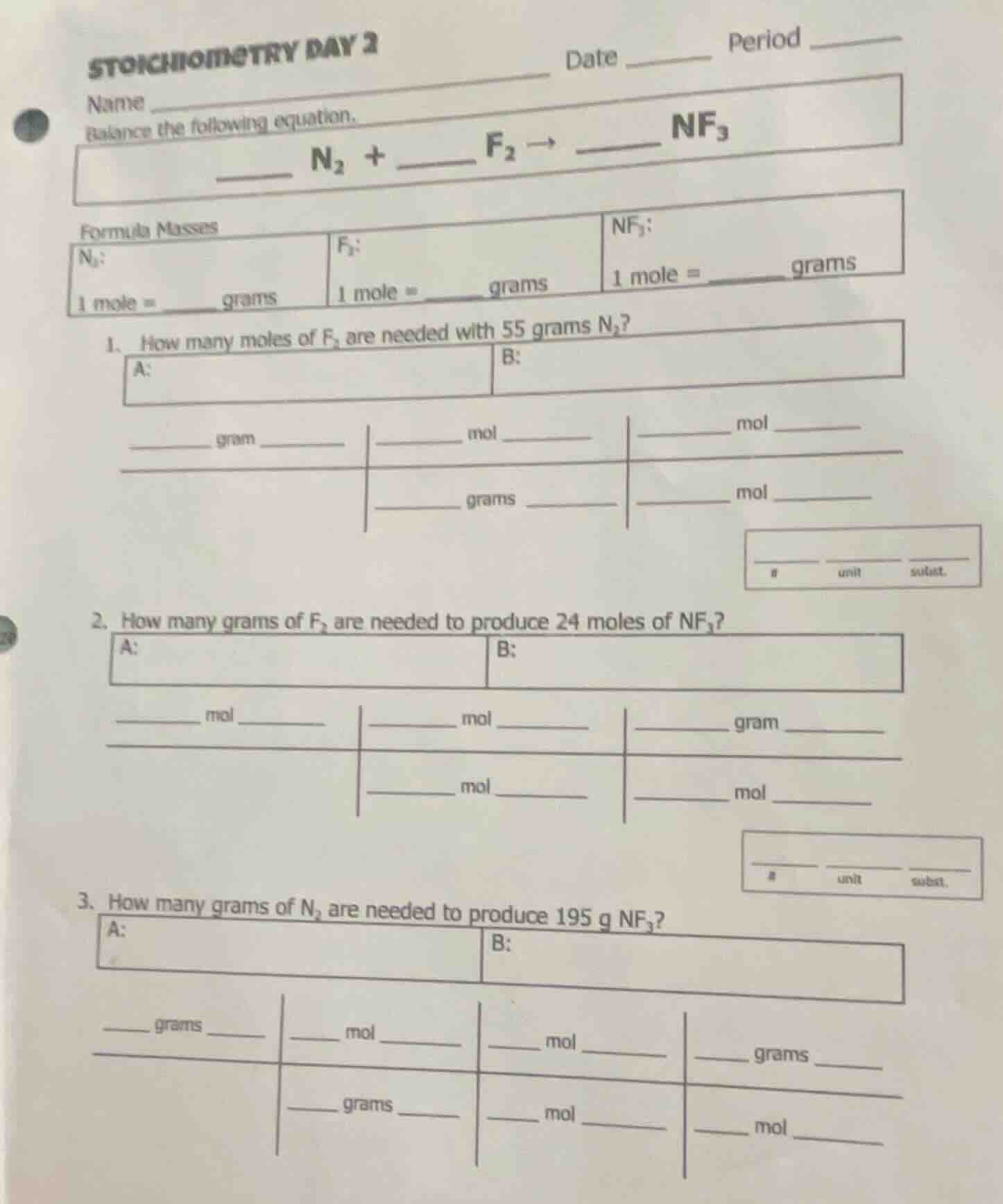
stoichiometry day 2
name
date
period
balance the following equation.
____ $\ce{n_{2}}$ + ____ $\ce{f_{2}}$ $\
ightarrow$ ______ $\ce{nf_{3}}$
formula masses
$\ce{n_{2}}$:
1 mole = ______ grams
$\ce{f_{2}}$:
1 mole = ______ grams
$\ce{nf_{3}}$:
1 mole = ______ grams
- how many moles of $\ce{f_{2}}$ are needed with 55 grams $\ce{n_{2}}$?
a:
b:
____ gram ____
____ grams ____
| ____ mol ____
____ mol ____
| ____ mol ____
____ mol ____
- how many grams of $\ce{f_{2}}$ are needed to produce 24 moles of $\ce{nf_{3}}$?
a:
b:
____ mol ____
____ mol ____
| ____ gram ____
____ mol ____
| ____ mol ____
- how many grams of $\ce{n_{2}}$ are needed to produce 195 g $\ce{nf_{3}}$?
a:
b:
____ grams ____
____ grams ____
| ____ mol ____
____ mol ____
| ____ mol ____
____ mol ____
| ____ grams ____
____ mol ____
Part 1: Balance the Equation
First, we balance the chemical equation \( \text{N}_2 + \text{F}_2
ightarrow \text{NF}_3 \).
Step 1: Balance Nitrogen (N)
On the left, we have 2 N atoms (from \( \text{N}_2 \)). On the right, each \( \text{NF}_3 \) has 1 N atom. So we need 2 \( \text{NF}_3 \) to balance N:
\( \text{N}_2 + \text{F}_2
ightarrow 2\text{NF}_3 \)
Step 2: Balance Fluorine (F)
On the right, \( 2\text{NF}_3 \) has \( 2 \times 3 = 6 \) F atoms. On the left, \( \text{F}_2 \) has 2 F atoms per molecule. So we need 3 \( \text{F}_2 \) to get 6 F atoms:
\( \text{N}_2 + 3\text{F}_2
ightarrow 2\text{NF}_3 \)
Part 2: Formula Masses
- \( \text{N}_2 \): Molar mass of N is 14.01 g/mol, so \( \text{N}_2 = 2 \times 14.01 = 28.02 \) g/mol.
- \( \text{F}_2 \): Molar mass of F is 19.00 g/mol, so \( \text{F}_2 = 2 \times 19.00 = 38.00 \) g/mol.
- \( \text{NF}_3 \): Molar mass = \( 14.01 + 3 \times 19.00 = 14.01 + 57.00 = 71.01 \) g/mol.
Question 1: Moles of \( \text{F}_2 \) with 55 g \( \text{N}_2 \)
Step 1: Moles of \( \text{N}_2 \)
Moles of \( \text{N}_2 = \frac{\text{mass of } \text{N}_2}{\text{molar mass of } \text{N}_2} = \frac{55\ \text{g}}{28.02\ \text{g/mol}} \approx 1.96\ \text{mol} \)
Step 2: Moles of \( \text{F}_2 \) (mole ratio)
From the balanced equation, \( 1\ \text{mol}\ \text{N}_2 \) reacts with \( 3\ \text{mol}\ \text{F}_2 \).
Moles of \( \text{F}_2 = 1.96\ \text{mol}\ \text{N}_2 \times \frac{3\ \text{mol}\ \text{F}_2}{1\ \text{mol}\ \text{N}_2} \approx 5.88\ \text{mol} \)
Question 2: Grams of \( \text{F}_2 \) to produce 24 mol \( \text{NF}_3 \)
Step 1: Moles of \( \text{F}_2 \) (mole ratio)
From the balanced equation, \( 2\ \text{mol}\ \text{NF}_3 \) requires \( 3\ \text{mol}\ \text{F}_2 \).
Moles of \( \text{F}_2 = 24\ \text{mol}\ \text{NF}_3 \times \frac{3\ \text{mol}\ \text{F}_2}{2\ \text{mol}\ \text{NF}_3} = 36\ \text{mol}\ \text{F}_2 \)
Step 2: Grams of \( \text{F}_2 \)
Mass of \( \text{F}_2 = \text{moles} \times \text{molar mass} = 36\ \text{mol} \times 38.00\ \text{g/mol} = 1368\ \text{g} \)
Question 3: Grams of \( \text{N}_2 \) to produce 195 g \( \text{NF}_3 \)
Step 1: Moles of \( \text{NF}_3 \)
Moles of \( \text{NF}_3 = \frac{195\ \text{g}}{71.01\ \text{g/mol}} \approx 2.746\ \text{mol} \)
Step 2: Moles of \( \text{N}_2 \) (mole ratio)
From the balanced equation, \( 2\ \text{mol}\ \text{NF}_3 \) requires \( 1\ \text{mol}\ \text{N}_2 \).
Moles of \( \text{N}_2 = 2.746\ \text{mol}\ \text{NF}_3 \times \frac{1\ \text{mol}\ \text{N}_2}{2\ \text{mol}\ \text{NF}_3} \approx 1.373\ \text{mol} \)
Step 3: Grams of \( \text{N}_2 \)
Mass of \( \text{N}_2 = 1.373\ \text{mol} \times 28.02\ \text{g/mol} \approx 38.47\ \text{g} \)
Final Answers
- Balanced Equation: \( \boldsymbol{1}\ \text{N}_2 + \boldsymbol{3}\ \text{F}_2
ightarrow \boldsymbol{2}\ \text{NF}_3 \)
- Formula Masses:
- \( \text{N}_2 \): 28.02 g/mol
- \( \text{F}_2 \): 38.00 g/mol
- \( \text{NF}_3 \): 71.01 g/mol
- Question 1: \( \approx 5.88\ \text{mol}\ \text{F}_2 \)
- Question 2: \( 1368\ \text{g}\ \text{F}_2 \)
- Question 3: \( \approx 38.5\ \text{g}\ \text{N}_2 \)

Snap & solve any problem in the app
Get step-by-step solutions on Sovi AI
Photo-based solutions with guided steps
Explore more problems and detailed explanations
Part 1: Balance the Equation
First, we balance the chemical equation \( \text{N}_2 + \text{F}_2
ightarrow \text{NF}_3 \).
Step 1: Balance Nitrogen (N)
On the left, we have 2 N atoms (from \( \text{N}_2 \)). On the right, each \( \text{NF}_3 \) has 1 N atom. So we need 2 \( \text{NF}_3 \) to balance N:
\( \text{N}_2 + \text{F}_2
ightarrow 2\text{NF}_3 \)
Step 2: Balance Fluorine (F)
On the right, \( 2\text{NF}_3 \) has \( 2 \times 3 = 6 \) F atoms. On the left, \( \text{F}_2 \) has 2 F atoms per molecule. So we need 3 \( \text{F}_2 \) to get 6 F atoms:
\( \text{N}_2 + 3\text{F}_2
ightarrow 2\text{NF}_3 \)
Part 2: Formula Masses
- \( \text{N}_2 \): Molar mass of N is 14.01 g/mol, so \( \text{N}_2 = 2 \times 14.01 = 28.02 \) g/mol.
- \( \text{F}_2 \): Molar mass of F is 19.00 g/mol, so \( \text{F}_2 = 2 \times 19.00 = 38.00 \) g/mol.
- \( \text{NF}_3 \): Molar mass = \( 14.01 + 3 \times 19.00 = 14.01 + 57.00 = 71.01 \) g/mol.
Question 1: Moles of \( \text{F}_2 \) with 55 g \( \text{N}_2 \)
Step 1: Moles of \( \text{N}_2 \)
Moles of \( \text{N}_2 = \frac{\text{mass of } \text{N}_2}{\text{molar mass of } \text{N}_2} = \frac{55\ \text{g}}{28.02\ \text{g/mol}} \approx 1.96\ \text{mol} \)
Step 2: Moles of \( \text{F}_2 \) (mole ratio)
From the balanced equation, \( 1\ \text{mol}\ \text{N}_2 \) reacts with \( 3\ \text{mol}\ \text{F}_2 \).
Moles of \( \text{F}_2 = 1.96\ \text{mol}\ \text{N}_2 \times \frac{3\ \text{mol}\ \text{F}_2}{1\ \text{mol}\ \text{N}_2} \approx 5.88\ \text{mol} \)
Question 2: Grams of \( \text{F}_2 \) to produce 24 mol \( \text{NF}_3 \)
Step 1: Moles of \( \text{F}_2 \) (mole ratio)
From the balanced equation, \( 2\ \text{mol}\ \text{NF}_3 \) requires \( 3\ \text{mol}\ \text{F}_2 \).
Moles of \( \text{F}_2 = 24\ \text{mol}\ \text{NF}_3 \times \frac{3\ \text{mol}\ \text{F}_2}{2\ \text{mol}\ \text{NF}_3} = 36\ \text{mol}\ \text{F}_2 \)
Step 2: Grams of \( \text{F}_2 \)
Mass of \( \text{F}_2 = \text{moles} \times \text{molar mass} = 36\ \text{mol} \times 38.00\ \text{g/mol} = 1368\ \text{g} \)
Question 3: Grams of \( \text{N}_2 \) to produce 195 g \( \text{NF}_3 \)
Step 1: Moles of \( \text{NF}_3 \)
Moles of \( \text{NF}_3 = \frac{195\ \text{g}}{71.01\ \text{g/mol}} \approx 2.746\ \text{mol} \)
Step 2: Moles of \( \text{N}_2 \) (mole ratio)
From the balanced equation, \( 2\ \text{mol}\ \text{NF}_3 \) requires \( 1\ \text{mol}\ \text{N}_2 \).
Moles of \( \text{N}_2 = 2.746\ \text{mol}\ \text{NF}_3 \times \frac{1\ \text{mol}\ \text{N}_2}{2\ \text{mol}\ \text{NF}_3} \approx 1.373\ \text{mol} \)
Step 3: Grams of \( \text{N}_2 \)
Mass of \( \text{N}_2 = 1.373\ \text{mol} \times 28.02\ \text{g/mol} \approx 38.47\ \text{g} \)
Final Answers
- Balanced Equation: \( \boldsymbol{1}\ \text{N}_2 + \boldsymbol{3}\ \text{F}_2
ightarrow \boldsymbol{2}\ \text{NF}_3 \)
- Formula Masses:
- \( \text{N}_2 \): 28.02 g/mol
- \( \text{F}_2 \): 38.00 g/mol
- \( \text{NF}_3 \): 71.01 g/mol
- Question 1: \( \approx 5.88\ \text{mol}\ \text{F}_2 \)
- Question 2: \( 1368\ \text{g}\ \text{F}_2 \)
- Question 3: \( \approx 38.5\ \text{g}\ \text{N}_2 \)