QUESTION IMAGE
Question
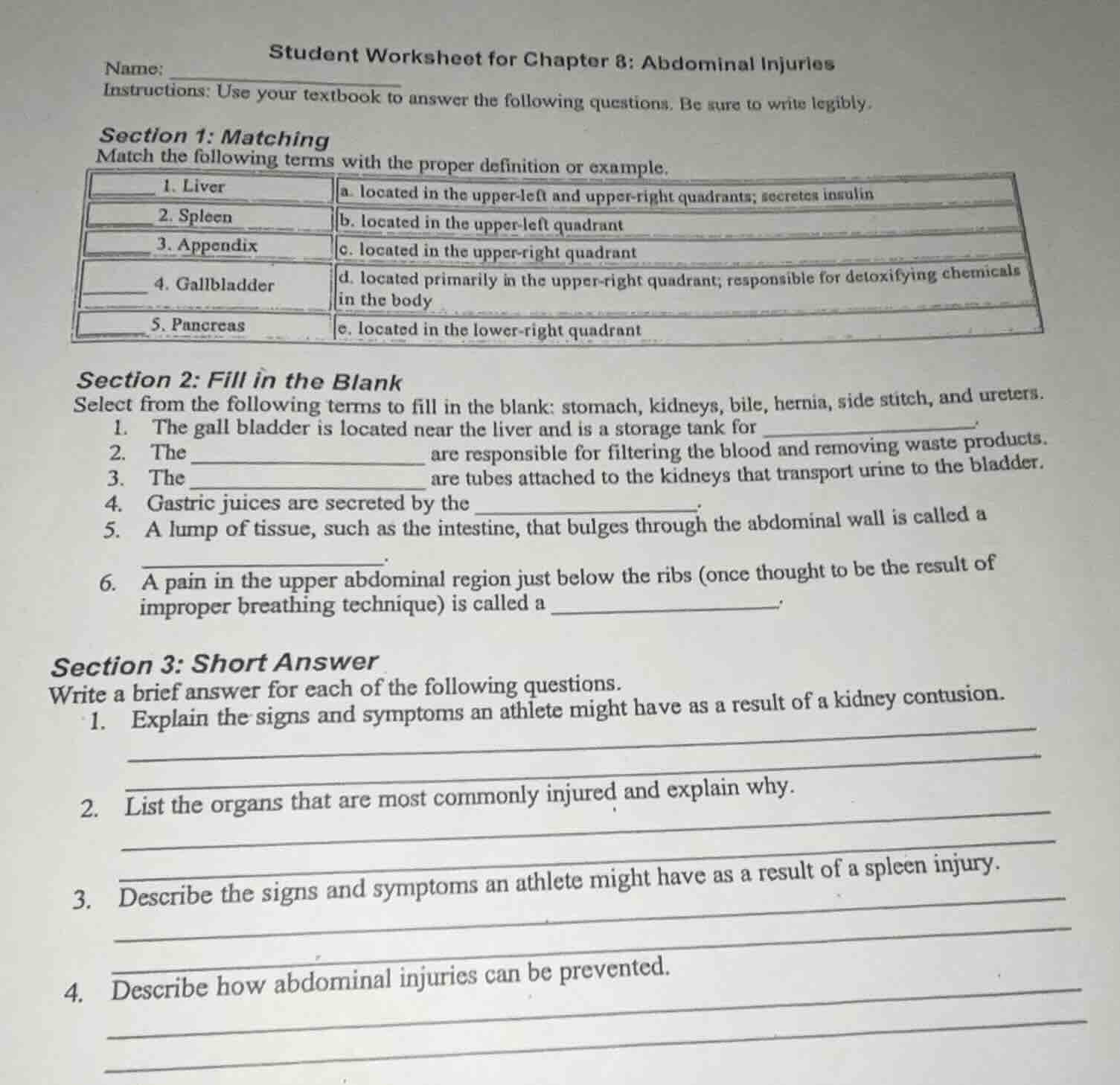
student worksheet for chapter 8: abdominal injuries
name:
instructions: use your textbook to answer the following questions. be sure to write legibly.
section 1: matching
match the following terms with the proper definition or example.
- liver a. located in the upper - left and upper - right quadrants; secretes insulin
- spleen b. located in the upper - left quadrant
- appendix c. located in the upper - right quadrant
- gallbladder d. located primarily in the upper - right quadrant; responsible for detoxifying chemicals in the body
- pancreas e. located in the lower - right quadrant
section 2: fill in the blank
select from the following terms to fill in the blank: stomach, kidneys, bile, hernia, side stitch, and ureters.
- the gall bladder is located near the liver and is a storage tank for ________.
- the ________ are responsible for filtering the blood and removing waste products.
- the ________ are tubes attached to the kidneys that transport urine to the bladder.
- gastric juices are secreted by the ________.
- a lump of tissue, such as the intestine, that bulges through the abdominal wall is called a ________.
- a pain in the upper abdominal region just below the ribs (once thought to be the result of improper breathing technique) is called a ________.
section 3: short answer
write a brief answer for each of the following questions.
- explain the signs and symptoms an athlete might have as a result of a kidney contusion.
- list the organs that are most commonly injured and explain why.
- describe the signs and symptoms an athlete might have as a result of a spleen injury.
- describe how abdominal injuries can be prevented.
Response
Section 1: Matching
- Liver: d (The liver is in the upper - right quadrant and detoxifies chemicals).
- Spleen: b (The spleen is in the upper - left quadrant).
- Appendix: e (The appendix is in the lower - right quadrant).
- Gallbladder: c (The gallbladder is in the upper - right quadrant, near the liver).
- Pancreas: a (The pancreas is in both upper - left and upper - right quadrants and secretes insulin).
Section 2: Fill in the Blank
- The gall bladder is a storage tank for \( \boldsymbol{\text{bile}} \) (The gallbladder stores bile produced by the liver).
- The \( \boldsymbol{\text{kidneys}} \) filter blood and remove waste (Kidneys are the main excretory organs for blood filtration).
- The \( \boldsymbol{\text{ureters}} \) transport urine to the bladder (Ureters are the tubes connecting kidneys to the bladder).
- Gastric juices are secreted by the \( \boldsymbol{\text{stomach}} \) (The stomach lining secretes gastric juices for digestion).
- A lump of tissue bulging through the abdominal wall is a \( \boldsymbol{\text{hernia}} \) (Definition of a hernia).
- Pain below the ribs in the upper abdomen is a \( \boldsymbol{\text{side stitch}} \) (A side stitch is this type of abdominal pain).
Section 3: Short Answer (Sample Answers)
- Kidney Contusion Symptoms:
- Pain in the lower back/abdomen.
- Blood in urine (hematuria).
- Tenderness over the kidney area.
- Possible nausea or vomiting.
- Commonly Injured Organs:
- Spleen: It’s relatively unprotected (left upper abdomen) and can rupture with trauma.
- Liver: Large, in the upper - right; trauma can cause laceration/bleeding.
- Kidneys: In the back, vulnerable to blunt force (e.g., in contact sports).
- Spleen Injury Symptoms:
- Left - sided abdominal pain.
- Pain radiating to the left shoulder (Kehr’s sign).
- Tenderness over the spleen area.
- Signs of internal bleeding (pale skin, rapid pulse, low blood pressure).
- Preventing Abdominal Injuries:
- Use protective gear (e.g., in contact sports: padding, helmets).
- Proper warm - up/cool - down to avoid muscle strains (which can lead to abdominal issues).
- Maintain good core strength to support abdominal organs.
- Avoid risky movements (e.g., excessive twisting) in sports.

Snap & solve any problem in the app
Get step-by-step solutions on Sovi AI
Photo-based solutions with guided steps
Explore more problems and detailed explanations
s (Condensed for Each Section)
Section 1
- d
- b
- e
- c
- a
Section 2
- bile
- kidneys
- ureters
- stomach
- hernia
- side stitch