QUESTION IMAGE
Question
think it over
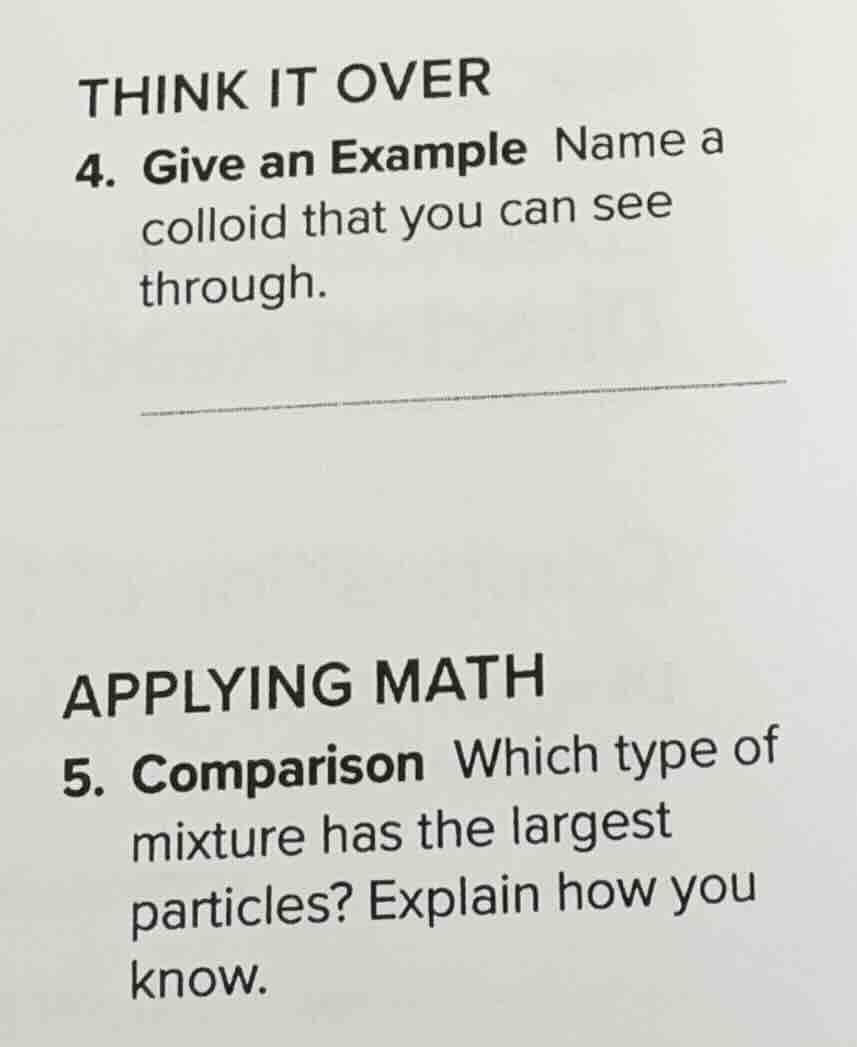
- give an example name a colloid that you can see through.
applying math
- comparison which type of mixture has the largest particles? explain how you know.
Question 4
A colloid that is transparent (can be seen through) is a sol like gelatin in water (a hydrophilic colloid) or air (aerosol, though gaseous colloids can be transparent). A common example is a solution of gelatin in water when it's in a liquid state (before setting), or more typically, a substance like fog is not, but a true solution - wait, no, colloids like a starch solution (when dilute) or a protein solution. But a classic example of a transparent colloid is a solution of gelatin in water (liquid gelatin) or a sugar - free Jell - O mix in water before it gels. However, the most common example is a solution of sodium chloride is a true solution, but a colloid like a dilute starch solution. Wait, actually, a colloid that is transparent is called a "sol" and a common example is water with a small amount of gelatin dissolved (liquid gelatin) or air (which is a colloid of gas in gas, but that's a special case). Another example is a solution of egg white in water (before beating). But the most standard example is a solution of gelatin in water (when it's in the liquid phase, not gelled) or a dilute starch solution. However, the best - known example of a transparent colloid is a solution of gelatin in water (liquid gelatin) or a substance like a soap solution (though soap solutions can be colloidal). But the most common answer is a solution of gelatin in water (liquid gelatin) or a sugar - free Jell - O mixture in water before it solidifies.
Mixtures are classified into solutions, colloids, and suspensions.
- Solutions: The particle size in a solution is very small, typically less than 1 nm. The particles are individual ions or molecules, and they are so small that they do not scatter light (Tyndall effect is not observed) and pass through filter paper and semi - permeable membranes.
- Colloids: The particle size in a colloid ranges from 1 nm to 1000 nm. The particles are larger than in a solution but still small enough to remain dispersed and not settle out quickly. They show the Tyndall effect (scattering of light) and can pass through filter paper but not through semi - permeable membranes.
- Suspensions: The particle size in a suspension is greater than 1000 nm. The particles are large enough to be seen with the naked eye (in some cases) or at least under a microscope. They do not pass through filter paper (can be separated by filtration) and settle out over time due to gravity.
So, by comparing the particle sizes of solutions (less than 1 nm), colloids (1 - 1000 nm), and suspensions (greater than 1000 nm), we can see that suspensions have the largest particles. We know this because of the definitions of the three types of mixtures: solutions have particles too small to be seen or filtered, colloids have particles that are larger than in solutions but still small enough to stay dispersed and pass through filters, and suspensions have particles large enough to be filtered out and settle due to gravity.

Snap & solve any problem in the app
Get step-by-step solutions on Sovi AI
Photo-based solutions with guided steps
Explore more problems and detailed explanations
A common example of a colloid that you can see through is a dilute gelatin solution (liquid gelatin) or a starch solution (when dilute). (A more precise example is a hydrophilic colloid like a solution of gelatin in water in its liquid state.)