QUESTION IMAGE
Question
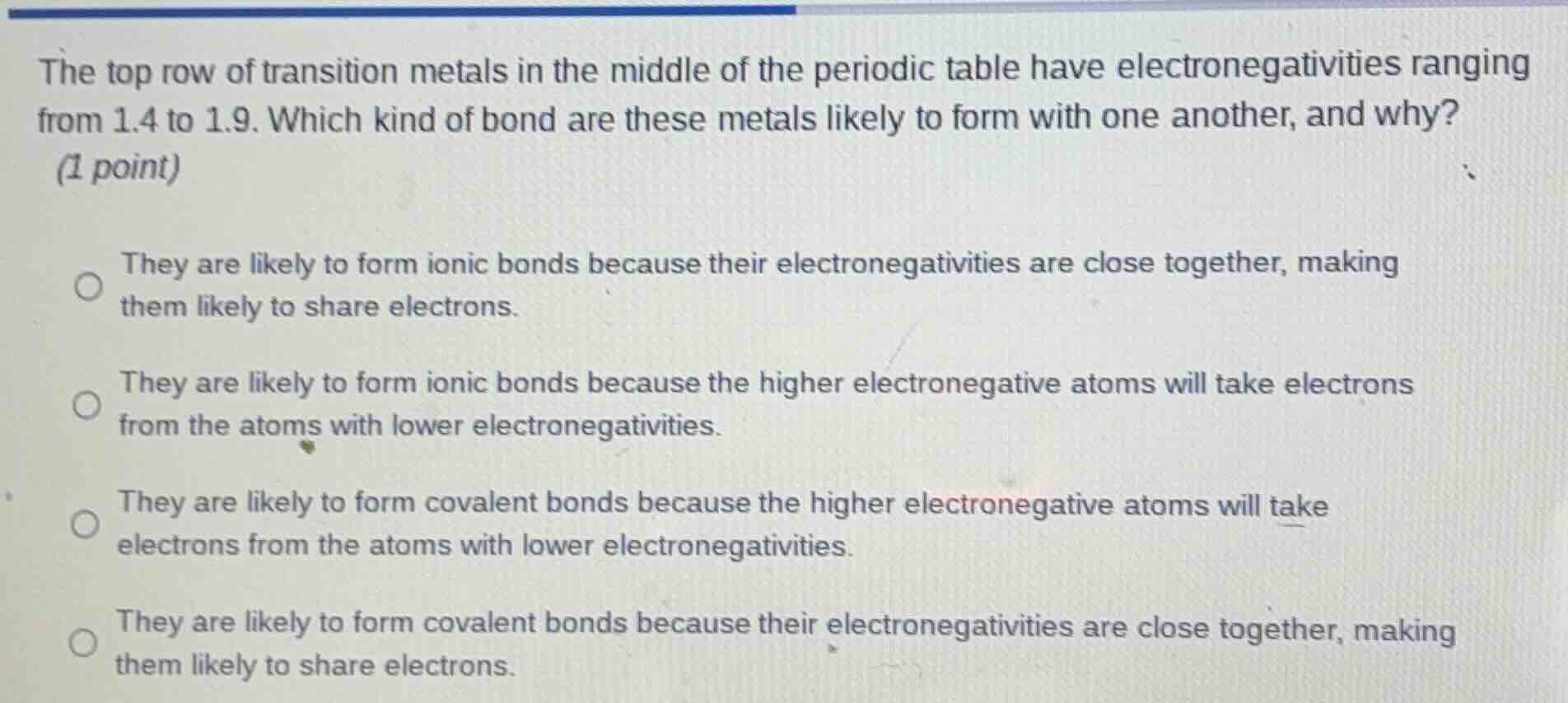
the top row of transition metals in the middle of the periodic table have electronegativities ranging from 1.4 to 1.9. which kind of bond are these metals likely to form with one another, and why? (1 point) they are likely to form ionic bonds because their electronegativities are close together, making them likely to share electrons. they are likely to form ionic bonds because the higher electronegative atoms will take electrons from the atoms with lower electronegativities. they are likely to form covalent bonds because the higher electronegative atoms will take electrons from the atoms with lower electronegativities. they are likely to form covalent bonds because their electronegativities are close together, making them likely to share electrons.
- Recall bond - formation principles: Ionic bonds form when there is a large electronegativity difference (one atom takes electrons from another), and covalent bonds form when electronegativities are close (atoms share electrons).
- Analyze the given electronegativities: The transition metals have electronegativities ranging from 1.4 to 1.9, so their electronegativities are close to each other.
- Evaluate each option:
- Option 1: Ionic bonds are not formed by sharing electrons (covalent bonds are for sharing), and close electronegativities don't favor ionic bonding. Eliminate.
- Option 2: Ionic bonding requires a large electronegativity difference for electron transfer. Close electronegativities don't support this. Eliminate.
- Option 3: Covalent bonds are about sharing electrons, not one atom taking electrons from another (that's ionic). Eliminate.
- Option 4: Since their electronegativities are close, they are likely to share electrons, which is characteristic of covalent bonds. This option is correct.

Snap & solve any problem in the app
Get step-by-step solutions on Sovi AI
Photo-based solutions with guided steps
Explore more problems and detailed explanations
D. They are likely to form covalent bonds because their electronegativities are close together, making them likely to share electrons.