QUESTION IMAGE
Question
unit 5: mass-mole-molecules in compounds
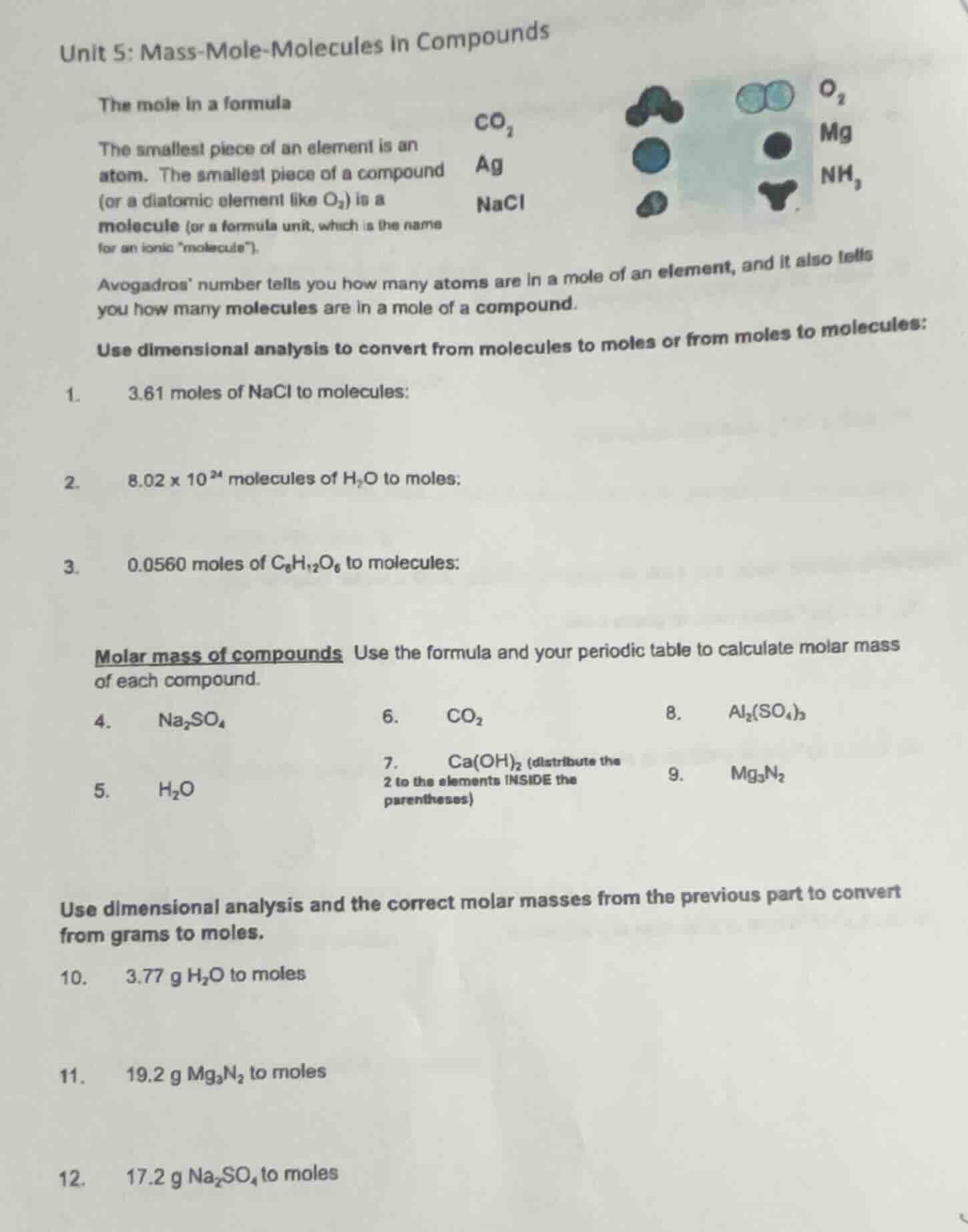
the mole in a formula
the smallest piece of an element is an atom. the smallest piece of a compound (or a diatomic element like $o_2$) is a molecule (or a formula unit, which is the name for an ionic \molecule\).
$co_2$
$ag$
$nacl$
$o_2$
$mg$
$nh_3$
avogadros number tells you how many atoms are in a mole of an element, and it also tells you how many molecules are in a mole of a compound.
use dimensional analysis to convert from molecules to moles or from moles to molecules:
- 3.61 moles of nacl to molecules:
- $8.02 \times 10^{24}$ molecules of $h_2o$ to moles:
- 0.0560 moles of $c_6h_{12}o_6$ to molecules:
molar mass of compounds use the formula and your periodic table to calculate molar mass of each compound.
- $na_2so_4$
- $h_2o$
- $co_2$
- $ca(oh)_2$ (distribute the 2 to the elements inside the parentheses)
- $al_2(so_4)_3$
- $mg_3n_2$
use dimensional analysis and the correct molar masses from the previous part to convert from grams to moles.
- 3.77 g $h_2o$ to moles
- 19.2 g $mg_3n_2$ to moles
- 17.2 g $na_2so_4$ to moles
Step1: Moles to molecules (Q1)
Use Avogadro's number $6.022 \times 10^{23}$ formula units/mol.
$3.61\ \text{mol NaCl} \times 6.022 \times 10^{23}\ \text{formula units/mol}$
Step2: Molecules to moles (Q2)
Divide by Avogadro's number.
$\frac{8.02 \times 10^{24}\ \text{molecules H}_2\text{O}}{6.022 \times 10^{23}\ \text{molecules/mol}}$
Step3: Moles to molecules (Q3)
Multiply by Avogadro's number.
$0.0560\ \text{mol C}_6\text{H}_{12}\text{O}_6 \times 6.022 \times 10^{23}\ \text{molecules/mol}$
Step4: Molar mass of $\text{Na}_2\text{SO}_4$ (Q4)
Sum atomic masses: $2(22.99) + 32.07 + 4(16.00)$
$= 45.98 + 32.07 + 64.00 = 142.05\ \text{g/mol}$
Step5: Molar mass of $\text{H}_2\text{O}$ (Q5)
Sum atomic masses: $2(1.008) + 16.00$
$= 2.016 + 16.00 = 18.02\ \text{g/mol}$
Step6: Molar mass of $\text{CO}_2$ (Q6)
Sum atomic masses: $12.01 + 2(16.00)$
$= 12.01 + 32.00 = 44.01\ \text{g/mol}$
Step7: Molar mass of $\text{Ca(OH)}_2$ (Q7)
Sum atomic masses: $40.08 + 2(16.00 + 1.008)$
$= 40.08 + 2(17.008) = 40.08 + 34.016 = 74.10\ \text{g/mol}$
Step8: Molar mass of $\text{Al}_2(\text{SO}_4)_3$ (Q8)
Sum atomic masses: $2(26.98) + 3(32.07 + 4(16.00))$
$= 53.96 + 3(32.07 + 64.00) = 53.96 + 3(96.07) = 53.96 + 288.21 = 342.17\ \text{g/mol}$
Step9: Molar mass of $\text{Mg}_3\text{N}_2$ (Q9)
Sum atomic masses: $3(24.31) + 2(14.01)$
$= 72.93 + 28.02 = 100.95\ \text{g/mol}$
Step10: Grams to moles (Q10)
Use $\text{H}_2\text{O}$ molar mass.
$\frac{3.77\ \text{g H}_2\text{O}}{18.02\ \text{g/mol}}$
Step11: Grams to moles (Q11)
Use $\text{Mg}_3\text{N}_2$ molar mass.
$\frac{19.2\ \text{g Mg}_3\text{N}_2}{100.95\ \text{g/mol}}$
Step12: Grams to moles (Q12)
Use $\text{Na}_2\text{SO}_4$ molar mass.
$\frac{17.2\ \text{g Na}_2\text{SO}_4}{142.05\ \text{g/mol}}$

Snap & solve any problem in the app
Get step-by-step solutions on Sovi AI
Photo-based solutions with guided steps
Explore more problems and detailed explanations
- $2.17 \times 10^{24}$ formula units of NaCl
- $13.3$ moles of $\text{H}_2\text{O}$
- $3.37 \times 10^{22}$ molecules of $\text{C}_6\text{H}_{12}\text{O}_6$
- $142.05\ \text{g/mol}$
- $18.02\ \text{g/mol}$
- $44.01\ \text{g/mol}$
- $74.10\ \text{g/mol}$
- $342.17\ \text{g/mol}$
- $100.95\ \text{g/mol}$
- $0.209$ moles of $\text{H}_2\text{O}$
- $0.190$ moles of $\text{Mg}_3\text{N}_2$
- $0.121$ moles of $\text{Na}_2\text{SO}_4$