QUESTION IMAGE
Question
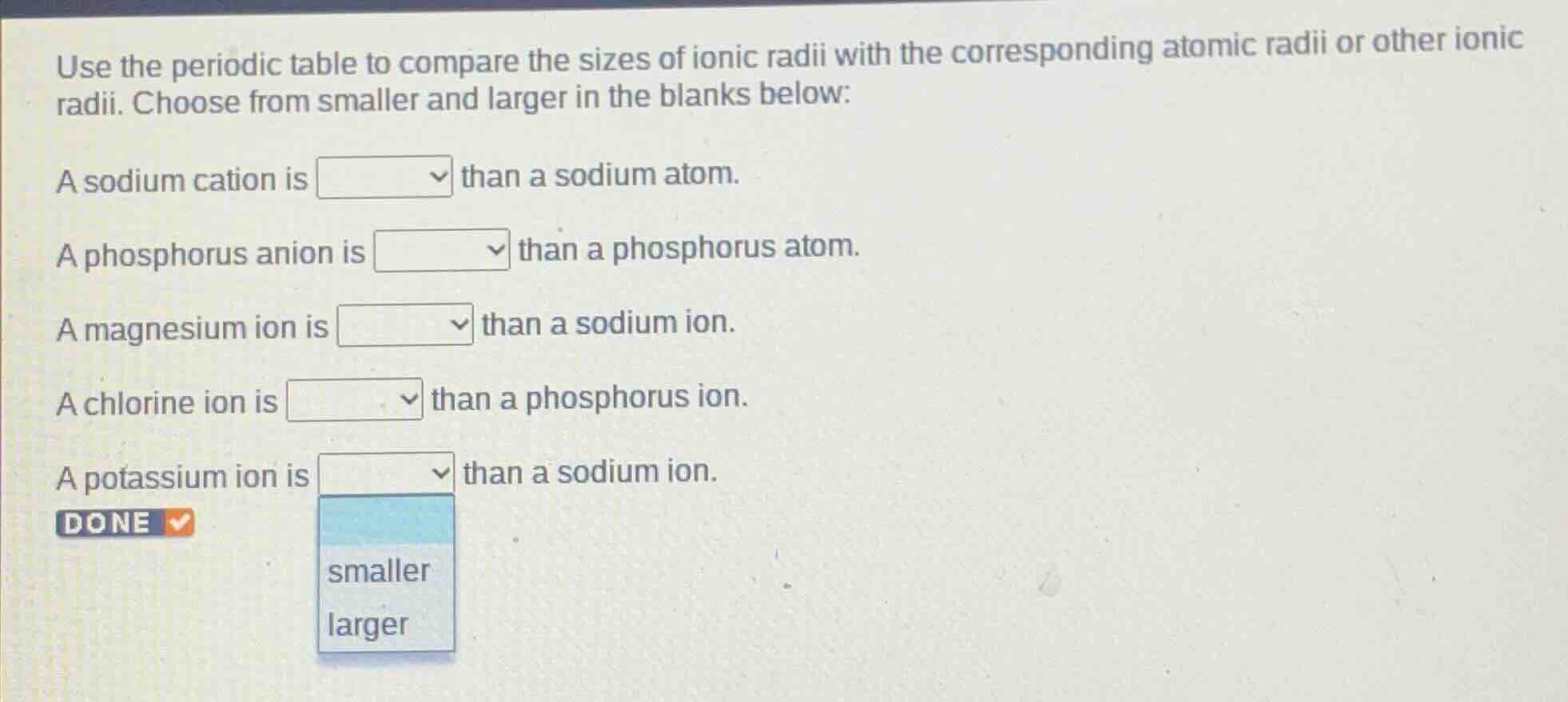
use the periodic table to compare the sizes of ionic radii with the corresponding atomic radii or other ionic radii. choose from smaller and larger in the blanks below:
a sodium cation is than a sodium atom.
a phosphorus anion is than a phosphorus atom.
a magnesium ion is than a sodium ion.
a chlorine ion is than a phosphorus ion.
a potassium ion is than a sodium ion.
done
smaller
larger
Brief Explanations
- Sodium cation ($\text{Na}^+$) loses an electron, reducing electron-electron repulsion and shrinking the electron cloud, so it is smaller than the neutral Na atom.
- Phosphorus anion ($\text{P}^{3-}$) gains 3 electrons, increasing electron-electron repulsion and expanding the electron cloud, so it is larger than the neutral P atom.
- $\text{Mg}^{2+}$ and $\text{Na}^+$ are isoelectronic; $\text{Mg}^{2+}$ has more protons, pulling electrons closer, so it is smaller than $\text{Na}^+$.
- $\text{Cl}^-$ and $\text{P}^{3-}$ are isoelectronic; $\text{Cl}^-$ has more protons, pulling electrons closer, so it is smaller than $\text{P}^{3-}$.
- $\text{K}^+$ has an additional electron shell compared to $\text{Na}^+$, so it is larger than $\text{Na}^+$.

Snap & solve any problem in the app
Get step-by-step solutions on Sovi AI
Photo-based solutions with guided steps
Explore more problems and detailed explanations
- A sodium cation is smaller than a sodium atom.
- A phosphorus anion is larger than a phosphorus atom.
- A magnesium ion is smaller than a sodium ion.
- A chlorine ion is smaller than a phosphorus ion.
- A potassium ion is larger than a sodium ion.