QUESTION IMAGE
Question
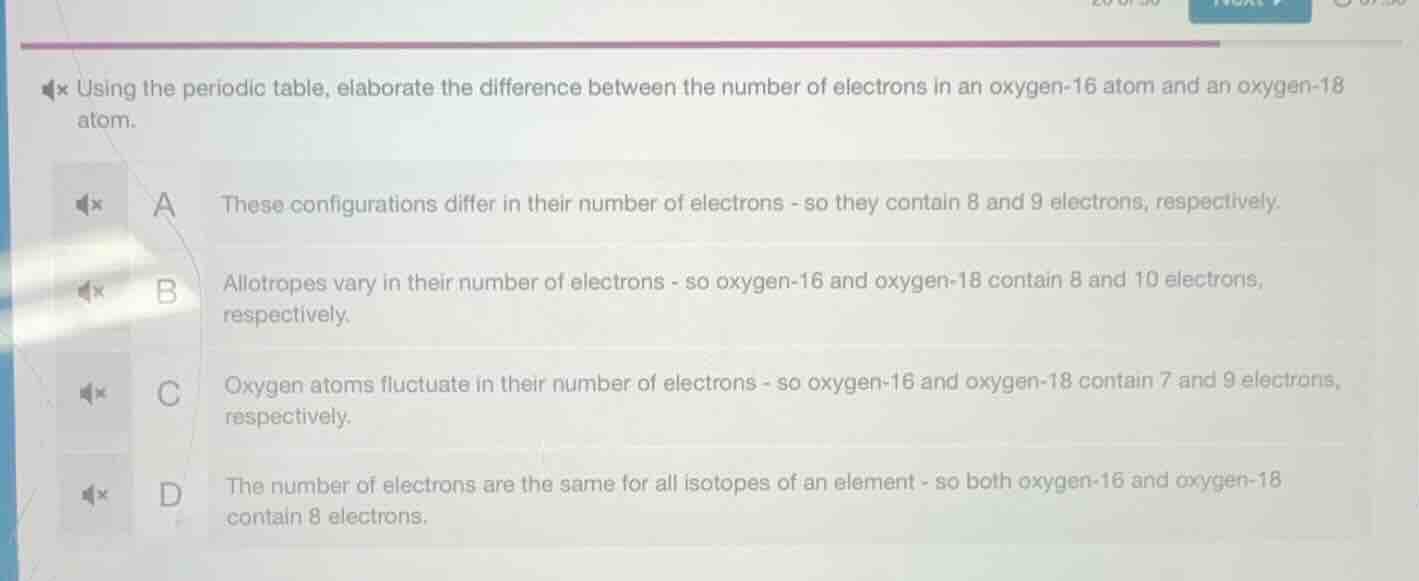
using the periodic table, elaborate the difference between the number of electrons in an oxygen-16 atom and an oxygen-18 atom. a these configurations differ in their number of electrons - so they contain 8 and 9 electrons, respectively. b allotropes vary in their number of electrons - so oxygen-16 and oxygen-18 contain 8 and 10 electrons, respectively. c oxygen atoms fluctuate in their number of electrons - so oxygen-16 and oxygen-18 contain 7 and 9 electrons, respectively. d the number of electrons are the same for all isotopes of an element - so both oxygen-16 and oxygen-18 contain 8 electrons.
Isotopes of an element have the same number of protons (and electrons, in neutral atoms) but different numbers of neutrons. Oxygen - 16 and oxygen - 18 are isotopes of oxygen. The atomic number of oxygen is 8, which means a neutral oxygen atom has 8 electrons. So both oxygen - 16 and oxygen - 18 (being neutral isotopes of oxygen) have 8 electrons. Option A is wrong as it says they have 8 and 9 electrons. Option B is wrong because allotropes are different forms of the same element (like O₂ and O₃), not related to electron number differences in isotopes, and it incorrectly states electron numbers. Option C is wrong as oxygen atoms (neutral) have 8 electrons, not 7 or 9. Option D correctly states that isotopes of an element have the same number of electrons, so both have 8 electrons.

Snap & solve any problem in the app
Get step-by-step solutions on Sovi AI
Photo-based solutions with guided steps
Explore more problems and detailed explanations
D. The number of electrons are the same for all isotopes of an element - so both oxygen - 16 and oxygen - 18 contain 8 electrons.