QUESTION IMAGE
Question
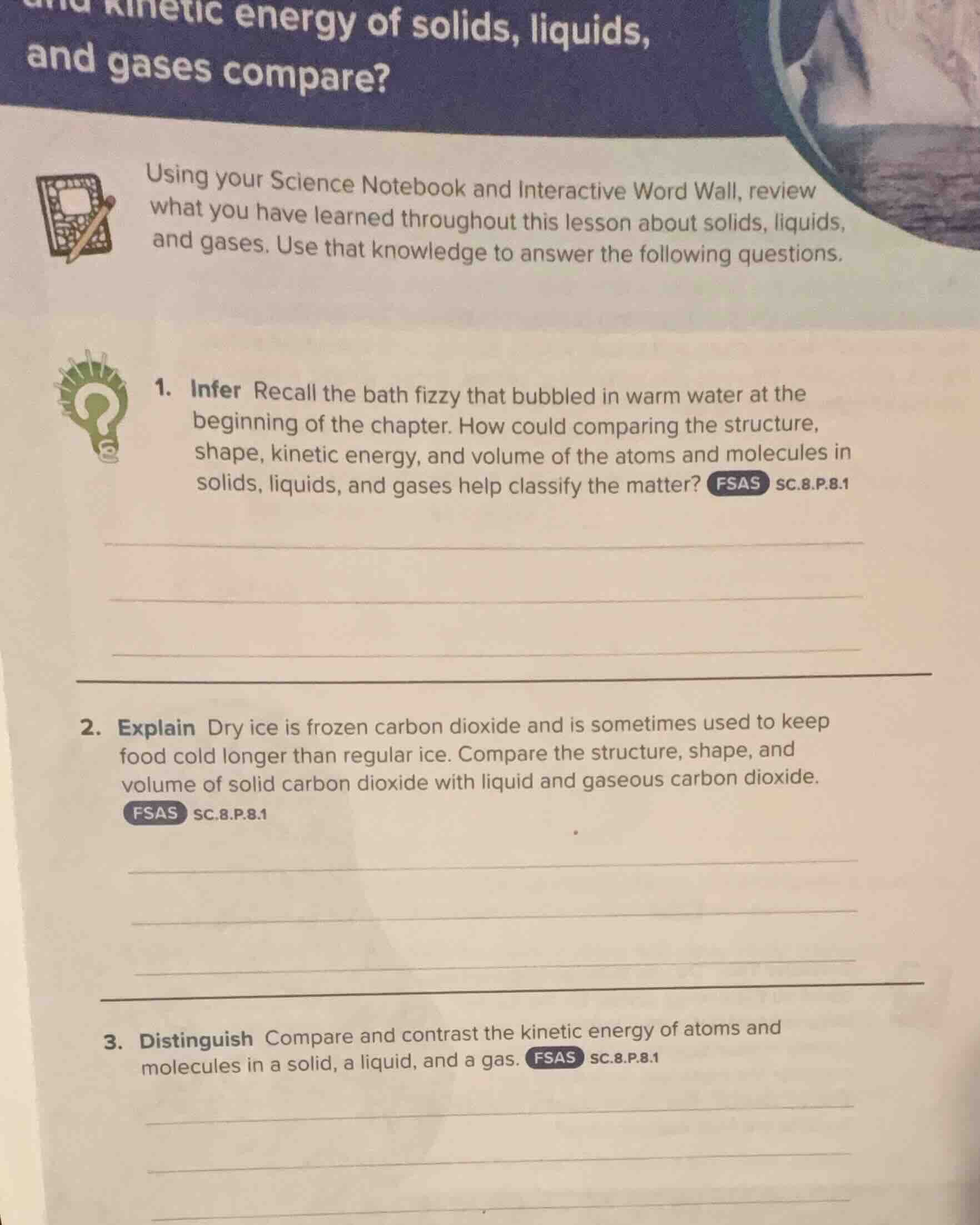
using your science notebook and interactive word wall, review what you have learned throughout this lesson about solids, liquids, and gases. use that knowledge to answer the following questions. 1. infer recall the bath fizzy that bubbled in warm water at the beginning of the chapter. how could comparing the structure, shape, kinetic energy, and volume of the atoms and molecules in solids, liquids, and gases help classify the matter? fsas sc.8.p.8.1 2. explain dry ice is frozen carbon dioxide and is sometimes used to keep food cold longer than regular ice. compare the structure, shape, and volume of solid carbon dioxide with liquid and gaseous carbon dioxide. fsas sc.8.p.8.1 3. distinguish compare and contrast the kinetic energy of atoms and molecules in a solid, a liquid, and a gas. fsas sc.8.p.8.1
Question 1
To classify matter as solid, liquid, or gas, we analyze atomic/molecular properties:
- Structure: Solids have closely packed, ordered atoms/molecules; liquids have close but disordered arrangement; gases have widely spaced, random atoms/molecules.
- Shape: Solids have definite shape; liquids take container shape; gases fill container.
- Kinetic Energy (KE): Solids have low KE (vibrate in place); liquids have moderate KE (slide past each other); gases have high KE (move freely).
- Volume: Solids/liquids have definite volume; gases expand to fill volume.
Comparing these properties (e.g., a bath fizzy dissolving: solid fizzy → liquid/gas bubbles) reveals how atoms/molecules behave, aiding classification.
For carbon dioxide (\( \text{CO}_2 \)) in solid (dry ice), liquid, and gas phases:
- Structure:
- Solid (\( \text{CO}_2 \)): Atoms/molecules are tightly packed, ordered (crystalline structure).
- Liquid (\( \text{CO}_2 \)): Molecules are close but disordered, can slide past each other.
- Gas (\( \text{CO}_2 \)): Molecules are widely spaced, move freely.
- Shape:
- Solid: Definite shape (maintains form).
- Liquid: Takes the shape of its container.
- Gas: Fills the container’s shape.
- Volume:
- Solid/Liquid: Definite volume (hard to compress).
- Gas: Expands to fill the container’s volume (easily compressible).
Dry ice (solid \( \text{CO}_2 \)) sublimes (skips liquid phase) to gas, but comparing all three phases shows how molecular arrangement changes with state.
Kinetic energy (KE) of atoms/molecules in solids, liquids, and gases depends on their motion:
- Solid: Atoms/molecules vibrate in fixed positions (low KE, minimal movement).
- Liquid: Molecules slide past each other (moderate KE, more movement than solids).
- Gas: Molecules move freely and rapidly (high KE, maximum movement).
Compare (similarities): All phases have KE (molecules are never stationary).
Contrast (differences): KE increases from solid (low) → liquid (moderate) → gas (high) due to increasing molecular motion.

Snap & solve any problem in the app
Get step-by-step solutions on Sovi AI
Photo-based solutions with guided steps
Explore more problems and detailed explanations
By comparing structure (packing/order), shape (definite vs. adaptive), kinetic energy (motion intensity), and volume (definite vs. expandable) of atoms/molecules:
- Solids: Closely packed, definite shape/volume, low KE.
- Liquids: Close but disordered, adaptive shape, definite volume, moderate KE.
- Gases: Widely spaced, adaptive shape/volume, high KE.
This comparison reveals how matter behaves (e.g., a bath fizzy’s solid → liquid/gas change), helping classify it.