QUESTION IMAGE
Question
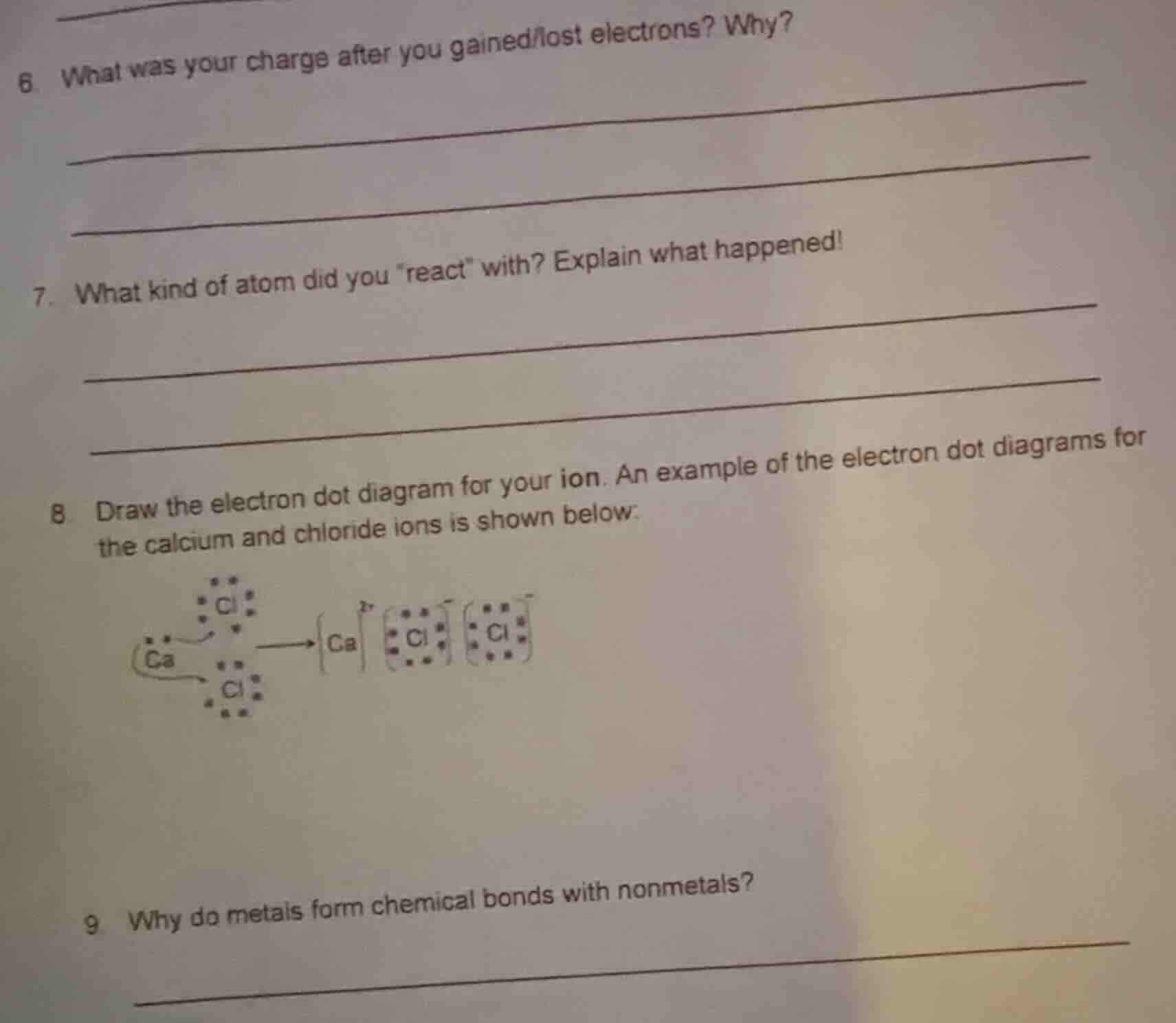
- what was your charge after you gained/lost electrons? why?
- what kind of atom did you
eact\ with? explain what happened!
- draw the electron dot diagram for your ion. an example of the electron dot diagrams for the calcium and chloride ions is shown below:
image of electron dot diagram for calcium and chloride ions
- why do metals form chemical bonds with nonmetals?
Question 6
If an atom loses electrons, it has more protons (positive charge) than electrons (negative charge), so it becomes positively charged (cation). If it gains electrons, it has more electrons than protons, so it becomes negatively charged (anion). For example, a sodium atom (Na) has 11 protons and 11 electrons. If it loses 1 electron, it has 11 protons and 10 electrons, so its charge is \( +1 \) (since \( 11 - 10 = +1 \)). The reason is that electrons have a negative charge, so losing them reduces the negative charge, making the overall charge positive, and gaining them increases the negative charge, making the overall charge negative.
Typically, metals (like Na, Mg, Ca) react with non - metals (like Cl, O, S). For example, in the case of sodium (Na, a metal) and chlorine (Cl, a non - metal), sodium has 1 valence electron and chlorine has 7 valence electrons. Sodium loses its 1 valence electron to achieve a stable octet (like the noble gas Ne), and chlorine gains that 1 electron to achieve a stable octet (like the noble gas Ar). The transfer of electrons forms ions ( \( \text{Na}^+ \) and \( \text{Cl}^- \)) which are then attracted to each other by electrostatic forces, forming an ionic bond.
Let's assume we have a sodium ion (\( \text{Na}^+ \)) as an example. A sodium atom has 11 electrons, with an electron configuration of \( 1s^2 2s^2 2p^6 3s^1 \). When it loses 1 electron (from the 3s orbital), the sodium ion (\( \text{Na}^+ \)) has an electron configuration of \( 1s^2 2s^2 2p^6 \). The electron dot diagram (Lewis dot structure) for \( \text{Na}^+ \) would show the symbol \( \text{Na} \) with a superscript \( + \) and no valence electrons (since it lost its 3s electron). For a chloride ion (\( \text{Cl}^- \)), a chlorine atom has 7 valence electrons. When it gains 1 electron, it has 8 valence electrons. The electron dot diagram would show \( \text{Cl} \) surrounded by 8 dots (representing the 8 valence electrons) and a superscript \( - \).

Snap & solve any problem in the app
Get step-by-step solutions on Sovi AI
Photo-based solutions with guided steps
Explore more problems and detailed explanations
If I lost electrons, my charge was positive (cation) because I had more protons than electrons. If I gained electrons, my charge was negative (anion) because I had more electrons than protons. (The specific charge depends on the number of electrons gained or lost. For example, losing 1 electron gives a \( +1 \) charge, losing 2 gives \( +2 \), gaining 1 gives \( -1 \), etc.)