QUESTION IMAGE
Question
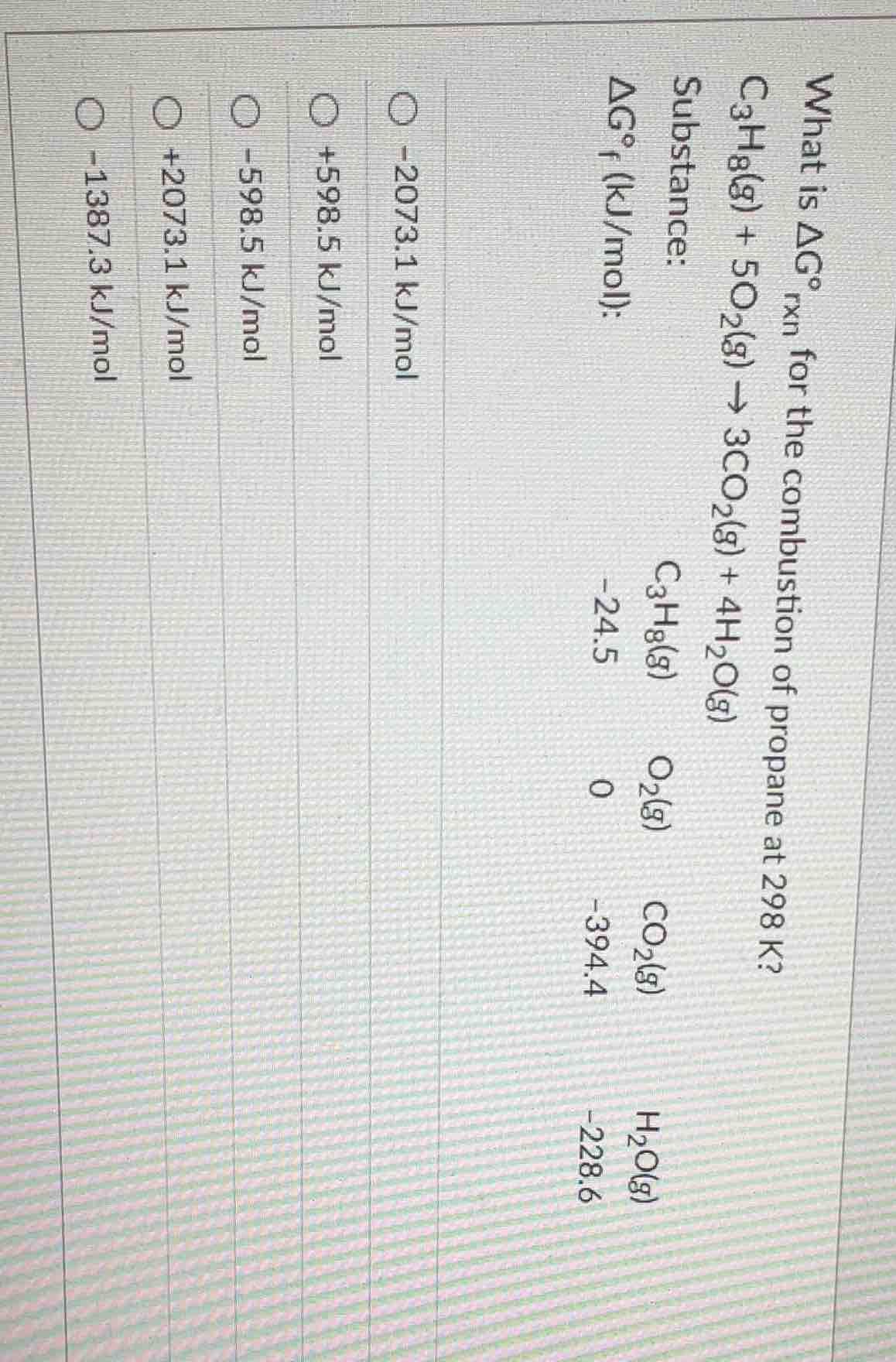
what is $\delta g^\circ_{\text{rxn}}$ for the combustion of propane at 298 k?
$\ce{c3h8(g) + 5o2(g) -> 3co2(g) + 4h2o(g)}$
substance: $\delta g^\circ_\text{f}$(kj/mol):
$\ce{c3h8(g)}$: $-24.5$
$\ce{o2(g)}$: $0$
$\ce{co2(g)}$: $-394.4$
$\ce{h2o(g)}$: $-228.6$
options:
- $-2073.1$ kj/mol
- $+598.5$ kj/mol
- $-598.5$ kj/mol
- $+2073.1$ kj/mol
- $-1387.3$ kj/mol
Step1: Recall the formula for $\Delta G^\circ_{\text{rxn}}$
The formula for the standard Gibbs free energy change of a reaction ($\Delta G^\circ_{\text{rxn}}$) is the sum of the standard Gibbs free energies of formation ($\Delta G^\circ_f$) of the products minus the sum of the standard Gibbs free energies of formation of the reactants. Mathematically, it is:
$$\Delta G^\circ_{\text{rxn}} = \sum n \Delta G^\circ_f(\text{products}) - \sum m \Delta G^\circ_f(\text{reactants})$$
where $n$ and $m$ are the stoichiometric coefficients of the products and reactants, respectively.
Step2: Identify the reactants and products with their stoichiometric coefficients
The reaction is:
- Reactants: $\text{C}_3\text{H}_8$ (stoichiometric coefficient = 1), $\text{O}_2$ (stoichiometric coefficient = 5)
- Products: $\text{CO}_2$ (stoichiometric coefficient = 3), $\text{H}_2\text{O}$ (stoichiometric coefficient = 4)
Step3: List the $\Delta G^\circ_f$ values for each substance
From the given data:
- $\Delta G^\circ_f(\text{C}_3\text{H}_8(\text{g})) = -24.5\ \text{kJ/mol}$
- $\Delta G^\circ_f(\text{O}_2(\text{g})) = 0\ \text{kJ/mol}$ (standard state for elements)
- $\Delta G^\circ_f(\text{CO}_2(\text{g})) = -394.4\ \text{kJ/mol}$
- $\Delta G^\circ_f(\text{H}_2\text{O}(\text{g})) = -228.6\ \text{kJ/mol}$
Step4: Calculate the sum of $\Delta G^\circ_f$ for products
For the products ($3\text{CO}_2$ and $4\text{H}_2\text{O}$):
$$\sum n \Delta G^\circ_f(\text{products}) = 3 \times \Delta G^\circ_f(\text{CO}_2) + 4 \times \Delta G^\circ_f(\text{H}_2\text{O})$$
Substitute the values:
$$3 \times (-394.4) + 4 \times (-228.6)$$
First, calculate each term:
- $3 \times (-394.4) = -1183.2\ \text{kJ/mol}$
- $4 \times (-228.6) = -914.4\ \text{kJ/mol}$
Now, sum these two terms:
$$-1183.2 + (-914.4) = -1183.2 - 914.4 = -2097.6\ \text{kJ/mol}$$
Step5: Calculate the sum of $\Delta G^\circ_f$ for reactants
For the reactants ($1\text{C}_3\text{H}_8$ and $5\text{O}_2$):
$$\sum m \Delta G^\circ_f(\text{reactants}) = 1 \times \Delta G^\circ_f(\text{C}_3\text{H}_8) + 5 \times \Delta G^\circ_f(\text{O}_2)$$
Substitute the values:
$$1 \times (-24.5) + 5 \times 0$$
Simplify:
$$-24.5 + 0 = -24.5\ \text{kJ/mol}$$
Step6: Calculate $\Delta G^\circ_{\text{rxn}}$
Using the formula from Step1:
$$\Delta G^\circ_{\text{rxn}} = \sum n \Delta G^\circ_f(\text{products}) - \sum m \Delta G^\circ_f(\text{reactants})$$
Substitute the values from Step4 and Step5:
$$\Delta G^\circ_{\text{rxn}} = (-2097.6) - (-24.5)$$
Simplify the subtraction (subtracting a negative is adding the positive):
$$\Delta G^\circ_{\text{rxn}} = -2097.6 + 24.5 = -2073.1\ \text{kJ/mol}$$

Snap & solve any problem in the app
Get step-by-step solutions on Sovi AI
Photo-based solutions with guided steps
Explore more problems and detailed explanations
$\boldsymbol{-2073.1\ \text{kJ/mol}}$ (corresponding to the option: -2073.1 kJ/mol)