QUESTION IMAGE
Question
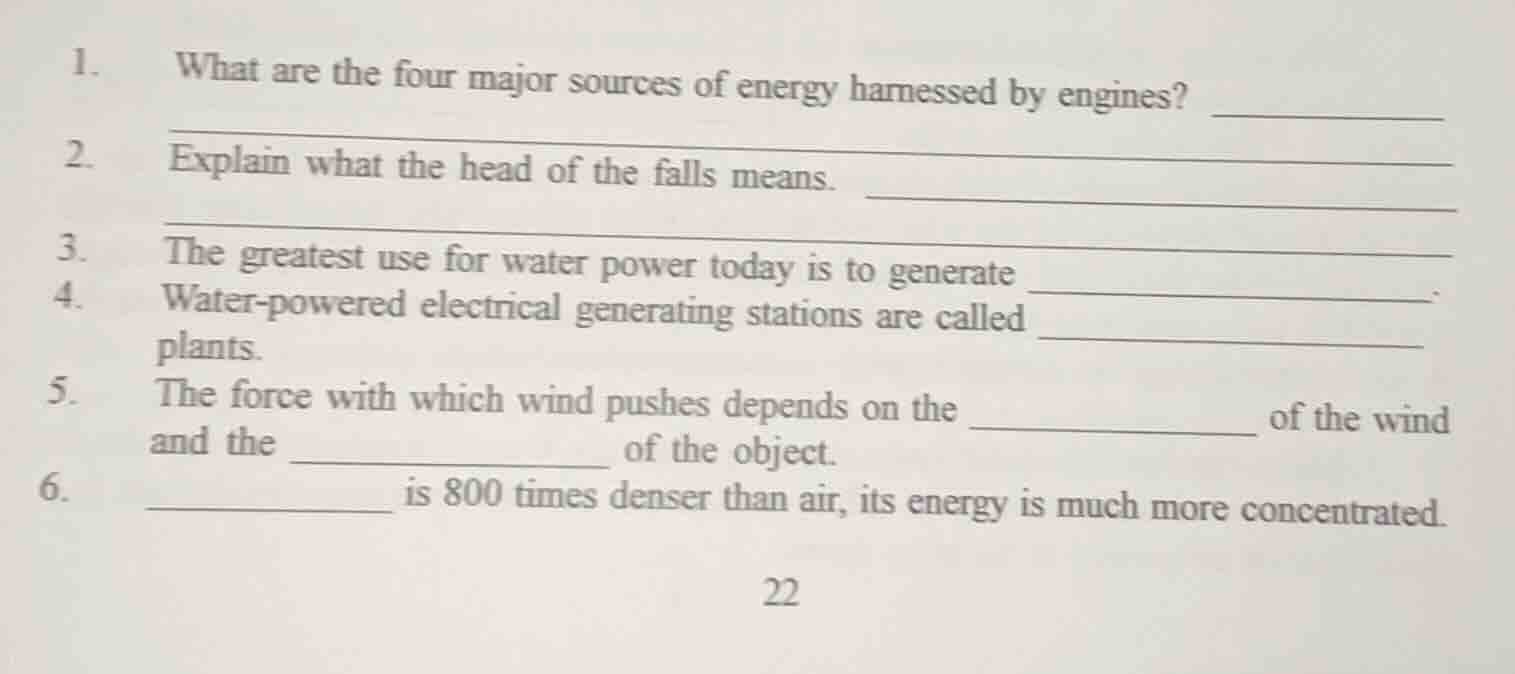
- what are the four major sources of energy harnessed by engines?
- explain what the head of the falls means.
- the greatest use for water power today is to generate
- water - powered electrical generating stations are called plants.
- the force with which wind pushes depends on the of the wind and the of the object.
- is 800 times denser than air, its energy is much more concentrated.
Question 1
Engines harness energy from various sources. The four major ones are typically chemical (like fuel combustion), thermal (heat energy), mechanical (from motion), and electrical (from electric sources). But more specifically for common engine applications, the four major sources harnessed by engines are chemical energy (from fuels like gasoline, diesel, or biofuels), thermal energy (heat, e.g., in steam engines), mechanical energy (from motion, e.g., in some engines using kinetic energy transfer), and electrical energy (for electric motors). However, a more precise answer in the context of energy for engines (like internal combustion or power - generating engines) is that the four major sources are chemical (fuel), thermal (heat), mechanical (motion), and electrical (electricity). But another common breakdown is the four major energy sources harnessed by engines are coal, petroleum, natural gas (all chemical - based fossil fuels), and water (hydropower, mechanical energy from water flow), but this can vary by context. A standard answer is that the four major sources of energy harnessed by engines are chemical energy (from fuels), thermal energy (heat), mechanical energy (from moving parts or fluid flow), and electrical energy (for electric engines). But in the context of traditional engines (like those in power plants or vehicles), the four major sources are often considered to be coal, oil (petroleum), natural gas, and water (for hydropower - based engines).
In the context of waterfalls (hydropower or natural waterfalls), the "head of the falls" refers to the vertical distance (height) between the surface of the water at the top of the waterfall (or the upstream water level) and the surface of the water at the bottom of the waterfall (or the downstream water level). It is a crucial factor in determining the potential energy of the water, as the potential energy of water is given by \(PE = mgh\), where \(m\) is mass, \(g\) is acceleration due to gravity, and \(h\) is the height (the head). In hydropower, a greater head means more potential energy can be converted into kinetic energy and then into electrical energy.
Today, the greatest use of water power (hydropower) is to generate electricity. Hydropower plants use the kinetic and potential energy of water (from the head and flow of water) to turn turbines, which are connected to generators that produce electricity. This is by far the most widespread and significant use of water power in the modern era, as it is a clean and renewable source of large - scale electricity generation.

Snap & solve any problem in the app
Get step-by-step solutions on Sovi AI
Photo-based solutions with guided steps
Explore more problems and detailed explanations
The four major sources of energy harnessed by engines are typically chemical energy (from fuels like gasoline, diesel, coal, etc.), thermal energy (heat, e.g., from steam), mechanical energy (from motion like water flow or wind), and electrical energy (for electric motors). A more common answer in engineering/energy context is: chemical (fuel - based like coal, petroleum, natural gas), thermal (heat), mechanical (e.g., water, wind motion), and electrical (electricity).