QUESTION IMAGE
Question
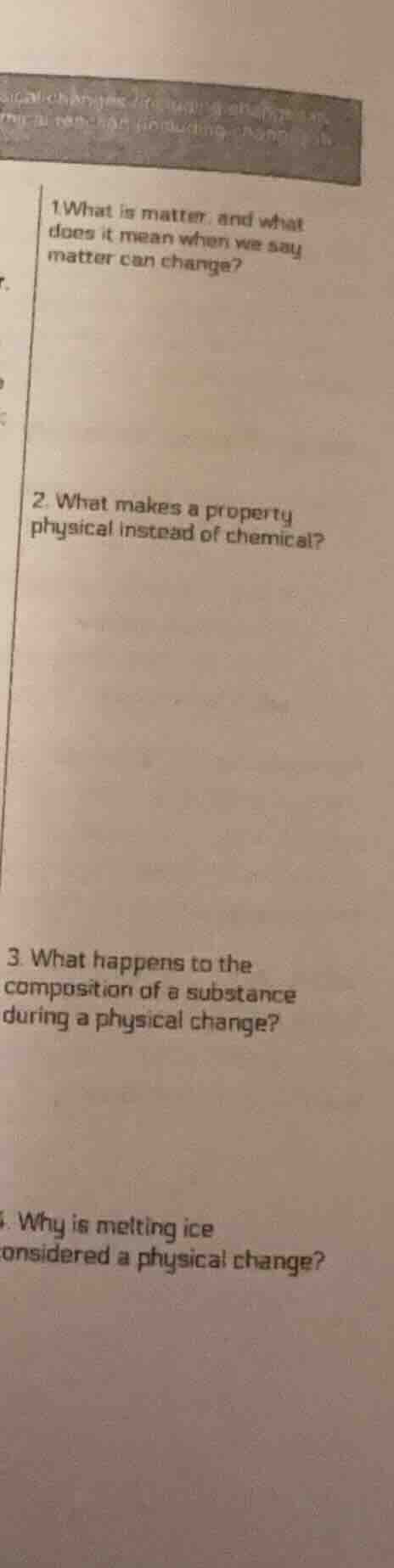
1 what is matter, and what does it mean when we say matter can change?
- what makes a property physical instead of chemical?
- what happens to the composition of a substance during a physical change?
- why is melting ice considered a physical change?
Brief Explanations
- Matter is defined as anything that has mass and occupies space. When we say matter can change, this refers to it undergoing either physical changes (altering form/state without changing composition) or chemical changes (forming new substances with different properties).
- A property is physical if it can be observed or measured without changing the chemical composition of the substance it describes. Chemical properties require a substance to react and change its composition to be observed.
- During a physical change, the chemical composition of the substance remains entirely unchanged; only its physical state, shape, or appearance is altered.
- Melting ice is a physical change because the solid water (ice) only changes its state to liquid water, and the chemical composition ($H_2O$) stays the same throughout the process. No new substance is formed.

Snap & solve any problem in the app
Get step-by-step solutions on Sovi AI
Photo-based solutions with guided steps
Explore more problems and detailed explanations
- Matter is anything with mass and volume. Matter changing means it undergoes physical/chemical alterations to its form or composition.
- A physical property is observable/measurable without changing the substance's chemical makeup.
- The composition of the substance stays exactly the same during a physical change.
- Melting ice is a physical change because it only changes from solid to liquid water, with no change to its $H_2O$ chemical composition, and no new substance is created.