QUESTION IMAGE
Question
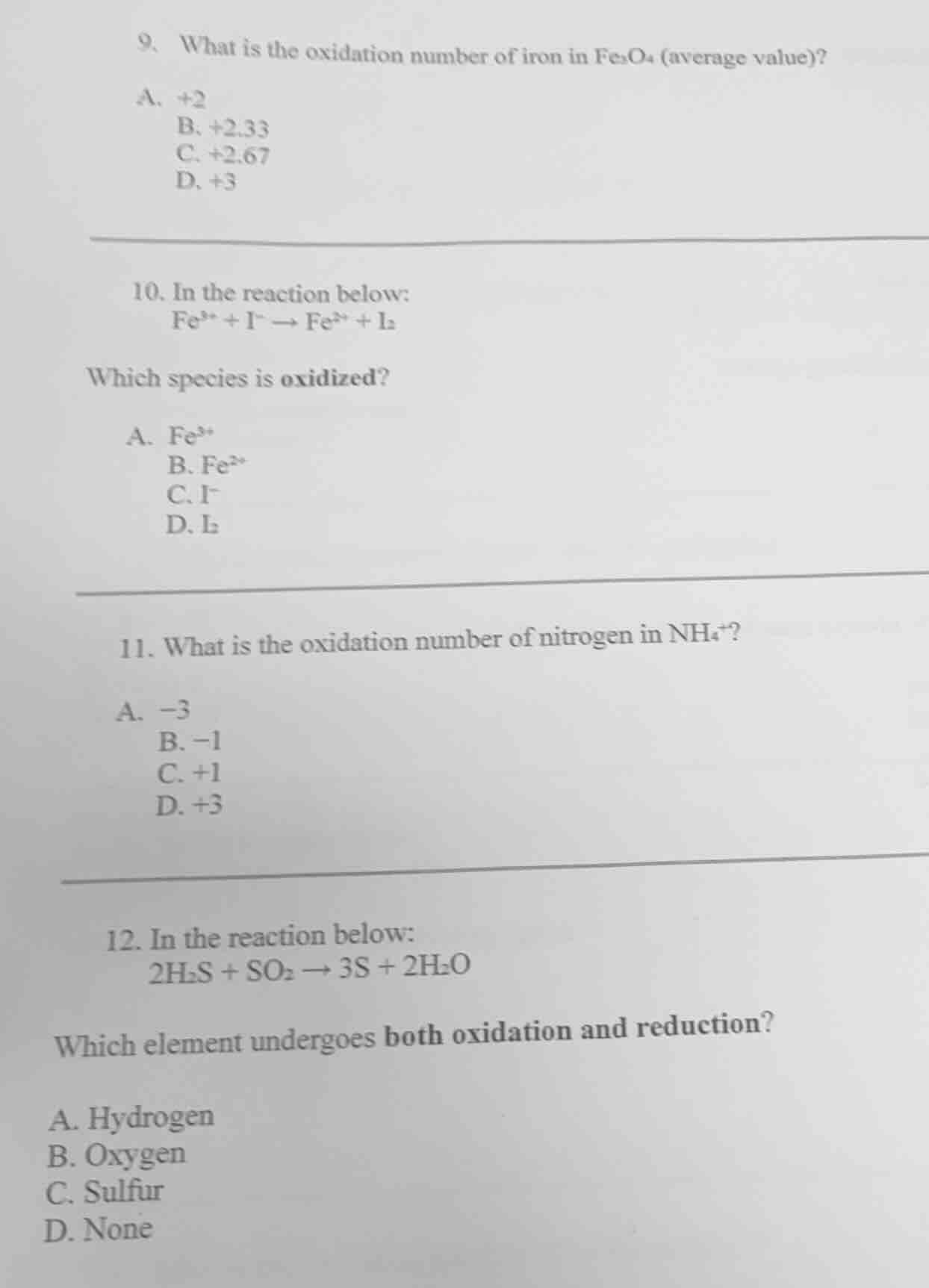
- what is the oxidation number of iron in fe₃o₄ (average value)?
a. +2
b. +2.33
c. +2.67
d. +3
- in the reaction below:
fe³⁺ + i⁻ → fe²⁺ + i₂
which species is oxidized?
a. fe³⁺
b. fe²⁺
c. i⁻
d. i₂
- what is the oxidation number of nitrogen in nh₄⁺?
a. −3
b. −1
c. +1
d. +3
- in the reaction below:
2h₂s + so₂ → 3s + 2h₂o
which element undergoes both oxidation and reduction?
a. hydrogen
b. oxygen
c. sulfur
d. none
Question 9
Step1: Recall oxidation number rules
Oxygen usually has an oxidation number of -2 in compounds. Let the oxidation number of Fe be \( x \). In \( \text{Fe}_3\text{O}_4 \), there are 3 Fe atoms and 4 O atoms. The sum of oxidation numbers in a neutral compound is 0. So, \( 3x + 4\times(-2)=0 \).
Step2: Solve for \( x \)
\( 3x - 8 = 0 \) → \( 3x = 8 \) → \( x=\frac{8}{3}\approx +2.67 \).
Oxidation is the loss of electrons (increase in oxidation number). In the reaction \( \text{Fe}^{3+}+\text{I}^-
ightarrow\text{Fe}^{2+}+\text{I}_2 \), \( \text{I}^- \) (oxidation number -1) becomes \( \text{I}_2 \) (oxidation number 0), so it loses electrons (oxidized). \( \text{Fe}^{3+} \) (oxidation number +3) becomes \( \text{Fe}^{2+} \) (oxidation number +2), so it gains electrons (reduced).
Step1: Recall oxidation number rules
Hydrogen has an oxidation number of +1 in compounds (except in hydrides). Let the oxidation number of N be \( x \). In \( \text{NH}_4^+ \), the sum of oxidation numbers is +1 (charge of the ion). So, \( x + 4\times(+1)=+1 \).
Step2: Solve for \( x \)
\( x + 4 = 1 \) → \( x = 1 - 4=-3 \).

Snap & solve any problem in the app
Get step-by-step solutions on Sovi AI
Photo-based solutions with guided steps
Explore more problems and detailed explanations
C. +2.67