QUESTION IMAGE
Question
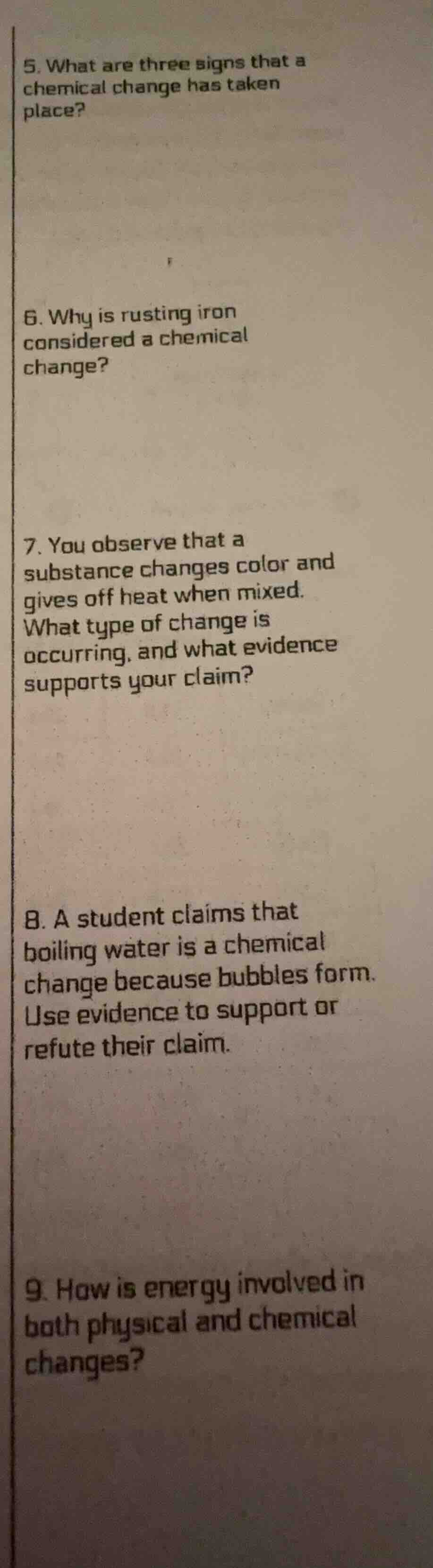
- what are three signs that a chemical change has taken place?
- why is rusting iron considered a chemical change?
- you observe that a substance changes color and gives off heat when mixed. what type of change is occurring, and what evidence supports your claim?
- a student claims that boiling water is a chemical change because bubbles form. use evidence to support or refute their claim.
- how is energy involved in both physical and chemical changes?
Brief Explanations
- For question 5: Chemical changes create new substances, and these are common observable signs.
- For question 6: Rusting forms a new, non-reversible substance from iron.
- For question 7: Color change and heat release are key chemical change indicators.
- For question 8: Boiling only alters water's state, not its chemical identity.
- For question 9: Energy shifts occur in both change types but differ in permanence.

Snap & solve any problem in the app
Get step-by-step solutions on Sovi AI
Photo-based solutions with guided steps
Explore more problems and detailed explanations
- Three signs of chemical change are: formation of a new precipitate/solid, color change, and release/absorption of heat/light (or gas production).
- Rusting iron is a chemical change because iron reacts with oxygen and water to form iron oxide (rust), a new substance with different properties, and this change cannot be reversed to recover pure iron.
- A chemical change is occurring. The evidence is the observed color change (a sign of new substance formation) and the release of heat (a change in energy associated with chemical reactions).
- The student's claim is incorrect. Boiling water is a physical change: the bubbles are water vapor (H₂O in gaseous form), not a new chemical substance. When the water cools, it returns to liquid water with the same chemical composition, so no new substance is formed.
- In physical changes, energy is absorbed or released to change the state of a substance (e.g., melting ice absorbs energy to turn solid water to liquid, but no new substance forms). In chemical changes, energy is absorbed (endothermic) or released (exothermic) as chemical bonds break and form, resulting in new substances (e.g., burning fuel releases energy as bonds in the fuel and oxygen break, forming new bonds in CO₂ and water).