QUESTION IMAGE
Question
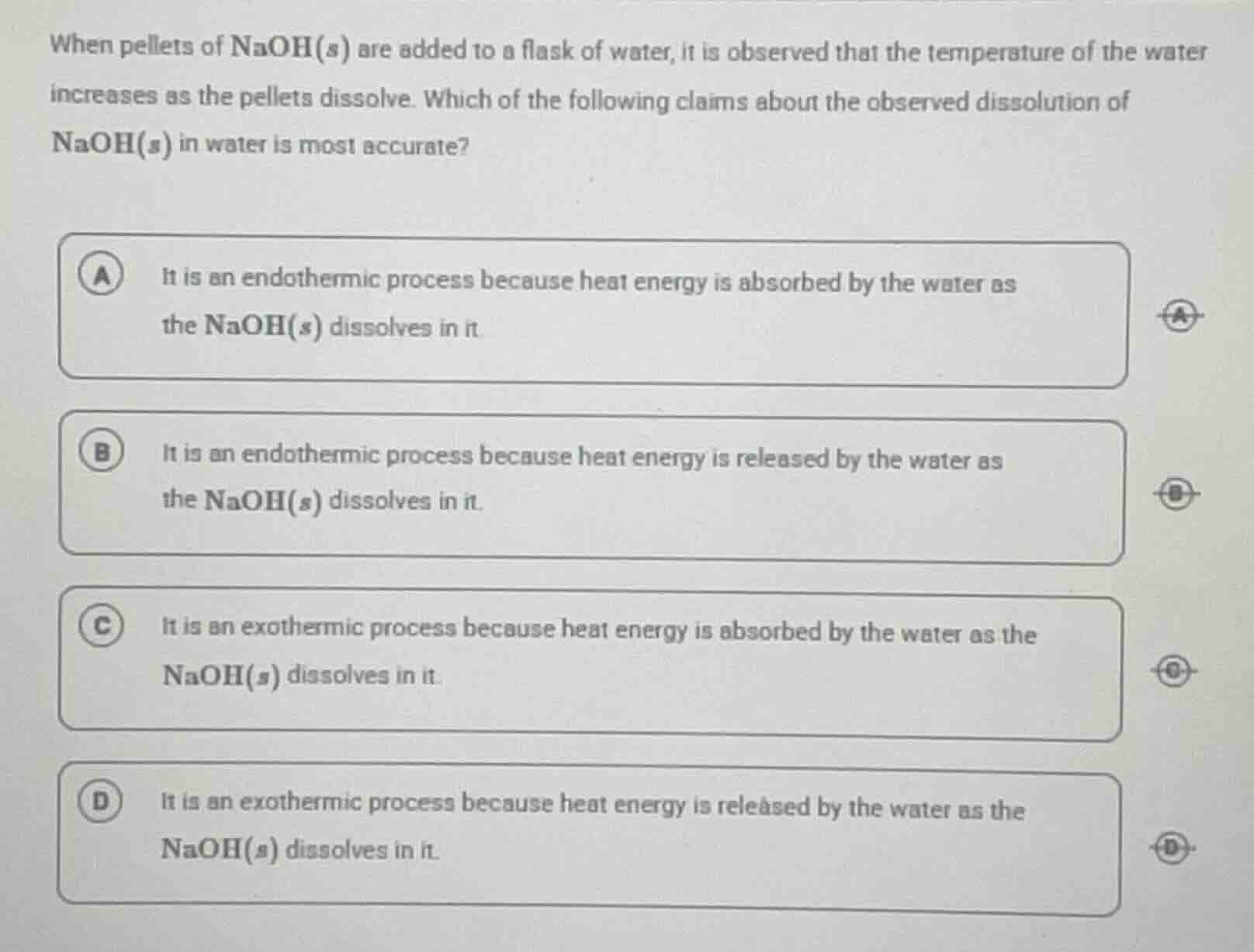
when pellets of naoh(s) are added to a flask of water, it is observed that the temperature of the water increases as the pellets dissolve. which of the following claims about the observed dissolution of naoh(s) in water is most accurate? a it is an endothermic process because heat energy is absorbed by the water as the naoh(s) dissolves in it. b it is an endothermic process because heat energy is released by the water as the naoh(s) dissolves in it. c it is an exothermic process because heat energy is absorbed by the water as the naoh(s) dissolves in it. d it is an exothermic process because heat energy is released by the water as the naoh(s) dissolves in it.
- Recall the definitions: An exothermic process releases heat (system releases heat, surroundings absorb it), and an endothermic process absorbs heat (system absorbs heat, surroundings release it).
- When NaOH dissolves in water, the water's temperature increases. This means the water (surroundings) is absorbing heat. So the dissolution process (system) is releasing heat, making it exothermic.
- Analyze options:
- Option A: Claims endothermic, but endothermic would cool the water. Incorrect.
- Option B: Endothermic and heat released by water is contradictory (endothermic needs water to absorb, not release). Incorrect.
- Option C: Exothermic (correct type) and water absorbs heat (matches observation). Correct.
- Option D: Exothermic but says water releases heat (which would cool water, opposite of observation). Incorrect.

Snap & solve any problem in the app
Get step-by-step solutions on Sovi AI
Photo-based solutions with guided steps
Explore more problems and detailed explanations
C. It is an exothermic process because heat energy is absorbed by the water as the $\ce{NaOH}(s)$ dissolves in it.