QUESTION IMAGE
Question
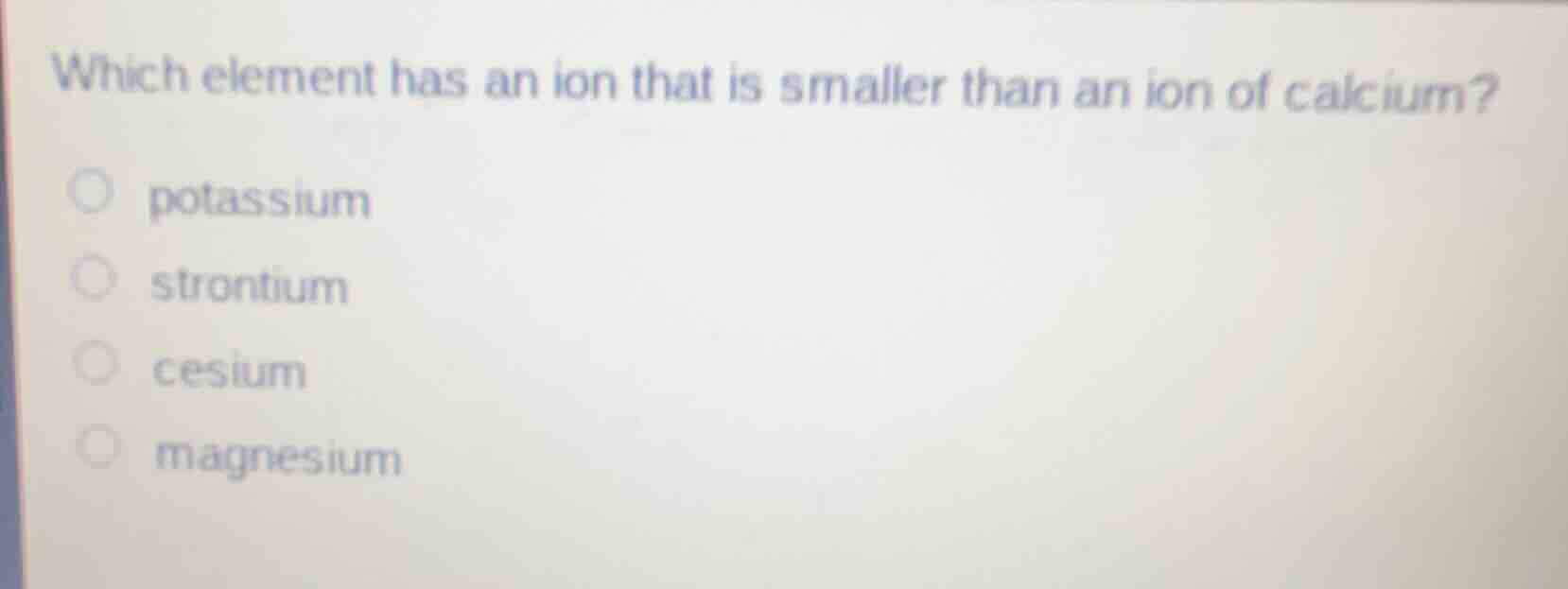
which element has an ion that is smaller than an ion of calcium?
○ potassium
○ strontium
○ cesium
○ magnesium
Brief Explanations
- First, determine the ions of the elements: Calcium (Ca) forms \(Ca^{2+}\), Potassium (K) forms \(K^+\), Strontium (Sr) forms \(Sr^{2+}\), Cesium (Cs) forms \(Cs^+\), Magnesium (Mg) forms \(Mg^{2+}\).
- For ions with the same charge (like \(Ca^{2+}\), \(Sr^{2+}\), \(Mg^{2+}\)): As we move up a group in the periodic table, the ionic radius decreases because the number of electron shells decreases. Mg is in the same group (Group 2) as Ca but above Ca, so \(Mg^{2+}\) has fewer electron shells than \(Ca^{2+}\), making its radius smaller. For \(K^+\) (charge +1) vs \(Ca^{2+}\) (charge +2): Even though K is in the same period as Ca (Period 4), the higher positive charge on \(Ca^{2+}\) pulls the electrons more tightly, but \(K^+\) has a larger radius than \(Ca^{2+}\) (since \(K^+\) has one less proton than \(Ca^{2+}\) in the same electron configuration). \(Sr^{2+}\) is below Ca in Group 2, so it has more electron shells, larger radius. \(Cs^+\) is far below in Group 1, large radius.

Snap & solve any problem in the app
Get step-by-step solutions on Sovi AI
Photo-based solutions with guided steps
Explore more problems and detailed explanations
D. magnesium