QUESTION IMAGE
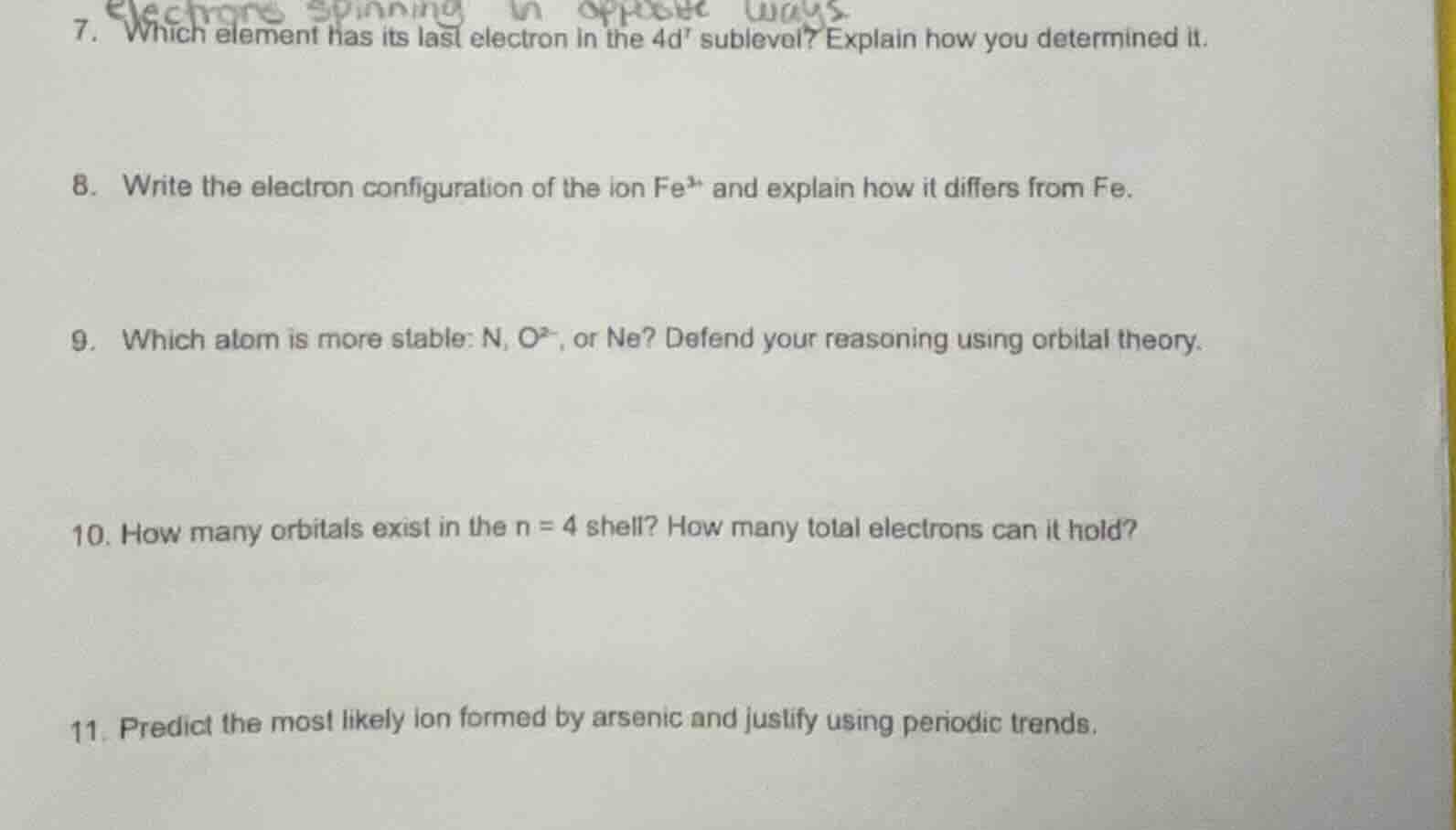
Question
- which element has its last electron in the 4d⁷ sublevel? explain how you determined it.
- write the electron configuration of the ion fe³⁺ and explain how it differs from fe.
- which atom is more stable: n, o²⁻, or ne? defend your reasoning using orbital theory.
- how many orbitals exist in the n = 4 shell? how many total electrons can it hold?
- predict the most likely ion formed by arsenic and justify using periodic trends.
Step1: Solve Question 7
Elements in the 5th period, d-block have electrons in 4d. The 4d⁷ configuration corresponds to the element with atomic number: [Kr] 4d⁷ 5s¹ = 36 + 7 + 1 = 44, which is Ruthenium (Ru). (Note: Exceptions to Aufbau principle apply here, 5s fills partially before 4d completes to reach a more stable half-filled or near-filled d-sublevel)
Step2: Solve Question 8
First, neutral Fe (atomic number 26) has electron configuration: $1s^2 2s^2 2p^6 3s^2 3p^6 3d^6 4s^2$. Fe³⁺ loses 3 electrons (2 from 4s first, then 1 from 3d): $1s^2 2s^2 2p^6 3s^2 3p^6 3d^5$. It differs from Fe by having 3 fewer electrons, with a half-filled 3d sublevel (more stable) instead of a partially filled 3d⁶.
Step3: Solve Question 9
Neon (Ne) has a full valence shell ($2s^2 2p^6$), a closed-shell electron configuration. Nitrogen (N) has a half-filled 2p sublevel ($2s^2 2p^3$) but not a full valence shell. $O^{2-}$ has the same electron configuration as Ne, but it carries a negative charge, which makes it less stable than neutral Ne (extra electron-electron repulsion in the same orbital set). So Ne is the most stable.
Step4: Solve Question 10
For n=4, the subshells are 4s, 4p, 4d, 4f. Number of orbitals per subshell: 4s=1, 4p=3, 4d=5, 4f=7. Total orbitals: $1+3+5+7=16$. Total electrons a shell can hold is $2n^2$, so $2(4)^2=32$.
Step5: Solve Question 11
Arsenic (As) is in group 15 of the periodic table. Group 15 elements have 5 valence electrons. To reach a stable noble gas configuration (8 valence electrons), it gains 3 electrons, forming the $As^{3-}$ ion. This follows the periodic trend where p-block nonmetals in groups 15-17 gain electrons to fill their valence p-subshell.

Snap & solve any problem in the app
Get step-by-step solutions on Sovi AI
Photo-based solutions with guided steps
Explore more problems and detailed explanations
- Ruthenium (Ru). The electron configuration is [Kr] 4d⁷ 5s¹; it is a 5th-period d-block element, with its highest energy (last) electrons occupying the 4d sublevel (with an exception to the Aufbau principle for stability).
- Electron configuration of Fe³⁺: $1s^2 2s^2 2p^6 3s^2 3p^6 3d^5$. It differs from neutral Fe ($1s^2 2s^2 2p^6 3s^2 3p^6 3d^6 4s^2$) by having 3 fewer electrons, losing 2 from the 4s sublevel first then 1 from the 3d sublevel, resulting in a stable half-filled 3d⁵ sublevel.
- Ne is the most stable. Ne has a full, closed valence shell electron configuration ($2s^2 2p^6$) with no unpaired electrons and no net charge. N has a half-filled 2p sublevel but not a full valence shell, and $O^{2-}$ has the same electron configuration as Ne but carries a negative charge, leading to increased electron-electron repulsion that reduces stability.
- Number of orbitals in n=4 shell: 16; Total electrons the shell can hold: 32
- The most likely ion is $As^{3-}$. Arsenic is in group 15, so it has 5 valence electrons. Following periodic trends, group 15 nonmetals gain 3 electrons to achieve a full 8-valence-electron noble gas configuration (matching krypton's electron configuration), forming a -3 charged ion.