QUESTION IMAGE
Question
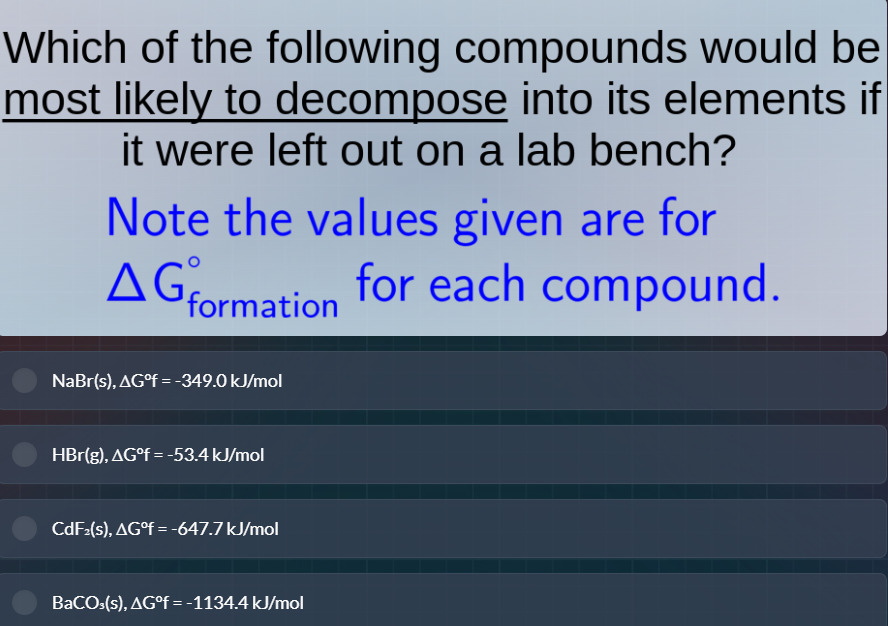
which of the following compounds would be most likely to decompose into its elements if it were left out on a lab bench? note the values given are for $delta g^circ_{\text{formation}}$ for each compound. nabr(s), $delta g^circ$f = -349.0 kj/mol hbr(g), $delta g^circ$f = -53.4 kj/mol cdf₂(s), $delta g^circ$f = -647.7 kj/mol baco₃(s), $delta g^circ$f = -1134.4 kj/mol
To determine which compound is most likely to decompose into its elements, we use the concept of Gibbs free energy of formation ($\Delta G_f^\circ$). A compound is more likely to decompose if the reverse reaction (decomposition into elements) has a negative $\Delta G$ (spontaneous). The decomposition reaction is the reverse of the formation reaction, so:
For a formation reaction: $\text{Elements}
ightarrow \text{Compound}$, $\Delta G_f^\circ$ (formation) is given.
For decomposition: $\text{Compound}
ightarrow \text{Elements}$, $\Delta G_{\text{decomp}}^\circ = -\Delta G_f^\circ$ (formation).
Step 1: Recall the relationship
A reaction is spontaneous when $\Delta G < 0$. For decomposition, $\Delta G_{\text{decomp}}^\circ = -\Delta G_f^\circ$ (formation). Thus, the less negative (or more positive) $\Delta G_f^\circ$ (formation) is, the more negative $\Delta G_{\text{decomp}}^\circ$ becomes (making decomposition more spontaneous).
Step 2: Compare $\Delta G_f^\circ$ values
We analyze each compound:
- $\text{NaBr}(s)$: $\Delta G_f^\circ = -349.0\ \text{kJ/mol}$
- $\text{HBr}(g)$: $\Delta G_f^\circ = -53.4\ \text{kJ/mol}$ (least negative)
- $\text{CdF}_2(s)$: $\Delta G_f^\circ = -647.7\ \text{kJ/mol}$
- $\text{BaCO}_3(s)$: $\Delta G_f^\circ = -1134.4\ \text{kJ/mol}$ (most negative)
Step 3: Determine decomposition spontaneity
For decomposition, $\Delta G_{\text{decomp}}^\circ = -\Delta G_f^\circ$. The least negative $\Delta G_f^\circ$ (formation) gives the most negative $\Delta G_{\text{decomp}}^\circ$ (most spontaneous decomposition).
Among the options, $\text{HBr}(g)$ has the least negative $\Delta G_f^\circ$ (formation) ($-53.4\ \text{kJ/mol}$). Thus, its decomposition ($\text{HBr}(g)
ightarrow \text{H}_2(g) + \text{Br}_2(l)$) will have $\Delta G_{\text{decomp}}^\circ = -(-53.4) = +53.4\ \text{kJ/mol}$? Wait, no—wait, the formation reaction for $\text{HBr}(g)$ is $\frac{1}{2}\text{H}_2(g) + \frac{1}{2}\text{Br}_2(l)
ightarrow \text{HBr}(g)$, so decomposition is $\text{HBr}(g)
ightarrow \frac{1}{2}\text{H}_2(g) + \frac{1}{2}\text{Br}_2(l)$, and $\Delta G_{\text{decomp}}^\circ = -\Delta G_f^\circ = -(-53.4) = +53.4\ \text{kJ/mol}$? Wait, no—wait, spontaneity: if $\Delta G_f^\circ$ (formation) is negative, the compound is stable (formation is spontaneous). For decomposition, we need $\Delta G_{\text{decomp}} < 0$. So $\Delta G_{\text{decomp}} = -\Delta G_f^\circ$ (formation). Thus, if $\Delta G_f^\circ$ (formation) is *less negative* (closer to zero), then $-\Delta G_f^\circ$ (decomposition) is more positive? Wait, no—let’s correct:
Wait, $\Delta G_f^\circ$ (formation) is the free energy change to form 1 mol of the compound from its elements. For decomposition, the reaction is the reverse: compound → elements. So $\Delta G_{\text{decomp}} = -\Delta G_f^\circ$ (formation).
A reaction is spontaneous when $\Delta G < 0$. So for decomposition to be spontaneous, $\Delta G_{\text{decomp}} < 0$ → $-\Delta G_f^\circ < 0$ → $\Delta G_f^\circ > 0$? No, wait:
Wait, if $\Delta G_f^\circ$ (formation) is negative, the formation reaction is spontaneous (elements form compound). For decomposition (compound → elements) to be spontaneous, $\Delta G_{\text{decomp}} < 0$ → $-\Delta G_f^\circ < 0$ → $\Delta G_f^\circ > 0$? No, that can’t be. Wait, no—let’s take an example:
If $\Delta G_f^\circ$ (formation) is negative (e.g., $\text{H}_2\text{O}(l)$: $\Delta G_f^\circ = -237\ \text{kJ/mol}$), formation is spontaneous (elements → water). Decomposition (water → elements) has $\Delta G_{\text{decomp}} = +237\ \text{kJ/mol}$ (non -…

Snap & solve any problem in the app
Get step-by-step solutions on Sovi AI
Photo-based solutions with guided steps
Explore more problems and detailed explanations
$\boldsymbol{\text{HBr}(g)}$ (with $\Delta G_f^\circ = -53.4\ \text{kJ/mol}$)