QUESTION IMAGE
Question
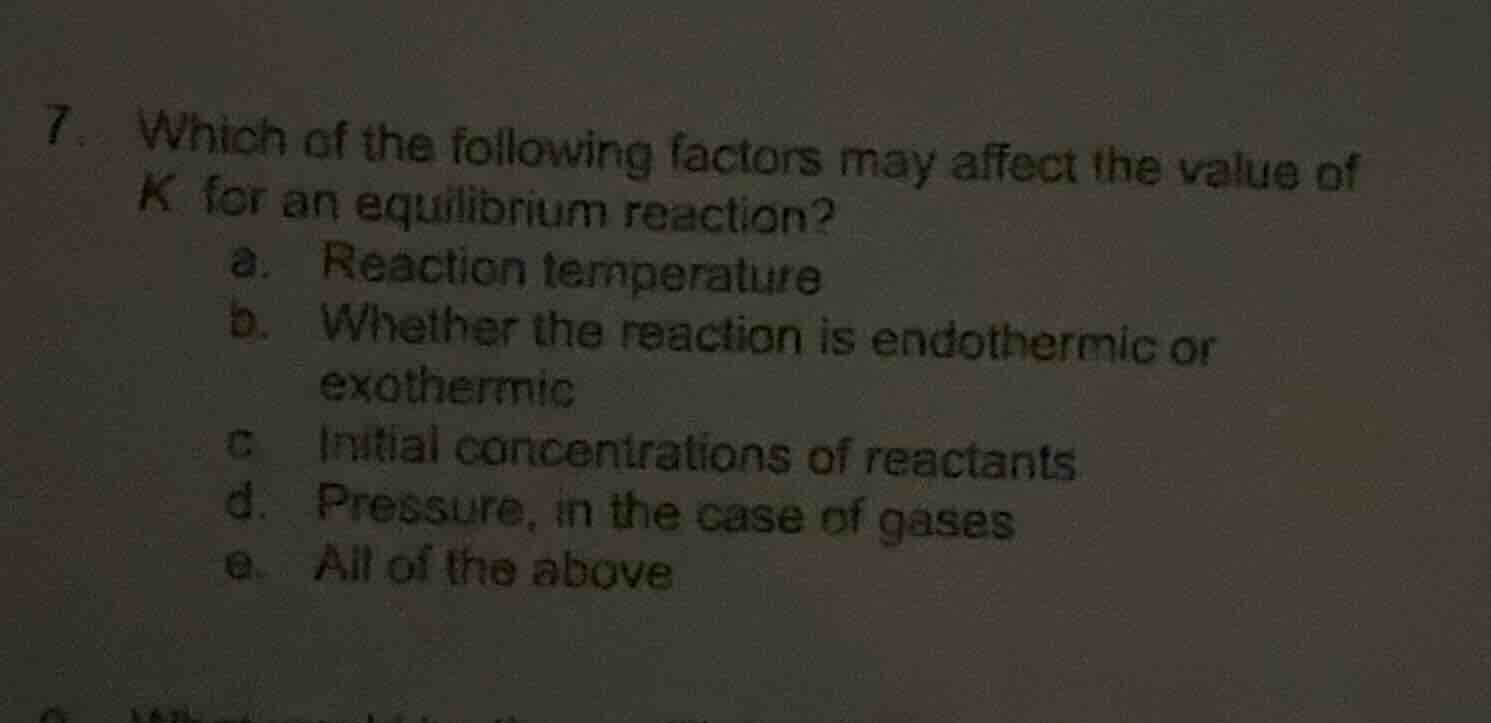
- which of the following factors may affect the value of k for an equilibrium reaction?
a. reaction temperature
b. whether the reaction is endothermic or exothermic
c. initial concentrations of reactants
d. pressure, in the case of gases
e. all of the above
Brief Explanations
- For an equilibrium reaction, the equilibrium constant \( K \) is affected by reaction temperature. For endothermic reactions, increasing temperature increases \( K \), and for exothermic reactions, increasing temperature decreases \( K \), so the nature of the reaction (endothermic/exothermic) along with temperature affects \( K \).
- Initial concentrations of reactants and pressure (for gases) do not change the value of \( K \); they only affect the position of equilibrium. So factors a (reaction temperature) and b (whether reaction is endothermic/exothermic) affect \( K \), but since the options are structured, we analyze:
- Option a: Temperature affects \( K \) (as \( K \) is temperature - dependent).
- Option b: The enthalpy change (endothermic/exothermic) determines how temperature affects \( K \), so it is related to the change in \( K \) with temperature.
- Option c: Initial concentrations do not affect \( K \), only the equilibrium concentrations matter for \( K \) calculation.
- Option d: Pressure (for gaseous reactions) affects the position of equilibrium (shifts it) but not the value of \( K \).
- Option e: Since c and d do not affect \( K \), e is wrong. But actually, the key is that temperature (a) and the reaction's enthalpy (b, as it determines the direction of \( K \) change with temperature) affect \( K \). However, in the context of the options, the main factor among the given is reaction temperature (a) and the nature (b) is related to how temperature affects it. But the most direct factor from the options that affects \( K \) is reaction temperature (a), but also the nature (b) is related. But according to chemical principles, the equilibrium constant \( K \) is only affected by temperature. The confusion here is that the nature of the reaction (endothermic/exothermic) determines the direction of change of \( K \) with temperature. But the primary factor that affects \( K \) is temperature (a). Wait, no: the value of \( K \) depends on temperature. The enthalpy change (endothermic/exothermic) determines the sign of the change of \( K \) with temperature. But the factor that affects \( K \) is temperature. However, the question is "which of the following factors may affect the value of \( K \)". So:
- Reaction temperature (a) affects \( K \): yes.
- Whether the reaction is endothermic or exothermic (b): this determines how \( K \) changes with temperature, but the factor that causes \( K \) to change is temperature. But the question is about factors that may affect \( K \). So temperature (a) is a factor. The nature of the reaction (b) is related to the change of \( K \) with temperature. But in the options, the correct answer is that reaction temperature (a) and the nature (b) are related, but the main factor is temperature. Wait, no, according to chemical equilibrium: The equilibrium constant \( K \) is a function of temperature only. The initial concentrations (c) and pressure (d) do not affect \( K \). The enthalpy change (b) is a property of the reaction that determines the magnitude of the change of \( K \) with temperature, but the factor that changes \( K \) is temperature. So among the options, the factor that affects \( K \) is reaction temperature (a). But there is a confusion here because the nature of the reaction (b) is related to the change of \( K \) with temperature. However, the correct answer is that reaction temperature (a) is the factor that affects \( K \). But let's re - evaluate:
- The equilibrium constant \( K \) is defined as \( K=\frac{[products]^{n}}{[…

Snap & solve any problem in the app
Get step-by-step solutions on Sovi AI
Photo-based solutions with guided steps
Explore more problems and detailed explanations
a. Reaction temperature