QUESTION IMAGE
Question
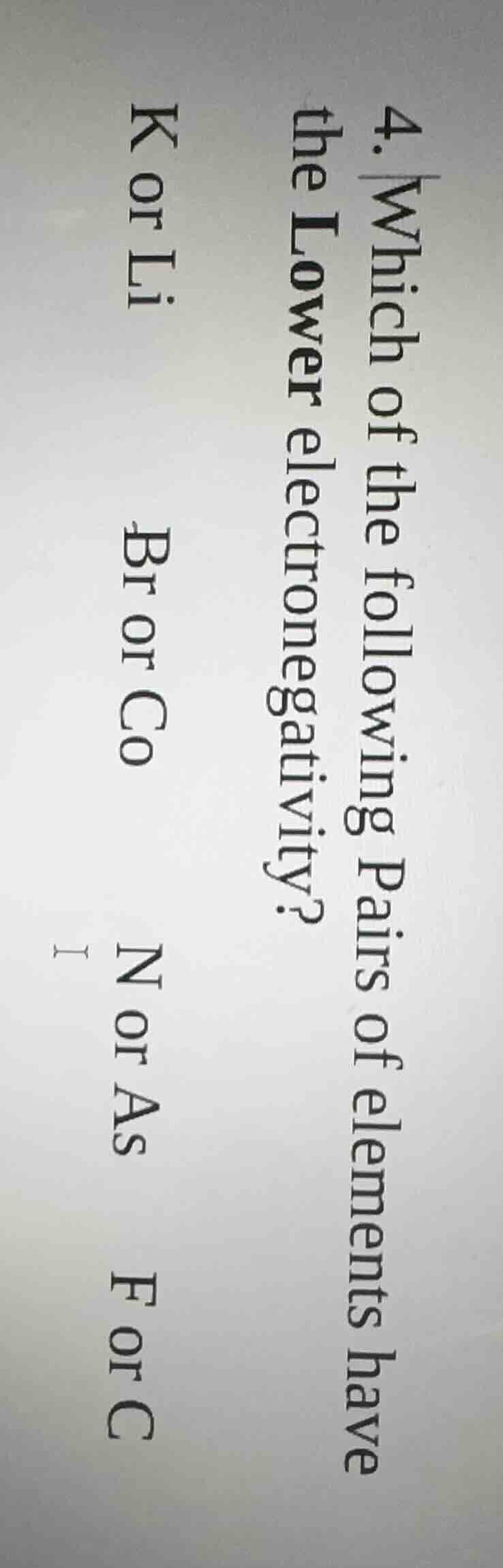
- which of the following pairs of elements have
the lower electronegativity?
k or li
br or co
n or as
f or c
Response
To determine which element in each pair has lower electronegativity, we use the trends of electronegativity in the periodic table:
- Electronegativity generally increases across a period (left to right) and decreases down a group (top to bottom).
Pair 1: K or Li
- K (Potassium) and Li (Lithium) are in Group 1 (alkali metals).
- Electronegativity decreases down a group. K is below Li in Group 1.
- Thus, K has lower electronegativity.
Pair 2: Br or Co
- Br (Bromine) is in Group 17 (halogens), Period 4.
- Co (Cobalt) is in Group 9, Period 4 (transition metal).
- Across a period, electronegativity increases from left to right. Co is to the left of Br in Period 4.
- Thus, Co has lower electronegativity.
Pair 3: N or As
- N (Nitrogen) is in Group 15, Period 2.
- As (Arsenic) is in Group 15, Period 4.
- Electronegativity decreases down a group. As is below N in Group 15.
- Thus, As has lower electronegativity.
Pair 4: F or C
- F (Fluorine) is in Group 17, Period 2.
- C (Carbon) is in Group 14, Period 2.
- Across a period, electronegativity increases from left to right. C is to the left of F in Period 2.
- Thus, C has lower electronegativity.
Final Answers:
- K or Li: $\boldsymbol{\text{K}}$
- Br or Co: $\boldsymbol{\text{Co}}$
- N or As: $\boldsymbol{\text{As}}$
- F or C: $\boldsymbol{\text{C}}$

Snap & solve any problem in the app
Get step-by-step solutions on Sovi AI
Photo-based solutions with guided steps
Explore more problems and detailed explanations
To determine which element in each pair has lower electronegativity, we use the trends of electronegativity in the periodic table:
- Electronegativity generally increases across a period (left to right) and decreases down a group (top to bottom).
Pair 1: K or Li
- K (Potassium) and Li (Lithium) are in Group 1 (alkali metals).
- Electronegativity decreases down a group. K is below Li in Group 1.
- Thus, K has lower electronegativity.
Pair 2: Br or Co
- Br (Bromine) is in Group 17 (halogens), Period 4.
- Co (Cobalt) is in Group 9, Period 4 (transition metal).
- Across a period, electronegativity increases from left to right. Co is to the left of Br in Period 4.
- Thus, Co has lower electronegativity.
Pair 3: N or As
- N (Nitrogen) is in Group 15, Period 2.
- As (Arsenic) is in Group 15, Period 4.
- Electronegativity decreases down a group. As is below N in Group 15.
- Thus, As has lower electronegativity.
Pair 4: F or C
- F (Fluorine) is in Group 17, Period 2.
- C (Carbon) is in Group 14, Period 2.
- Across a period, electronegativity increases from left to right. C is to the left of F in Period 2.
- Thus, C has lower electronegativity.
Final Answers:
- K or Li: $\boldsymbol{\text{K}}$
- Br or Co: $\boldsymbol{\text{Co}}$
- N or As: $\boldsymbol{\text{As}}$
- F or C: $\boldsymbol{\text{C}}$