QUESTION IMAGE
Question
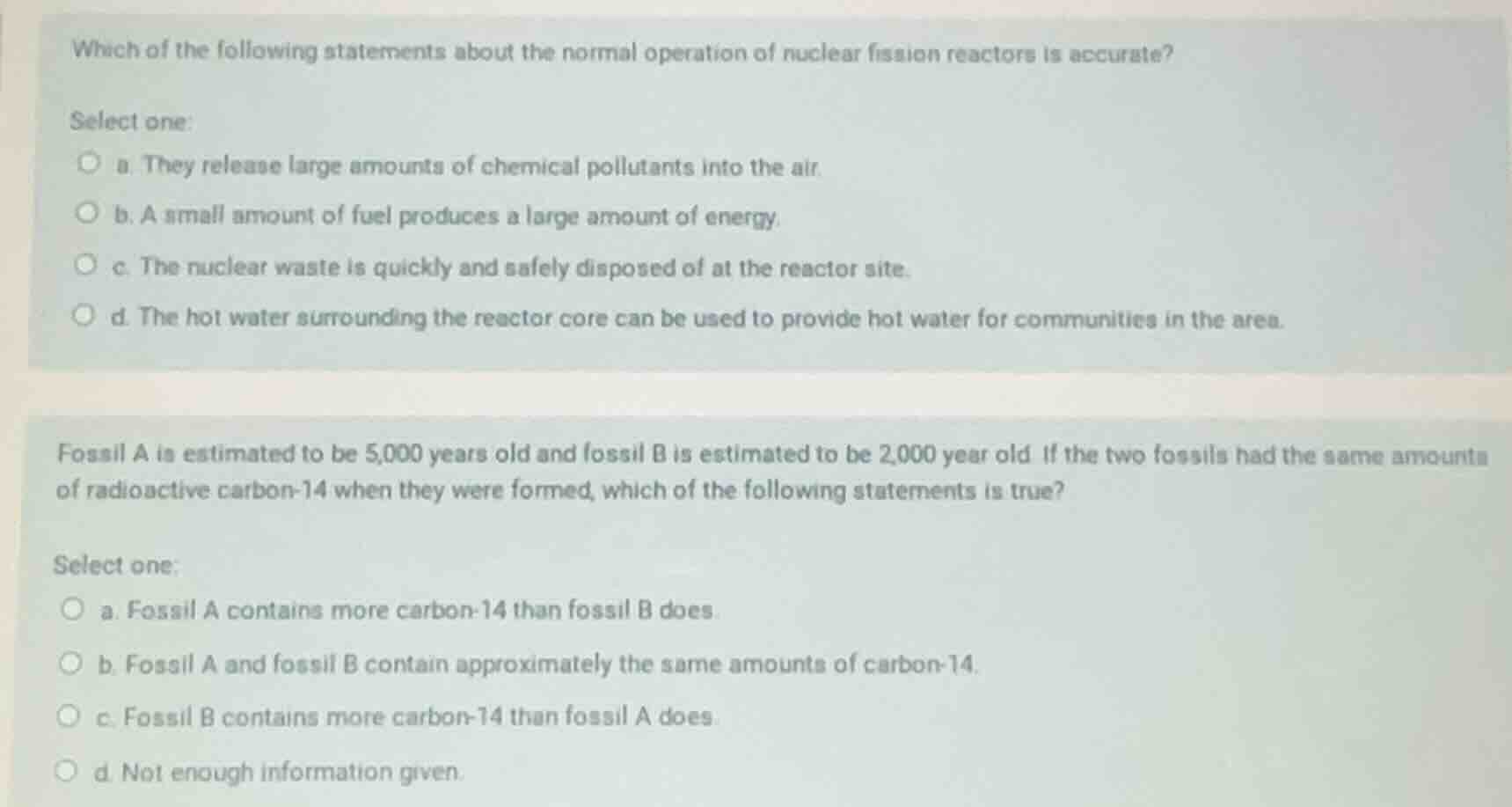
which of the following statements about the normal operation of nuclear fission reactors is accurate?
select one:
a. they release large amounts of chemical pollutants into the air.
b. a small amount of fuel produces a large amount of energy.
c. the nuclear waste is quickly and safely disposed of at the reactor site.
d. the hot water surrounding the reactor core can be used to provide hot water for communities in the area.
fossil a is estimated to be 5,000 years old and fossil b is estimated to be 2,000 year old. if the two fossils had the same amounts of radioactive carbon-14 when they were formed, which of the following statements is true?
select one:
a. fossil a contains more carbon-14 than fossil b does.
b. fossil a and fossil b contain approximately the same amounts of carbon-14.
c. fossil b contains more carbon-14 than fossil a does.
d. not enough information given.
For the first question:
- Option a is incorrect because nuclear fission reactors do not release large amounts of chemical air pollutants during normal operation, unlike fossil fuel plants.
- Option b is correct because nuclear fission converts a tiny amount of mass into a massive amount of energy, following $E=mc^2$, so a small fuel volume generates huge energy.
- Option c is incorrect because nuclear waste is not disposed of quickly on-site; it requires long-term, specialized off-site storage due to its long half-life.
- Option d is incorrect because the water around the reactor core is contaminated with radiation and cannot be used directly for community hot water.
For the second question:
Carbon-14 is a radioactive isotope that decays over time. Older fossils have had more time for their carbon-14 to decay. Since Fossil A is older (5,000 years) than Fossil B (2,000 years), Fossil B has had less time for decay, so it retains more carbon-14.

Snap & solve any problem in the app
Get step-by-step solutions on Sovi AI
Photo-based solutions with guided steps
Explore more problems and detailed explanations
- b. A small amount of fuel produces a large amount of energy.
- c. Fossil B contains more carbon-14 than fossil A does.