QUESTION IMAGE
Question
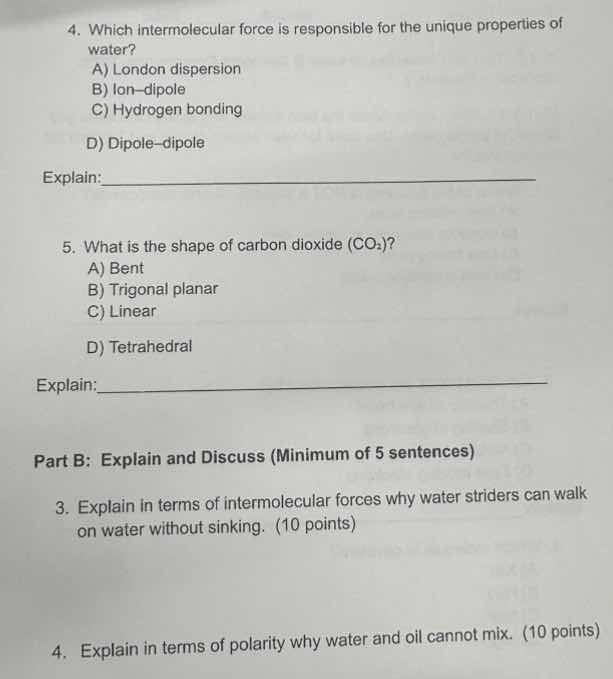
- which intermolecular force is responsible for the unique properties of water? a) london dispersion b) ion–dipole c) hydrogen bonding d) dipole–dipole explain:____________________________ 5. what is the shape of carbon dioxide (co₂)? a) bent b) trigonal planar c) linear d) tetrahedral explain:____________________________ part b: explain and discuss (minimum of 5 sentences) 3. explain in terms of intermolecular forces why water striders can walk on water without sinking. (10 points) 4. explain in terms of polarity why water and oil cannot mix. (10 points)
Question 4 (Intermolecular Forces of Water)
Water has highly electronegative oxygen bonded to hydrogen, creating polar O-H bonds. The partially positive H atoms form strong attractions to partially negative O atoms in adjacent water molecules. This unique, strong intermolecular force gives water properties like high boiling point, surface tension, and high specific heat.
Carbon dioxide has a central carbon atom double-bonded to two oxygen atoms. There are no lone electron pairs on the central carbon, so the bonding pairs arrange themselves to maximize distance, resulting in a straight, symmetric geometry.
Water exhibits strong hydrogen bonding between its molecules. These intermolecular attractions create a cohesive network of water molecules at the surface, forming a thin, rigid "skin" known as surface tension. Water striders have specialized, hydrophobic (water-repellent) legs that distribute their body weight evenly across a large surface area. The surface tension of water is strong enough to support the insect's small mass without breaking the cohesive molecular layer. When the water strider's legs press on the surface, the water molecules dip slightly but do not separate, allowing the insect to walk across the surface instead of sinking. Additionally, the hydrophobic nature of their legs prevents them from becoming wet, which would disrupt the surface tension and cause them to submerge.

Snap & solve any problem in the app
Get step-by-step solutions on Sovi AI
Photo-based solutions with guided steps
Explore more problems and detailed explanations
C) Hydrogen bonding
---