QUESTION IMAGE
Question
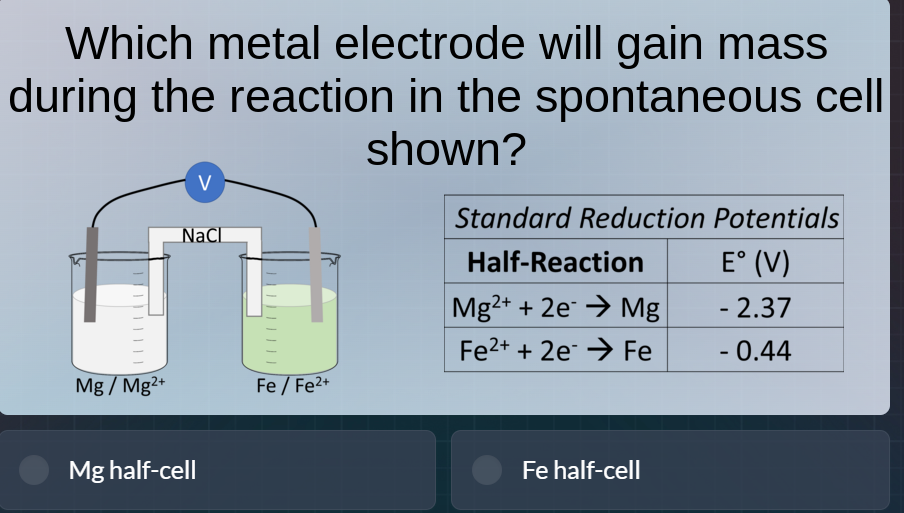
which metal electrode will gain mass during the reaction in the spontaneous cell shown? standard reduction potentials half-reaction e° (v) mg²⁺ + 2e⁻ → mg - 2.37 fe²⁺ + 2e⁻ → fe - 0.44 mg half-cell fe half-cell
Step1: Determine the anode and cathode
In a spontaneous electrochemical cell, the half - reaction with the more negative (or less positive) standard reduction potential will be reversed (oxidation occurs at the anode), and the half - reaction with the less negative (or more positive) standard reduction potential will occur as reduction (at the cathode).
The standard reduction potential of \(Mg^{2+}+2e^-
ightarrow Mg\) is \(E^{\circ}=- 2.37\ V\) and for \(Fe^{2+}+2e^-
ightarrow Fe\) is \(E^{\circ}=-0.44\ V\). Since \(-2.37<-0.44\), the \(Mg\) half - reaction will be reversed (oxidation: \(Mg
ightarrow Mg^{2+}+2e^-\)) and the \(Fe\) half - reaction will occur as reduction (\(Fe^{2+}+2e^-
ightarrow Fe\)).
Step2: Analyze mass change at each electrode
- At the anode (Mg half - cell): Magnesium metal is oxidized to \(Mg^{2+}\) ions. So the mass of the Mg electrode will decrease because \(Mg(s)\) is converted to \(Mg^{2+}(aq)\).
- At the cathode (Fe half - cell): \(Fe^{2+}\) ions are reduced to \(Fe\) metal. The reaction is \(Fe^{2+}(aq)+2e^-
ightarrow Fe(s)\). As \(Fe^{2+}\) ions are converted to solid \(Fe\) and deposit on the Fe electrode, the mass of the Fe electrode will increase.

Snap & solve any problem in the app
Get step-by-step solutions on Sovi AI
Photo-based solutions with guided steps
Explore more problems and detailed explanations
Fe half - cell