QUESTION IMAGE
Question
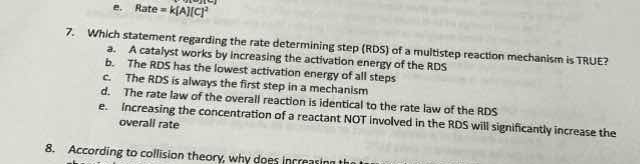
- which statement regarding the rate determining step (rds) of a multistep reaction mechanism is true?
a. a catalyst will increase the activation energy of the rds
b. the rds has the lowest activation energy of all steps
c. the rds is always the first step in a mechanism
d. the rate law of the overall reaction is identical to the rate law of the rds
e. increasing the concentration of a reactant not involved in the rds will significantly increase the overall rate
- according to collision theory, why does increasing
To solve question 7, we analyze each option based on the concept of the rate - determining step (RDS) in a multistep reaction:
Option a
A catalyst functions by lowering the activation energy of the reaction. It lowers the activation energy of the rate - determining step (since the RDS has the highest activation energy among the steps in the reaction mechanism) as well as the activation energies of the other steps. So, a catalyst does not increase the activation energy of the RDS. Thus, option a is incorrect.
Option b
The rate - determining step is the slowest step in a multistep reaction mechanism. The slowest step is the one with the highest activation energy (because a higher activation energy means that fewer reactant molecules have enough energy to undergo the reaction, resulting in a slower rate). So, the RDS has the highest activation energy of all the steps, not the lowest. Option b is incorrect.
Option c
The rate - determining step is not always the first step in a reaction mechanism. A reaction mechanism can have multiple steps, and the slowest step (the RDS) can occur at any point in the sequence of steps. For example, in some reactions, the first step may be fast, and a later step may be slow and act as the RDS. Option c is incorrect.
Option d
The rate law of the overall reaction is determined by the rate - determining step. The rate of the overall reaction is equal to the rate of the rate - determining step because the RDS is the slowest step and dictates how fast the entire reaction proceeds. So, the rate law of the overall reaction is identical to the rate law of the RDS. Option d is correct.
Option e
If a reactant is not involved in the rate - determining step, increasing its concentration will not significantly affect the rate of the overall reaction. The rate of the overall reaction is determined by the RDS, and reactants not in the RDS do not have a major impact on the rate. Option e is incorrect.

Snap & solve any problem in the app
Get step-by-step solutions on Sovi AI
Photo-based solutions with guided steps
Explore more problems and detailed explanations
d. The rate law of the overall reaction is identical to the rate law of the RDS